
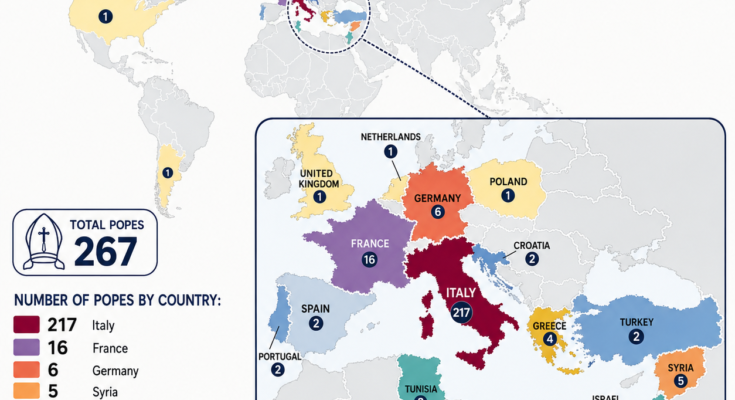
For an institution followed by Catholics around the world, the geographic history of the papacy is surprisingly concentrated.
Of the 267 papal reigns counted through Pope Leo XIV, the overwhelming majority are associated with places located in modern-day Italy.
The map above assigns the birthplaces of popes to today’s countries and produces a striking result:
Italy accounts for 217—far more than every other country combined.
France comes a distant second with 16, followed by Germany with 6, Syria with 5 and Greece with 4.
Yet hidden among those numbers is a much bigger story involving the Roman Empire, medieval kingdoms, the Byzantine world, the Holy Land, European politics and, eventually, a papacy that expanded beyond Europe to Argentina and the United States.
First, What Does “Country of Birth” Mean for a 2,000-Year-Old Institution?
This map needs one important explanation.
Modern countries such as Italy, Germany, France and Syria did not exist in their current forms when many early popes were born.
A pope categorized as Italian might actually have been born in:
- The Roman Empire
- The Papal States
- The Republic of Venice
- The Republic of Genoa
- The Kingdom of Italy
- One of numerous medieval Italian states
The same problem occurs elsewhere.
Popes born within the Holy Roman Empire can be difficult to classify neatly as French, German, Austrian or another modern nationality.
The map therefore uses a simplified method: historical birthplaces are assigned to modern countries or geographic equivalents.
That makes the map excellent for visualizing papal geography, but the exact totals should not be treated as universally agreed historical classifications. Different sources can move a small number of popes between categories.
Why Are There 267 Popes but Not 267 Different Men?
Pope Leo XIV is officially numbered as the 267th pope.
However, there is a strange historical detail behind that number.
Pope Benedict IX held the papacy three separate times during the 11th century.
Historical lists therefore count his separate pontificates individually in the traditional sequence.
This is why some references distinguish between the number of papal reigns and the number of individual men who have held the office.
For simplicity, this article follows the traditional numbering represented by Pope Leo XIV as the 267th pope.
1. Italy — 217 Popes
No country comes remotely close to Italy.
According to the classification used for this map, 217 of the 267 papal reigns are associated with birthplaces in modern-day Italy.
That means more than four out of every five papal entries belong to Italy.
The explanation is largely geographical and historical.
The pope is the Bishop of Rome, and for most of Christian history the machinery of the Catholic Church was centered in Rome and the Italian Peninsula.
Travel was difficult.
Political influence was often local.
Cardinals were heavily European and frequently Italian.
And for long stretches of history, electing someone from the Italian Peninsula was simply the most practical and politically acceptable solution.
Among the many popes associated with modern Italy are famous figures such as:
- Gregory I
- Gregory VII
- Innocent III
- Urban VIII
- Pius IX
- Pius XII
- John XXIII
- Paul VI
- John Paul I
The most recent Italian-born pope was John Paul I, elected in 1978.
His pontificate lasted only 33 days.
Remarkably, no Italian has been elected pope since then.
Italy’s Long Dominance Suddenly Ended in 1978
For centuries, an Italian pope was almost expected.
Before 1978, the last non-Italian pope had been Adrian VI, who died in 1523.
Then came a dramatic change.
In October 1978, the cardinals elected Polish Cardinal Karol Wojtyła, who became Pope John Paul II.
For the first time in roughly 455 years, the pope was not Italian.
And the change turned out not to be temporary.
Every pope since John Paul I has been born outside Italy:
John Paul II — Poland
Benedict XVI — Germany
Francis — Argentina
Leo XIV — United States
What had once been one of the world’s most geographically concentrated major offices suddenly became much more international.
2. France — 16 Popes
France ranks a distant second on the map with 16 popes.
Among the best-known are:
- Sylvester II
- Urban II
- Callixtus II
- Urban IV
- Clement IV
- Martin IV
- Clement V
- John XXII
- Benedict XII
- Clement VI
- Urban V
- Gregory XI
France’s prominence is closely tied to the politics of medieval Europe.
The most famous French chapter in papal history occurred during the Avignon Papacy.
From 1309 until 1377, the popes resided primarily in Avignon rather than Rome.
Seven successive popes governed the Church from there, all of them French.
The period dramatically increased French influence within the papacy and remains one of the most unusual episodes in Catholic history.
Eventually Pope Gregory XI returned the papal court to Rome in 1377.
Why Some Sources Say France Had 17
Historical classifications can produce different results.
For example, Pope Leo IX was born in Egisheim, in Alsace—territory located in modern France but historically associated with the Holy Roman Empire.
Some classifications therefore group him differently.
This is precisely why maps assigning medieval figures to modern countries should be understood as geographic approximations rather than perfect nationality records.
3. Germany — 6 Popes on This Map
The map assigns six papal reigns to Germany.
The best-known modern example is undoubtedly Pope Benedict XVI.
Born Joseph Ratzinger in Bavaria in 1927, Benedict became pope in 2005 following the death of John Paul II.
He served until 2013, when he made the extraordinary decision to resign.
His resignation was historically significant because voluntary papal resignations are extremely rare.
Other medieval popes associated with the German or Holy Roman Imperial world include figures such as Clement II, Damasus II and Victor II.
Again, exact totals can differ depending on how medieval birthplaces are converted into modern national categories.
4. Syria — 5 Popes
One of the map’s most surprising statistics is Syria’s five popes.
Today, many people instinctively associate the papacy almost entirely with Western Europe.
Early Christianity looked very different.
The eastern Mediterranean—particularly Syria, Palestine, Anatolia and Egypt—was one of Christianity’s most important early centers.
Cities such as Antioch played a crucial role in the development of the early Church.
Popes associated with what is now Syria include early figures such as:
- Anicetus
- John V
- Sisinnius
- Constantine
- Gregory III
Pope Gregory III, whose pontificate ended in 741, is particularly important to the modern story.
For more than 1,270 years after Gregory III, every pope was born in Europe.
That sequence finally ended with the election of Argentina-born Pope Francis in 2013.
5. Greece — 4 Popes
The map assigns four popes to modern-day Greece.
Greek culture was enormously influential in early Christianity.
In fact, Greek was one of the principal languages of the early Christian world, including Christian communities in Rome.
Several early bishops of Rome came from the Greek-speaking eastern Mediterranean.
The four typically placed within the modern Greek category include:
- Anacletus
- Hyginus
- Eleutherius
- Sixtus II
Their presence reflects a period when the Roman Church was much more deeply connected to the Greek-speaking Mediterranean than many modern observers realize.
6. Israel / Holy Land — 3 Popes
The map assigns three popes to territory classified within modern-day Israel or the Holy Land.
The most important is, of course, Saint Peter.
Catholic tradition regards Peter as the first pope and the first Bishop of Rome.
This category highlights another difficulty with applying modern political borders to ancient history.
Peter lived in the first-century Roman world, nearly two millennia before the creation of today’s states and borders.
Historical sources describe early papal origins using places such as Judea, Palestine, Galilee and the wider Holy Land.
Modern mapmakers must therefore choose how to translate those ancient locations onto a contemporary political map.
The map’s “Israel — 3” figure should be understood within that methodological context.
7. Tunisia — 3 Popes
Another surprising papal birthplace appears in North Africa.
The map assigns three popes to modern-day Tunisia, representing figures associated with Roman North Africa.
They include early popes traditionally identified with the African provinces of the Roman Empire.
North Africa was once a major center of Christianity.
Long before Christianity became dominated demographically by Europe, cities across Roman Africa produced important Christian thinkers and church leaders.
The region was associated with figures such as:
- Tertullian
- Cyprian of Carthage
- Augustine of Hippo
Among popes, the African tradition includes Victor I, Miltiades and Gelasius I in common classifications.
The last of these lived in the fifth century.
8. Spain — 2 Popes
Spain contributed two famous popes:
Callixtus III and Alexander VI.
Both were members of the powerful Borgia family.
Alexander VI is particularly famous—and controversial.
Born Rodrigo Borgia in Valencia, he became pope in 1492, the same year Christopher Columbus made his first voyage across the Atlantic.
His pontificate became closely associated with Renaissance politics, family patronage and the intense struggles for power that characterized Italy at the time.
9. Portugal — 2 Popes
The map gives Portugal two popes.
The best-known is John XXI, who served from 1276 to 1277.
He was unusual among medieval popes because of his strong scholarly background and is traditionally associated with medicine, philosophy and science.
His reign ended suddenly when part of a building at the papal residence in Viterbo collapsed, severely injuring him.
He died several days later.
The classification of the other Portuguese-associated early pope, Damasus I, is another example where ancient birthplace evidence and modern-country assignment can be complicated.
10. Croatia — 2 Popes
Two early popes are associated with Dalmatia, corresponding broadly to part of modern Croatia:
- Caius
- John IV
Dalmatia was an important Roman province along the eastern Adriatic.
Its appearance on the map reminds us that the modern Balkan countries inherited territories that once belonged to the Roman and Byzantine worlds from which many early Christian leaders emerged.
11. Turkey — 2 Popes
The map assigns two popes to present-day Turkey, representing birthplaces in ancient Asia Minor or Anatolia.
Modern Turkey was home to some of the most important cities in early Christianity.
Places such as:
- Ephesus
- Nicaea
- Antioch’s wider regional connections
- Constantinople
played enormous roles in Christian theology and church politics.
The presence of Turkish territory on a papal birthplace map therefore makes much more historical sense than it may initially appear.
Argentina — 1 Pope
Argentina’s single entry is one of the most transformative in the history of the papacy.
Jorge Mario Bergoglio, born in Buenos Aires, was elected Pope Francis in 2013.
He immediately broke several historic patterns.
Francis was:
- The first pope born in South America
- The first pope from Latin America
- The first Jesuit pope
- The first pope to take the name Francis
- The first non-European pope in more than a millennium
His election reflected the increasingly global distribution of Catholicism.
For centuries, nearly all popes had come from Europe even as the Catholic population expanded rapidly through Latin America, Africa and Asia.
Francis changed that.
Poland — 1 Pope
Poland’s single pope had an enormous impact on both the Church and modern European history.
Karol Wojtyła became Pope John Paul II in 1978.
He was the first non-Italian pope since Adrian VI in 1522.
His election came while Poland remained under communist rule.
John Paul II’s highly visible support for religious freedom and his relationship with Poland’s Solidarity movement made him an influential figure during the final decades of the Cold War.
He ultimately served for more than 26 years, making his pontificate one of the longest in papal history.
United Kingdom — 1 Pope
England has produced exactly one pope:
Adrian IV.
Born Nicholas Breakspear around 1100, he was elected pope in 1154.
To this day, he remains the only Englishman ever elected pope.
His story is remarkable partly because of how unusual his background was compared with the predominantly Italian and French church leadership of medieval Europe.
Netherlands — 1 Pope
The Netherlands also has one pope:
Adrian VI.
He was born in Utrecht in 1459.
Adrian VI became pope in 1522 during the turbulent early years of the Protestant Reformation.
He died the following year.
For centuries afterward, his historical significance grew for another reason:
He was the last non-Italian pope until John Paul II was elected in 1978.
That means more than four and a half centuries separated Adrian VI from the next non-Italian pontiff.
United States — 1 Pope
The newest country to appear on the papal birthplace map is the United States.
On May 8, 2025, Cardinal Robert Francis Prevost was elected pope and chose the name Leo XIV.
He was born on September 14, 1955, in Chicago, Illinois.
Vatican News describes him as the first Augustinian pope and the 267th Bishop of Rome. He spent a significant portion of his ministry in Peru before later serving in senior Vatican positions.
His election created another historic first:
Leo XIV became the first pope born in the United States.
Suddenly, North America appeared on a map of papal birthplaces for the first time.
The Papacy Has Become Far More Global Since 1978
Perhaps the most fascinating part of the map is not Italy’s dominance.
It is what happened after that dominance ended.
Consider the sequence of birthplaces of the five most recent popes:
John Paul I — Italy
John Paul II — Poland
Benedict XVI — Germany
Francis — Argentina
Leo XIV — United States
In just a few decades, the papacy moved from centuries of predominantly Italian leadership to popes born across Europe, South America and North America.
That mirrors a much larger transformation within Catholicism.
The Catholic Church may be headquartered in Europe, but a huge proportion of its believers now live in Latin America, Africa and Asia.
Papal geography has slowly begun to reflect that global reality.
Why Has Italy Produced So Many Popes?
The simplest answer is Rome.
The pope is not merely the head of the Catholic Church.
He is specifically the Bishop of Rome.
For most of history:
- The papal court was based in or near Italy.
- The College of Cardinals was heavily Italian.
- Communication across long distances was slow.
- European politics strongly shaped papal elections.
- Italian families and city-states exercised enormous influence in Rome.
- Many senior church officials spent their careers within the Italian Peninsula.
Against that background, electing hundreds of Italian-born popes becomes much less surprising.
What is remarkable is how long that pattern lasted.
No Pope Was Actually Born in Vatican City
Another interesting point is missing from the map:
Vatican City has produced zero popes by birthplace.
That may sound strange considering that it is the headquarters of the Catholic Church.
But Vatican City did not become an independent sovereign state until 1929, following the Lateran Treaty.
Modern popes can become Vatican citizens as part of their office, but none was born there.
The country is also exceptionally small and has only a tiny resident population.
So while every modern pope works in Vatican City, it is not a papal birthplace.
The Numbers Tell a Story of Changing Christianity
At first, the map appears to be a simple ranking.
Italy — 217
France — 16
Germany — 6
Syria — 5
Greece — 4
But look closer and it becomes a map of nearly two thousand years of political and religious history.
The early entries from Syria, Greece, Anatolia, the Holy Land and North Africa reveal Christianity’s eastern Mediterranean roots.
The overwhelming Italian concentration reflects Rome’s dominance through the medieval and modern eras.
France and Germany reveal the influence of Europe’s great kingdoms and empires.
Poland’s John Paul II broke centuries of Italian control.
Argentina’s Francis shifted the papacy into the Southern Hemisphere.
And Chicago-born Leo XIV added the United States to the map for the first time in 2025.
The Full Ranking Shown on the Map
Using the map’s modern-country classification:
- Italy — 217
- France — 16
- Germany — 6
- Syria — 5
- Greece — 4
- Israel / Holy Land — 3
- Tunisia / Roman North Africa — 3
- Spain — 2
- Portugal — 2
- Croatia / Dalmatia — 2
- Turkey / Anatolia — 2
- Argentina — 1
- Poland — 1
- United Kingdom / England — 1
- Netherlands — 1
- United States — 1
The total is 267 papal entries under this classification.
One Map, Nearly 2,000 Years of History
Perhaps the biggest takeaway is how dramatically the geography of the papacy differs from the geography of Catholicism today.
The Catholic Church is now truly global.
Yet its leadership history remains overwhelmingly concentrated around the Mediterranean—and especially the Italian Peninsula.
217 of the 267 entries on this map belong to Italy.
Then, within less than half a century, the pattern changed dramatically.
Poland.
Germany.
Argentina.
The United States.
After almost two thousand years of papal history, the map is still gaining new countries.
And Pope Leo XIV’s election shows that the geography of the papacy may continue expanding in ways earlier generations could never have imagined.
Source Note
The current pope, Leo XIV, was elected in May 2025 and was born in Chicago, Illinois. Vatican News identifies him as the 267th Bishop of Rome. Country totals in historical maps can vary because ancient and medieval territories do not correspond perfectly to present-day national borders. This article follows the modern-country classification shown in the accompanying map and comparable contemporary compilations.