Two brothers had nowhere to go—until a dying stranger left them a farm no one had touched for forty years.
Daniel Mercer was twenty-seven when the floor finally disappeared beneath him. Literally. The kitchen floor in their rental house split open. Two weeks later, he lost his job. The next morning, he found his sixteen-year-old brother Caleb sitting on the porch with everything they owned in a cardboard box.
Their aunt had changed the locks.
By sunrise, they had forty-three dollars, a rusted Ford pickup, and nowhere to go. Three days later, a stranger they had never met looked Daniel straight in the eye from a hospital bed and said, “I’m giving you my farm.”
Daniel thought the old man was confused. Then the stranger whispered their dead mother’s name. And suddenly nothing in their lives made sense anymore.
A farm. An old man. A dying wish. And a secret that had been buried for forty years.
Have you ever received a gift that changed everything you thought you knew?
Then you need to read this story. It will break your heart—and then put it back together.
Part 1: The Fall
Daniel Mercer was twenty-seven years old when the floor finally disappeared beneath him. Not figuratively. Literally. The kitchen floor in the rental house sagged under his boot one Tuesday morning and split open beside the refrigerator, exposing black insulation and damp beams underneath. The landlord blamed him. Two weeks later, the warehouse where Daniel worked shut down without warning.
The next morning, he found Caleb sitting on the front porch with a cardboard box at his feet. Inside were two pairs of jeans, three T-shirts, one high school yearbook, their mother’s old Bible, and the chipped blue coffee mug she had used every morning for as long as Daniel could remember.
Their aunt Marjorie stood behind the screen door. “You boys need to figure something out,” she said.
Daniel stared at her. “We pay you rent.”
“You paid me some rent.”
“I gave you eight hundred last month.”
“And you owe me for groceries.”
Caleb’s jaw tightened. Daniel lifted one hand without looking at him. Caleb understood the signal. Stay calm. Their mother had taught Daniel that years ago, back when the electricity got turned off and bill collectors called during dinner. Anger made poor people look guilty. Silence made other people nervous.
So Daniel stayed quiet.
Marjorie crossed her arms. “I have my own life. I can’t keep rescuing you.”
Daniel almost laughed. She had inherited the house from Daniel’s grandfather. She had never rescued anyone. But Daniel knew there was no point. He picked up Caleb’s box. “Where’s my stuff?”
“In the garage.”
By noon, everything Daniel owned was tied beneath a blue tarp in the bed of his Ford. By dusk, rain had started. By midnight, the temperature had dropped to thirty-six degrees. They slept sitting upright inside the truck behind a closed hardware store outside Lexington, Kentucky. Caleb tucked his arms inside his hoodie and leaned against the passenger window. Daniel remained awake.
He counted their money again. Forty-three dollars. He counted the fuel gauge. Less than a quarter tank. He counted the things he could sell. His tools. His watch. Their mother’s coffee mug. Not the mug. Never the mug.
Caleb stirred. “You awake?”
“No.”
“Good.”
Daniel smiled despite himself.
Caleb looked out at the empty parking lot. “You think Mom would be embarrassed?”
Daniel turned. “What?”
“If she could see us.”
Daniel’s answer came immediately. “No.”
“You didn’t even think about it.”
“Didn’t have to.”
Caleb stared at his knees. Daniel leaned back. “She’d be angry.”
“At us?”
“At everybody else.”
That made Caleb laugh once. Softly. Then the boy became quiet again.
Their mother, Rebecca Mercer, had been gone for nearly four years. Cancer had taken her slowly. Debt had taken almost everything else. Their father had disappeared long before that. Daniel had raised Caleb since he was twelve. School meetings. Dentist appointments. Driving lessons. Bad grades. First breakup. Every problem eventually landed on Daniel’s side of the table. And Daniel had handled all of them. Until now.
“I’ll find work tomorrow,” he said.
Caleb nodded. “I can quit school.”
“No.”
“I can work.”
“No.”
“I’m sixteen, Dan.”
“You’re graduating.”
“What if we don’t have anywhere to live?”
“Then you’ll graduate from the truck.”
Caleb looked at him. Daniel didn’t smile.
Part 2: The Stranger
The next morning, they washed their faces in a gas station restroom. Daniel spent six dollars on coffee and breakfast sandwiches. Caleb complained about the price. Daniel told him hunger was more expensive. Then he started driving. He stopped anywhere that had a HELP WANTED sign. Auto shops. Feed stores. Construction yards. Landscaping companies. A tire warehouse. A roofing crew. A fence contractor.
By three in the afternoon, he had filled out eleven applications. Nobody hired him. At the twelfth place, a farm supply company, the manager shook Daniel’s hand. “Call me Monday.” Daniel thanked him.
Outside, Caleb was leaning against the truck reading a folded newspaper. “You look happy,” he said.
“Maybe Monday.”
“That means no.”
“Sometimes.”
Caleb held up the newspaper. “I found us a mansion.”
Daniel looked. The classified ad said: CARETAKER NEEDED. RURAL PROPERTY. HOUSING INCLUDED.
Daniel took the paper. “Where?”
“Millstone County.”
“That’s almost two hours away.”
“Do we have somewhere better to be?”
Daniel looked at the fuel gauge. Then at Caleb. “Probably a scam.”
“Probably.”
“Could be dangerous.”
“Probably.”
“You’re not helping.”
Caleb opened the passenger door. “Drive.”
Daniel drove.
Millstone County sat farther east, where the low hills began folding into Appalachia. The roads narrowed. Cell service disappeared. Old barns leaned toward fields gone brown from winter. The address led them to a small nursing facility outside a town called Cedar Hollow.
Daniel checked the newspaper again. “This isn’t a farm.”
Caleb looked at the building. “Maybe the farm died.”
Daniel gave him a look. They went inside.
The receptionist wore purple glasses and a cardigan covered in tiny pumpkins even though it was February. “Can I help you?” Daniel showed her the advertisement. Her expression changed. “Oh.” She looked at the brothers. “You’re here about Mr. Bennett?” “I guess.” “He placed that ad?” “So it says.” She glanced toward the hallway. “You should speak to him.”
The man in room 214 looked like someone had carved him from old wood. Thin face. White hair. Hands marked by blue veins and age. He was sitting beside the window wearing flannel pajamas and staring across a parking lot toward distant hills. A plastic oxygen tube rested under his nose.
Daniel stopped at the doorway. “Mr. Bennett?”
The old man turned. His eyes were pale gray. Sharp. Too sharp for a confused man.
“You’re late.”
Daniel looked at Caleb. “For what?”
“For a lot of things. For my funeral. For the farm. For meeting the children of the woman I owed everything to.”
Part 3: The Inheritance
The old man’s words hung in the air like smoke. Daniel felt his brother stiffen beside him. “What did you say?” Caleb asked, his voice barely above a whisper.
Mr. Bennett gestured to the chairs beside his bed. “Sit. Please. I don’t have much time left, and there’s too much to explain.”
Daniel didn’t move. “How do you know our mother?”
The old man’s eyes softened. “I knew Rebecca Mercer when she was just a girl. She lived on a farm not far from here. Her family—your grandparents—worked the land for generations. But when she was seventeen, something happened. Something that made her leave and never come back.”
Daniel and Caleb exchanged glances. Their mother had never talked about her childhood. She had never mentioned a farm or grandparents or any life before them.
“She never told you, did she?” Mr. Bennett asked. “Of course she didn’t. She was running away. From this place. From the family. From the shame.”
“What shame?” Caleb asked.
Mr. Bennett looked toward the window. “Her father—your grandfather—lost everything. The farm. The land. The animals. He drowned his sorrows in whiskey and his debts in denial. By the time Rebecca was seventeen, the farm was being sold at auction. Her parents were fighting constantly. She couldn’t stay. She ran to the city and never looked back.”
Daniel’s throat was dry. “Why are you telling us this?”
The old man turned back to them. “Because I’m the one who bought the farm. Forty years ago. At auction. For less than it was worth.”
Daniel sat down heavily. “You’re telling us you own the farm our mother grew up on?”
“I did,” Mr. Bennett said. “And I’ve been holding it ever since. Waiting.”
“Waiting for what?”
“For her. Or for someone like her. Someone who would remember what that land meant.”
Daniel shook his head. “She never said anything. She never—”
“I know,” Mr. Bennett interrupted. “She didn’t want to go back. She didn’t want to remember. But I always hoped. I kept the farm in her name, technically. In trust. Just in case she ever came home.”
Caleb’s face was pale. “But she died. Four years ago.”
“Yes,” Mr. Bennett said softly. “I found out too late. I searched for her for years. I found her obituary online. I wanted to reach out to you boys, but I didn’t know where you were. I only knew she had children. I didn’t know your names. Not until I placed that ad and prayed you would come.”
The room was silent. Daniel felt like the floor was disappearing again. But this time, it wasn’t falling. It was rising. Something was emerging from the wreckage of his life.
“Let me be clear,” Mr. Bennett said. “I’m not giving you the farm out of charity. I’m giving it to you because it belongs to you. It always did. I bought it, but I never truly owned it. It was always waiting for Rebecca to come home. And since she can’t, it waits for you.”
Caleb’s eyes were wet. “We don’t know anything about farming.”
Mr. Bennett smiled for the first time. “Then you’ll learn. The land doesn’t care what you know. It only cares that you show up. The same thing your mother taught me, when I was young and stupid and thought I knew everything.”
Daniel looked down at his hands. The same hands that had worked in warehouses, changed tires, fixed engines, and held his brother’s future together. “Why us?” he asked. “There must be other people who could take care of it.”
Mr. Bennett shook his head. “I’ve been watching the sky for forty years, Daniel. I’ve seen plenty of people pass through. But none of them looked like you. None of them carried the weight the way you do. And none of them reminded me of her.”
Daniel felt tears burning behind his eyes. “What happens now?”
“Now, you get to work,” Mr. Bennett said. “The farm is yours. The house is yours. The land is yours. I’ve left everything in the name of your mother’s estate. It’s been waiting for you. But it won’t take care of itself. You’ll need to be strong. You’ll need to be patient. And you’ll need to be willing to trust the ground beneath your feet.”
The next morning, Mr. Bennett passed away peacefully in his sleep. The nursing home staff said he had been calm and comfortable. Daniel and Caleb attended his burial on a hillside overlooking the farm. They stood in silence as his casket was lowered into the ground.
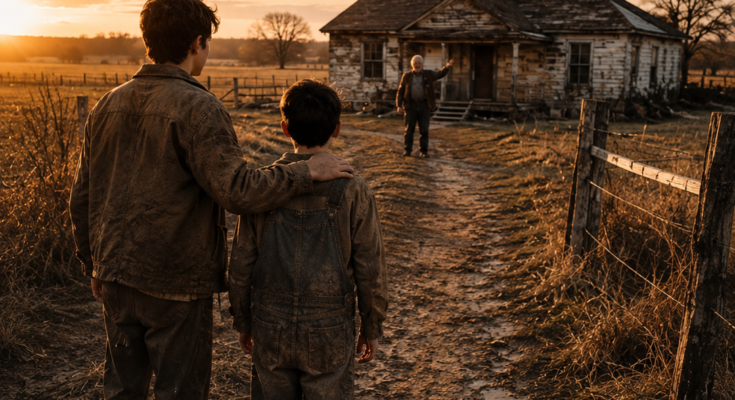
Then they walked to the farmhouse. It was old. It was weathered. But it was standing. It had waited.
The porch creaked. The kitchen smelled like dust and memories. The floors were worn smooth by feet that had long since stopped walking. But it was theirs.
Daniel walked through the rooms. He touched the walls. He looked out the windows. And he thought about his mother, who had left this place in pain and never returned. He thought about her smiling at the kitchen table, her chipped blue coffee mug in her hands. He thought about how she had spent her whole life running from this place, not knowing that someone had been holding it for her all along.
“She would have loved it,” Caleb said softly.
Daniel nodded. “She would have.”
They stayed in the farmhouse that night. Daniel sat on the porch with his brother beside him. They watched the stars rise over the fields. And for the first time in months, Daniel felt something he had forgotten how to feel.
Peace.
The farm would need work. The fields were fallow. The fences were broken. The roof had leaks. But Daniel and Caleb had shown up. They had survived. And now they had a chance.
Months later, Daniel received a letter from Mr. Bennett’s attorney. The will was clear: the farm was theirs. The land, the buildings, the equipment, and the trust that had been set up for maintenance and improvement.
Daniel and Caleb worked the farm. They fixed the fences. They planted crops. They raised animals. They restored the house that had waited forty years for someone to come home.
They never forgot Mr. Bennett. They never forgot their mother. And they never forgot the night that a dying stranger had given them everything.
Sometimes, the greatest inheritance isn’t money or land. It’s the knowledge that someone believed in you. Someone saw you when you were invisible. Someone left a light on, even when the world had turned dark.
The farm stood strong. The brothers grew stronger. And the land that had waited forty years finally had a family again.
That was the gift Mr. Bennett had left them. Not just a farm. A future. ❤️