Part 1: The Empty Room
The nurse would not meet my eyes. “They were here during the surgery,” she said softly. “But they left about an hour ago.” I was still foggy from anesthesia, my throat raw, my heart monitor ticking beside me in the quiet Seattle hospital room. “Why?” Her fingers tightened around the tablet in her hands. “They said the parking was getting too expensive.”
For a second, I thought I had heard her wrong. I had just come through heart surgery. My three children had promised they would be there when I woke up. David had said he would leave his accounting office. Sarah promised flowers. Michael said he would come after his sales calls. And they had walked away over twenty dollars.
I turned my face toward the window, but the tears came before I could stop them. The monitor beside me began beeping faster. “Mrs. Davis,” the nurse said, reaching for tissues, “please try not to upset yourself.” That only made it worse.
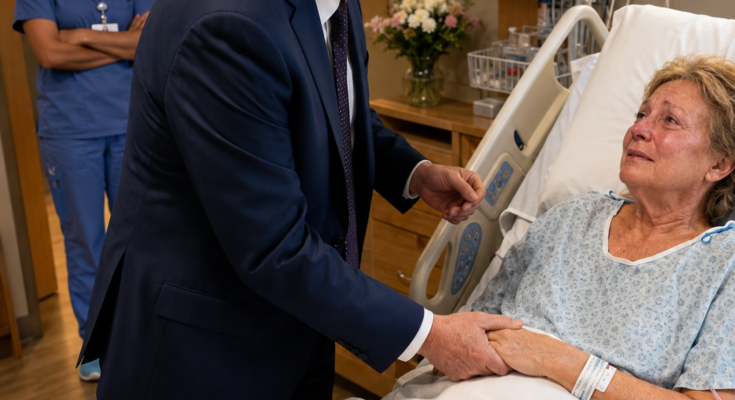
I was sixty-four years old, lying alone after a heart procedure, crying so hard my chest hurt, when heavy footsteps stopped outside my room. A tall man in a dark suit appeared in the doorway. Salt-and-pepper hair. Wire-rimmed glasses. A leather briefcase. The kind of quiet authority that made the nurse immediately straighten her posture.
“Is this Adrienne Davis?” I wiped my face. “Yes.” He stepped closer, and his expression changed when he saw me. “Mrs. Davis, you don’t remember me.” I stared at him. “But you paid for my lunch every day in third grade.”
The room seemed to go still. I searched his face, trying to connect this successful middle-aged man with some child from nearly fifty years ago. Then he said his name. “Malcolm Peterson. I became Malcolm Chen after I was adopted.”
And suddenly, I saw him. A thin little boy at Franklin Elementary. Dark hair that never sat right. Clothes too big for his narrow shoulders. Brown eyes that always dropped toward the cafeteria table while other children ate.
“You were hungry,” I whispered. Malcolm nodded. “You noticed.”
The memory returned in pieces. I had been sixteen, working as a teacher’s aide because my own family needed money. School lunches cost three dollars. I did not have much, but every day I found a way to slip Malcolm a lunch ticket without making him feel ashamed. I told him the cafeteria had extras. I told him somebody needed to eat them. I never told him I was spending almost half my tiny paycheck.
Malcolm pulled a chair beside my bed. Then the nurse cleared her throat. “Sir, visiting hours are limited unless you’re immediate family.” Malcolm glanced at her. “I own this hospital.”
Part 2: The Investigation
After the nurse left, Malcolm sat quietly beside me and reached into his briefcase. He pulled out an old yellow lunch card, soft at the edges from decades of handling. “I kept the last one you gave me.” My hand shook as I touched it. “Why?” “Because when I thought nobody cared whether I ate or not, this reminded me that one person did.”
I started crying again, but not for the same reason. He told me he had become a doctor. Then an administrator. Then the owner of four hospitals across the Pacific Northwest. He told me every hospital he ran had programs to make sure children receiving treatment never went hungry. “Because of one lunch card?” I asked. “Because of you.”
For the first time that afternoon, the room felt less cold. Then Malcolm looked toward the empty visitor chairs. “Where are your children?” The warmth disappeared. “They left.” His eyes narrowed slightly. “Why?” I swallowed. “Parking was too expensive.”
He said nothing for several seconds. Then his hand closed gently around mine. “I’ve been looking for you for years, Adrienne.” Something in his tone changed. Not sentimental now. Serious. “I wanted the chance to repay what you did for me. But I also wanted to make sure you were all right.”
Malcolm did not answer immediately. Instead, he opened his briefcase again. This time, he removed a thick manila folder. My heart monitor began picking up speed. “Adrienne, I need to tell you something, and some of it may be difficult to hear.”
He explained that after finally identifying me, he had quietly looked into my situation. He knew I lived on a small pension and Social Security. He knew I had helped David when his accounting practice struggled. He knew I had been paying Sarah’s credit card bills. He knew I had helped Michael buy his car. Then his voice dropped. “And I know your children have been asking questions about your finances.”
My stomach tightened. “What kind of questions?” Malcolm opened the folder but did not hand me anything yet. “David recently met with an elder-care attorney.” I felt cold. “Sarah has been researching assisted-living facilities.” My fingers closed around the hospital blanket. “And Michael has been asking about the process for having an older parent declared unable to manage their own affairs.”
Part 3: The Truth
“No,” the word came out before I could stop it. “They wouldn’t.” Malcolm’s expression stayed gentle. “I hoped I was wrong.” I shook my head. “They’re my children.” “I know.” “They love me.” “I’m sure they would say they do.”
That answer frightened me more than an accusation would have. Outside, rain had finally started tapping against the hospital window. I looked at the empty chairs where David, Sarah, and Michael were supposed to be sitting. Then I looked at the folder in Malcolm’s hands.
“Why are you telling me this now?” His jaw tightened. “Because today was the test.” I stopped breathing for a moment. “I hoped that when you needed them most, they would stay.” He looked toward the hallway where my children had disappeared hours earlier. “They didn’t.”
Then Malcolm pulled the first document halfway out of the folder. I saw an attorney’s letterhead. My name. And one sentence highlighted in yellow. Before I could read it, Malcolm looked directly into my eyes. “Adrienne, the parking fee wasn’t the real reason they left.”
He explained that he had spoken with the hospital’s front desk. My children had been told that parking would be validated for visitors of surgery patients. It would have been free. They never asked. They never checked. They simply used it as an excuse.
“The real reason,” Malcolm said quietly, “is that they were meeting with an attorney in the hospital’s conference room. Downstairs. While you were still unconscious.”
I felt like I had been punched. “What?”
“David had scheduled a meeting with a lawyer to discuss your financial affairs. Sarah was there. Michael was on speakerphone. They were planning your future, Adrienne. A future that didn’t include you making your own decisions.”
Malcolm handed me a document from the folder. I read it through blurred vision. It was an outline of next steps for pursuing guardianship. The language was clinical, cold. Words like “incapacity” and “transition” and “management of assets.”
“And they left,” I whispered. “They went to that meeting and then left.”
“Yes,” Malcolm said. “They were going to tell you after you woke up. They were going to say it was for your own good. That they only wanted to help.”
My hands were shaking. “I gave them everything. I helped David when his practice was failing. I paid Sarah’s credit cards. I helped Michael buy his car. I gave them everything, and they—”
“They wanted more,” Malcolm finished gently. “They wanted everything else too.”
I sat in silence for a long moment. The rain against the window was the only sound. Then I looked at Malcolm. “What do I do?”
He smiled—not a cruel smile, but a warm one. “That’s why I came, Adrienne. I’ve been preparing for this. I had my legal team look into your situation, just in case.”
“In case of what?”
“In case your children weren’t the family you deserved.”
He pulled out a document bearing my name. “I’ve set up a trust in your name. Not for your children. For you. It’s enough that you’ll never have to worry about money again. And I’ve made arrangements with my hospitals—you’ll always have the best care, paid for, no questions asked.”
“This is too much,” I said. “I can’t accept this.”
“You can,” Malcolm said firmly. “And you will. Because you took care of me when no one else would. You fed me when I was hungry. You saw me when I was invisible. You showed me that kindness exists in a world that had taught me otherwise. Everything I have, I owe to you. This is just me paying it forward.”
I wept. Not from sadness this time. From gratitude. From relief. From the overwhelming realization that the kindness I had given decades ago had come back to me in the most unexpected way.
Malcolm stayed with me that entire afternoon. He canceled his meetings. He held my hand. He told me about his life, his family, his children. He told me that he had named his first daughter Adrienne.
“I wanted you to always know,” he said, “that you mattered. That you changed my life. And that I never forgot.”
The next day, David, Sarah, and Michael tried to visit. I refused to see them. Malcolm’s attorneys had already contacted them, informing them that any attempt to pursue guardianship would be met with legal opposition. The trust was irrevocable. My affairs were protected. They could not touch a penny.
David called me, crying. Sarah left voicemails full of excuses. Michael showed up at my new apartment, begging for forgiveness. I listened to them. I let them speak. And then I told them the truth.
“You left me alone after heart surgery because you were too busy planning how to take everything I had. You didn’t care about me. You cared about my money. And now you have neither.”
I didn’t cut them out of my life entirely. They were still my children. But I set firm boundaries. I stopped paying for their mistakes. I stopped being their safety net. And I started living my life for me.
I moved to a small cottage near the water. Malcolm visited often. We became close friends. I met his wife and children. I became “Grandma Adrienne” to his kids. It was a second chance—a chance to be part of a family that loved me without conditions.
Years passed. My own children eventually came around. It took time, but they started to understand what they had done. David apologized genuinely. Sarah went to therapy. Michael paid me back the money he owed. They weren’t perfect. They were still human. But they were trying.
And I forgave them. Not because they deserved it. Because I had learned that holding onto anger only hurts the person holding it.
But I never forgot Malcolm. The little boy I fed lunch to in third grade, who grew up to be the man who saved me.
Sometimes, kindness comes back to you in ways you never expect. Sometimes, the seeds you plant grow into forests you never see. And sometimes, the person you helped when they had nothing becomes the one who gives you everything.
That was Malcolm’s gift to me. And it was the greatest gift I ever received. ❤️