Part 1:
For six years, I had quietly paid the water bill for the house next door, believing Ada Holloway knew absolutely nothing about it. I didn’t learn the truth until after she was gone.
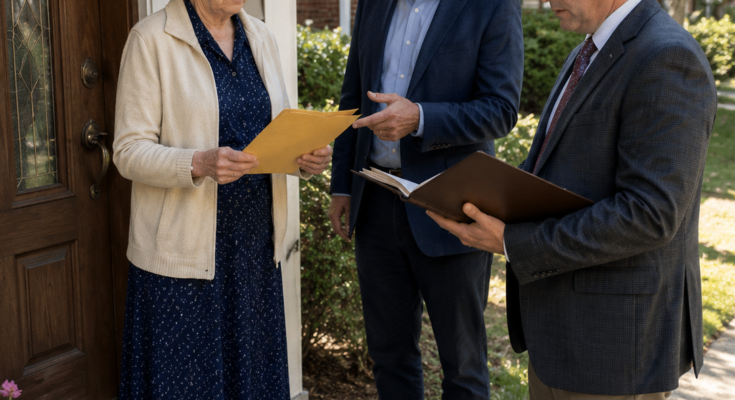
The morning after her funeral, her son, Philip, appeared on my porch accompanied by an attorney named Nathan Price. Nathan spoke first. “We’re examining whether Mrs. Holloway’s final estate decisions may have been affected by undue influence.”
Ada was eighty-four when she died. She had lived beside me for decades, fiercely independent and deeply proud. Back in 2019, I noticed an orange shutoff notice taped to her front door. Her water bill had gone unpaid long enough that service was about to be disconnected. I knew Ada would rather sit in a house without running water than admit she was struggling financially.
So I quietly paid the overdue amount. Then I kept paying it. Every month. Usually, the bill came to about twenty-nine dollars. It wasn’t enough to hurt me financially, and I saw no reason to force Ada into the embarrassment of accepting help face-to-face.
Philip pulled an old utility statement from his folder. My name appeared on it as the payer. Beneath it, in Ada’s unmistakable handwriting, was a note:
**”Helen has paid this since 2019. She will tell you it was nothing important. Do not embarrass her by arguing with her.”**
I stared at the words. Until that moment, I had genuinely believed she never knew.
Philip watched me closely. “Three days before the funeral, I learned that my mother changed her will.”
“I didn’t know that.”
He gave me a cold look. “Please don’t pretend.”
Nathan explained that my secret financial assistance could be considered relevant when evaluating Ada’s final decisions.
“I paid her water bill,” I said.
“You made her dependent on you,” Philip snapped.
I looked directly at him. “When was the last time you spoke to your mother?”
His expression hardened. “That has nothing to do with this.”
“June eighteenth. Her birthday. You spoke for four minutes.”
His jaw tightened.
“She fell in February. Did you know?”
His face changed. “No.”
“She was on her kitchen floor for almost forty minutes before I found her.”
Philip stared at me. “Why wasn’t I called?”
“Because she begged me not to call you.”
“Why?”
“Because she knew you would immediately start talking about assisted living again.”
“She was eighty-four.”
“Yes,” I said. “That was her age, Philip. It wasn’t her entire identity.”
Nathan stepped in. “We’re only trying to establish exactly what happened during the final months of her life.”
“Then you should know everything.”
I went inside. When I returned, I was carrying a sealed manila envelope.
Part 2: The Envelope
Ada had handed me the envelope months earlier and told me to keep it somewhere safe. Written across the front were the words:
**”For the attorney Philip hires if he challenges my decisions.”**
Philip froze. “So you two planned this.”
“No,” I said. “Ada planned it. I was simply told to hold the envelope.”
I gave it to Nathan. He broke the seal and began reading. Halfway through the first page, his expression changed. He looked at Philip.
“Philip, did you ever have authority over your mother’s bank accounts?”
Philip frowned. “What does that have to do with Helen?”
“Please answer.”
Reluctantly, Philip admitted that Ada had temporarily given him financial access after undergoing hip surgery in 2020.
Nathan continued reading. “That authority was revoked in August 2021 after your mother discovered unauthorized transfers.”
Philip’s jaw clenched.
Nathan removed several bank statements from the envelope and placed them in front of him. “The highlighted transfers total eighteen thousand six hundred dollars. They went to Northline Renovations.”
He paused. “A company registered to you.”
Philip shifted uncomfortably. “They were loans.”
“Where are the loan agreements?”
“She was my mother. We didn’t put everything on paper.”
Nathan held his gaze. “Did she approve each transfer before you made it?”
Philip looked away. “I planned to pay her back.”
“Did you?”
Silence.
He had arrived at my home accusing me of exploiting his mother over a twenty-nine-dollar water bill. Meanwhile, Ada had carefully documented thousands of dollars transferred from her savings into her son’s business.
Finally, Philip spoke. “My mother was getting confused.”
“No,” I said.
He looked at me.
“Ada could be stubborn. She could be lonely. She sometimes misplaced things. But when it came to her money, her home, and how people treated her, she knew exactly what she was doing.”
“You barely knew her.”
I glanced toward the blue shutters of the empty house next door. I knew Ada hated thunderstorms after her husband died. I knew she kept peppermints beside the front door. I knew she couldn’t stand oatmeal, loved old detective programs, and cheated shamelessly whenever we played cards.
Then I looked back at Philip. “You’re right.”
For just a second, he seemed satisfied. Then I finished. “I didn’t know her the way a son should know his mother.”
Philip flinched.
Part 3: The Letter
Inside Ada’s envelope were copies of the bank records, documents confirming the revocation of Philip’s financial authority, and a statement from the independent attorney who had prepared her revised will. There was also a medical assessment confirming that Ada fully understood her legal and financial decisions.
Finally, Nathan removed one last item. A sealed letter. Philip’s name was written across the front in Ada’s careful handwriting. Nathan handed it to him. Philip opened it. And after reading the first few lines, he slowly sat down.
The letter was long. But I could see the words on the first page from where I stood. Ada had written:
*”My dear Philip,*
*If you are reading this, then I am gone, and you have done exactly what I feared you would do. You have gone to Helen with suspicion and anger, accusing her of taking advantage of me. I need you to understand something: Helen was the only person in my life who never wanted anything from me.*
*She paid my water bill for six years, never telling me, never asking for thanks. I knew the whole time. I knew because I noticed the orange notices stopped appearing. I knew because I called the utility company and asked who had been paying. I knew because I saw her sneaking out to my mailbox in the rain.*
*But I also knew she would be embarrassed if I thanked her directly. So I wrote that note on the statement, hoping you would find it one day and understand.*
*I am leaving my house to Helen. Not because she paid my water bill. But because she was there when you weren’t. She was there when I fell. She was there on holidays when you called for four minutes and then said you had to go. She was there when I was lonely, when I was scared, when I didn’t know how I was going to make it through another winter.*
*You took $18,600 from my savings without asking. You told yourself it was a loan, but you never paid it back. You told yourself I was confused, but I wasn’t. I was just too tired to fight with you.*
*Helen never asked for anything. That is why she deserves everything.*
*I love you, Philip. You are my son. But being my son does not give you the right to take what is not yours or to accuse the only person who truly cared for me in my final years.*
*I hope you will read this letter and understand. I hope you will apologize to Helen. I hope you will become the man I always believed you could be.*
*With all my love,*
*Mother.”*
Philip stared at the letter for a long time. His hands were shaking. I could see tears forming in his eyes, but he refused to let them fall.
Nathan broke the silence. “Philip, the will is clear. The house and the remaining assets are bequeathed to Helen Bennett.”
“I don’t want the house,” I said quietly.
Both men looked at me.
“I never wanted anything from Ada. I paid that bill because she was my neighbor and my friend. I didn’t do it for a reward. I didn’t do it for her money. I did it because it was the right thing to do.”
Philip looked at me, his face pale. “Helen, I’m sorry. I didn’t know. I just—I assumed—”
“I know what you assumed,” I said. “You assumed I was like you. But I’m not.”
He flinched at the words, but he didn’t argue.
“I’m not going to take the house,” I continued. “It belongs to Ada’s family. But I think you and I both know that family is more than just blood. It’s about showing up. It’s about being there when it matters.”
Philip nodded slowly. “I know. I failed her. I failed her in so many ways.”
“Yes,” I said. “You did. But it’s not too late to become the man she wanted you to be.”
He looked at the letter in his hands, then back at me. “What do I do?”
“Start by honoring her wishes,” I said. “Sell the house if you need to. Keep it if you can. But remember what she wrote. Remember that being a son isn’t just about inheritance. It’s about love.”
Philip nodded and left with Nathan that afternoon. I watched them go, feeling a strange mixture of sadness and relief.
The house next door sat empty for months. I thought about Ada every day. I missed her peppermints and her card games and her stubborn refusal to accept help. I missed her.
Then, one afternoon, Philip appeared on my porch again. He was carrying a small box.
“I found something,” he said. “I think she wanted you to have it.”
He handed me the box. Inside was a collection of things that meant nothing to anyone else but everything to me. A bag of peppermints. A deck of cards. A photograph of Ada and me on her porch, taken years ago. And a note that said, simply:
**”Thank you for being my neighbor. Thank you for being my friend. I loved you like a daughter.”**
I cried for the first time since Ada’s funeral.
Philip stood there awkwardly, shifting his weight from foot to foot. “I’m sorry,” he said again. “I was wrong about everything. I was wrong about you. I was wrong about my mother. And I was wrong about what it means to be family.”
I wiped my eyes and looked at him. “What are you going to do now?”
“I’m going to stay,” he said. “I’m going to fix up the house. I’m going to be the neighbor she would have wanted me to be. And I’m going to try to be the son she deserved.”
I nodded. “That’s a good start.”
He smiled, and for the first time, I saw something in his eyes that reminded me of Ada.
Over the following years, Philip became a different person. He stayed in the house next door. He became involved in the community. He helped other elderly neighbors. He never forgot his mother’s words.
And I never forgot Ada.
Every year on the anniversary of her death, I put a peppermint on my windowsill and think about the woman who taught me that kindness doesn’t always need to be acknowledged to be meaningful.
Sometimes, the best gift you can give someone is the quiet help that no one ever notices.
Ada knew that. She knew it because she had lived a long life and learned what mattered. And in the end, she chose to leave me something far more valuable than a house.
She left me her trust. Her friendship. And her love.
That was worth more than any inheritance ever could be. ❤️