PART 3: What Cynthia Never Wanted Me To Know
It took another week, and two more meetings in rooms with half-closed blinds, before I understood the full shape of what had happened — pieced together from the detective’s interviews, from hospital records, and eventually, in a supervised visit I insisted on despite everyone’s hesitation, from Cynthia herself.
She had learned she was pregnant almost exactly a month before Lewis’s accident. She hadn’t told him yet — she’d been waiting, she said, for the “right moment,” some anniversary or milestone she’d built up in her head as the perfect way to share it. Then Lewis died on a rainy highway outside Portland, and the moment she’d been waiting for disappeared along with him.
What came after that, in her account, was less a plan than a slow unraveling. She said she couldn’t face raising a child alone, couldn’t face the family that would look at that baby and see nothing but the son they’d lost, couldn’t face becoming, in her words, “the widow with Lewis’s ghost living in her house forever.” She disappeared to Bend under the guise of grief, gave birth quietly at a small clinic using her middle name and a version of her maiden name, and spent six weeks trying to decide what to do with a baby she said she loved and could not, in her mind, keep.
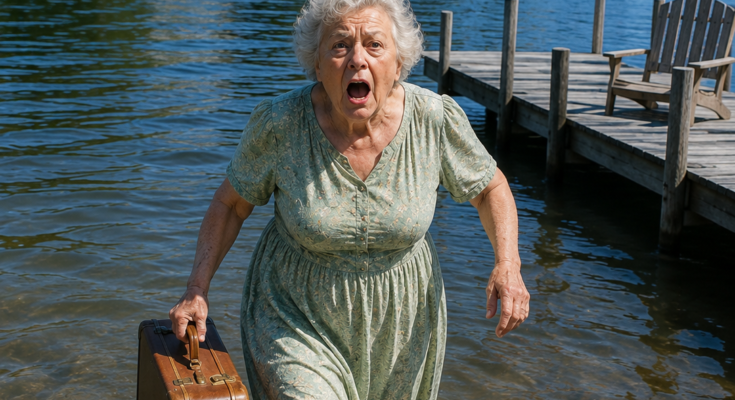
The suitcase wasn’t, she insisted through tears in that supervised room, meant to kill her daughter. She’d wrapped her carefully, fed her right before, believed — in whatever fractured logic grief and panic had built for her — that someone would find the suitcase quickly, that she was leaving her somewhere she’d be discovered, not somewhere she’d disappear. It didn’t make what she did any less horrifying, and it didn’t stop the detective from filing charges that included child endangerment and abandonment, charges Cynthia is still working through the legal system on as I write this. But it did, slowly, help me understand that the woman who threw that suitcase into the lake wasn’t a monster in the simple sense I’d wanted her to be. She was someone drowning in a grief she never let any of us see, who made a catastrophic decision instead of asking for help she didn’t believe she deserved.
I named my granddaughter Louisa, after Lewis, the day the state finalized emergency custody in my favor. She’s four months old now, sleeping most nights in the same nursery I once decorated for Lewis himself, the wallpaper faded but still recognizably his — trains and clouds he used to point at from his crib, according to the one photo I still have of that room from thirty years ago.
The porch where I used to sit alone with my tea isn’t quiet anymore. Louisa has Lewis’s exact dark hair and, according to the pediatrician, is well ahead on every measure that matters, no lasting harm from those minutes in the cold lake water, which the doctors still describe to me, whenever I ask, as something close to a miracle of timing.
I don’t know yet what I’ll tell her, years from now, about how she came into my life — about the suitcase, about the lake, about the mother who is working through her own long road toward whatever accountability and healing looks like for her. But I know I’ll tell her the truth eventually, the same way Lewis’s father always told me the truth mattered more than comfort. And I know that whatever else that October afternoon took from this family, it also, impossibly, gave me back a piece of my son I never knew I still had left to hold.