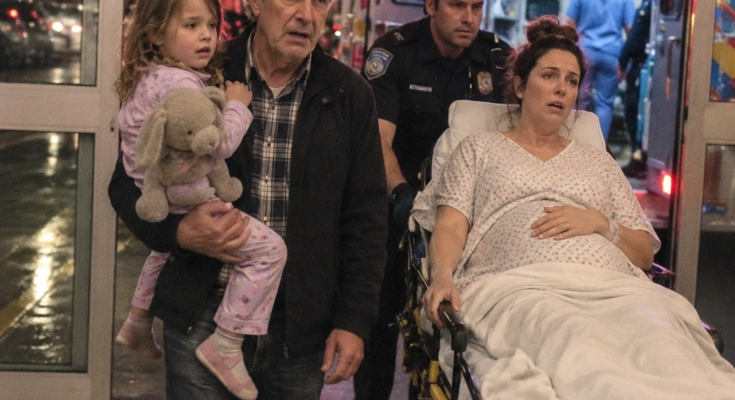
Part One — The Stuffed Elephant
My phone violently vibrated against the nightstand at 12:47 in the morning.
It wasn’t the late-night call any parent expects.
It was my six-year-old granddaughter, Lydia.
“Papa!”
She was crying so hard I could barely understand her.
“Papa, Mommy’s baby is coming!”
I was already sitting up.
My daughter, Cassidy, wasn’t due for another six weeks.
“Lydia, listen to me. Is Mommy awake?”
“Yes.”
“Can she talk?”
“No.”
That answer changed everything.
“Where is your daddy?”
The line went quiet.
Then Lydia whispered:
“He hurt Mommy’s tummy.”
I stopped breathing.
A second later:
“Then he got in his truck and drove away.”
Twenty-eight years working oil rigs across Montana and Wyoming had taught me one rule that mattered more than courage.
Panic wastes time.
“Lydia, I need you to do exactly what I say. Stay inside. Don’t touch anything sharp. Don’t go outside looking for Daddy. I’m calling an ambulance right now.”
“I already called.”
I closed my eyes.
Of course she had.
My six-year-old granddaughter had done what the adults around her should have protected her from ever needing to do.
“Good girl.”
Then I corrected myself immediately.
“You don’t have to be brave anymore. Help is coming.”
I made the drive to Cassidy’s house outside Bozeman in twenty-two minutes.
The ambulance was already there.
Red lights washed across the snowbanks and front porch.
Paramedics wheeled Cassidy through the door on a stretcher.
Her face was gray.
An oxygen mask covered her mouth.
One hand rested over her abdomen.
The other hung weakly beside the stretcher.
I caught it.
“Cass?”
Her eyes opened.
“Dad.”
Barely audible.
“I’m here.”
Inside the house, Lydia sat frozen on the couch in princess pajamas.
A stuffed elephant was clutched against her chest.
There was blood on her hands.
Not hers.
I knelt in front of her.
She looked at me.
“I tried to stop it.”
I wanted to ask a thousand questions.
What did you see?
Where did he hit her?
How many times?
Did he use anything?
Instead, I said:
“You did the right thing calling for help.”
A sheriff’s deputy took my basic information.
Then a hospital social worker arrived with the ambulance crew and told me something I would later be grateful for.
“Don’t ask Lydia to tell the story over and over.”
I nodded.
“She may need to speak with specially trained interviewers later. For now, safety and comfort.”
That became the rule.
At the hospital, Cassidy went straight into emergency surgery.
Her baby boy was delivered at thirty-four weeks.
Tiny.
Barely over four pounds.
He went directly to the NICU.
Cassidy had significant internal injuries.
The doctors were careful with their words.
Her injuries were consistent with blunt-force trauma.
They could not determine intent from medicine alone.
But they could say this was not a normal complication of labor.
Not a simple fall.
Not something that happened because she “got emotional.”
While I sat outside intensive care with Lydia curled against me, Deputy Brock Timmons walked into the waiting room.
I knew him.
Everybody in the county knew everybody eventually.
Brock drank with Cassidy’s husband, Trent, at a highway bar outside town.
He crouched in front of Lydia.
“So, kiddo. Your mom and dad had a fight?”
I stood.
“She doesn’t need to answer you.”
He glanced at me.
“Sir, I’m conducting an investigation.”
The hospital social worker, Marisol, stepped between Lydia and him.
“She is six years old, she witnessed a potentially traumatic event, and she is not being informally questioned in a public waiting room.”
Timmons frowned.
“I just need basic facts.”
“Basic facts can come from adults, medical staff, dispatch records, and the scene. If law enforcement needs a formal child interview, it should be handled through the proper process.”
He looked annoyed.
Then he wrote something in his notebook and left.
I was shaking with rage.
Marisol turned toward me.
“Don’t confront him.”
“I wasn’t planning to.”
That was a lie.
She seemed to know.
“Your daughter needs you more than your anger does.”
That shut me up.
At 4:18 in the morning, the surgeon came out.
Cassidy was alive.
Stable.
The baby was stable too.
I sat down so hard the plastic chair scraped the wall.
Then Lydia asked:
“Is Mommy dead?”
“No.”
I pulled her close.
“No, sweetheart. Mommy is alive.”
She started crying into my chest.
For the first time that night, so did I.
━━━━━━━━━━━━━━━━━━━━
Part Two — What Cassidy Had Been Hiding
Cassidy woke the next afternoon.
The first thing she asked was:
“Lydia?”
“Safe.”
“The baby?”
“NICU. Stable.”
Then her eyes filled.
“Trent?”
“Gone.”
She turned her face toward the wall.
That told me more than words would have.
Over the next two days, the truth came out slowly.
Not all at once.
Not because I demanded it.
Because Cassidy finally stopped trying to protect him.
The first assault had not happened that night.
There had been pushing.
Grabbing.
A hand around her wrist hard enough to bruise.
A hole in the laundry-room wall.
Threats about money.
Trent apologizing afterward.
Flowers.
Promises.
Then blaming stress.
Work.
Beer.
Jealousy.
Her pregnancy had made everything worse.
“Why didn’t you tell me?”
I hated myself the second the words came out.
Cassidy looked ashamed.
Marisol, sitting beside the bed, answered before she had to.
“Because people in coercive relationships often spend enormous energy trying to manage the danger and preserve normalcy at the same time.”
I looked at my daughter.
“I’m sorry.”
She nodded.
“I thought if I could keep him calm until the baby came…”
Her voice broke.
“You shouldn’t have had to.”
“I didn’t want Lydia growing up without a dad.”
I looked through the glass toward the NICU corridor.
“She almost grew up without you.”
Cassidy closed her eyes.
That was the last time I used fear to persuade her.
She didn’t need a lecture.
She needed choices.
A victim advocate helped her begin the protective-order process.
Police collected evidence from the house.
The 911 call was preserved.
Neighbors had heard shouting.
One doorbell camera had captured Trent’s truck leaving at 12:38 a.m.
Lydia’s statement was eventually taken through a trained child-interview process, with as few repetitions as possible.
She was not made responsible for proving what happened.
That mattered to me.
So did what happened with Deputy Timmons.
Marisol documented his attempted questioning.
I filed a complaint.
Cassidy’s attorney did too.
The sheriff’s office reviewed the conflict because Timmons had a personal relationship with Trent.
He was removed from involvement in the case while that was examined.
Not fired on the spot.
Not dragged out in handcuffs.
Just removed from a situation he should not have been handling.
Another investigator took over.
Trent was arrested two days later after being located at his brother’s property.
The criminal case did not resolve immediately.
Cases like that rarely do.
There were hearings.
Medical records.
Statements.
Attorneys.
Bail conditions.
No-contact orders.
Months of uncertainty.
But the most important thing changed before any verdict.
Cassidy stopped going home to him.
When she was discharged, she came to my house.
I converted my den into a bedroom.
Bought a bassinet.
Put a night-light in the hallway because Lydia had started waking whenever she heard a truck outside.
The baby stayed in the NICU for nearly three weeks.
We named him Owen.
That was the name Cassidy had chosen months earlier.
Trent had wanted him named after himself.
For the first time, Cassidy did not negotiate.
Owen came home as Owen.
━━━━━━━━━━━━━━━━━━━━
Part Three — The Call at 12:47
Lydia struggled more quietly than everyone expected.
She stopped playing princess.
Stopped sleeping with the elephant.
Stopped asking about her father.
That scared me.
A child therapist eventually helped her find language for what happened without turning her into the keeper of adult secrets.
One afternoon, she brought me the stuffed elephant.
There was still a faint brown stain near one ear despite several washings.
“Papa?”
“Yeah?”
“Can you throw him away?”
I looked at the elephant.
“You want me to?”
She nodded.
Then changed her mind.
“No.”
I waited.
“Can you put him in the closet?”
“Of course.”
She didn’t want the reminder.
But she wasn’t ready to lose it either.
That made sense.
A lot of healing looked like that.
Not letting go.
Just putting something farther away.
Cassidy’s case eventually ended with serious consequences for Trent.
I won’t pretend a conviction healed anyone.
It didn’t.
What mattered more was that he could no longer walk into the house and reset everyone’s reality by saying:
“It wasn’t that bad.”
The medical evidence said otherwise.
The 911 recording said otherwise.
The history said otherwise.
And eventually, Trent himself stopped denying the central facts.
He wrote Cassidy a letter through his attorney.
She did not have to read it.
Months later, she chose to.
In it, he wrote:
I kept calling it an argument because that word made what I did sound mutual. It wasn’t. I hurt you. Lydia saw it. I almost killed you and Owen.
Cassidy read that sentence three times.
Then put the letter away.
She did not write back.
Understanding was not access.
Remorse was not reconciliation.
Lydia’s relationship with her father became a separate issue handled slowly, with professional guidance and attention to safety.
Nobody told her she had to hate him.
Nobody told her she had to forgive him.
She was allowed to feel different things on different days.
Angry.
Sad.
Curious.
Afraid.
Missing him.
Not missing him.
Children should not have to choose one emotion just because adults prefer clean endings.
Three years passed.
Cassidy went back to work.
Owen became a loud, stubborn toddler who hated peas and loved construction equipment.
Lydia started sleeping through the night again.
One December, she asked me something while we decorated the tree.
“Papa?”
“Yeah?”
“Did I save Mommy?”
I almost answered too quickly.
Instead, I put down the ornament.
“You called for help.”
“So I saved her.”
“You helped the adults get there.”
She frowned.
“That sounds like the same thing.”
I smiled.
“Maybe. But there’s something I need you to know.”
“What?”
“It was never your job to save your mother.”
Her face changed.
I continued.
“You were six. Your job was supposed to be sleeping.”
She looked down.
“But I called.”
“You did.”
“Was that brave?”
“Yes.”
Then I added:
“But I hope nobody ever needs you to be that brave again.”
She leaned against me.
For a while, we said nothing.
Years later, the stuffed elephant came out of the closet.
Lydia found it when she was ten.
She carried it into the kitchen.
“You kept this?”
“You told me not to throw it away.”
She turned it over in her hands.
“It’s ugly.”
“It has character.”
She laughed.
Then she noticed the stain.
Her face went serious.
“Is that from that night?”
“Yes.”
She thought about it.
Then handed me the elephant.
“Can we wash it again?”
So we did.
The stain never disappeared completely.
I offered to buy her another elephant.
She shook her head.
“No.”
“Why?”
“Because this one was there.”
I understood.
The elephant did not symbolize her father’s violence anymore.
It symbolized something else.
A six-year-old girl sitting on a couch after doing the only thing she knew to do.
Calling someone safe.
That phone call happened at 12:47 a.m.
For years, I thought the sentence that changed our family was:
He hurt Mommy’s tummy.
It wasn’t.
The sentence that mattered most came before it.
One word.
Papa.
She called.
I answered.
That sounds ordinary.
It should be ordinary.
But that night taught me something I wish every child knew before they ever needed it.
There should always be one adult you can call when you’re scared.
One person who doesn’t ask whether you’re exaggerating.
One person who doesn’t tell you to keep a family secret.
One person whose first question is not:
What did you do?
But:
Where are you? I’m coming.
I spent nearly three decades working jobs where emergencies were loud.
Explosions.
Alarms.
Steel breaking.
Men shouting.
The worst emergency of my life arrived as a tiny voice through a phone at 12:47 in the morning.
And the most important thing I ever did wasn’t fighting anyone.
It was answering.