Part One — The Piece of Blue Blanket
I nearly rode right past him.
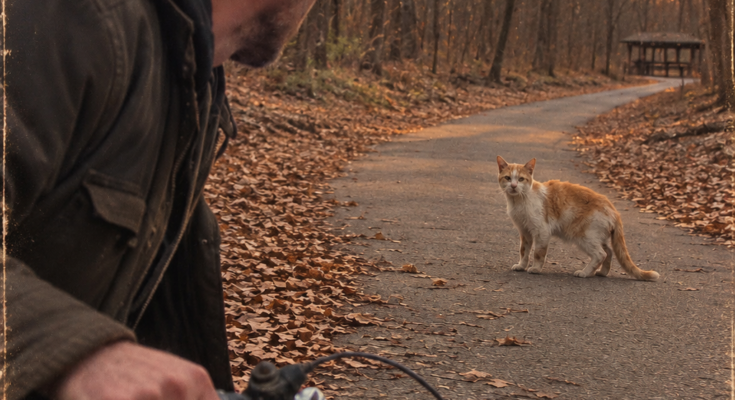
It was a gray February afternoon, the kind we get in the Midwest when winter has worn out its welcome but refuses to leave. The trees were bare, dead leaves crowded both sides of the trail, and a cold wind pushed against my face.
I was biking to my afternoon shift because my truck needed repairs I couldn’t afford yet.
My head was down, and I was thinking about bills when a small orange-and-white cat stepped onto the pavement.
I grabbed both brakes.
The cat stood about thirty feet ahead of me.
Thin.
Rough coat.
A little nick in his right ear.
But above his left eye was a crooked orange patch I knew better than my own reflection.
Then he made two short, scratchy meows.
My hands started shaking.
Chante had always done that when he wanted dinner.
Never one meow.
Never three.
Always two.
“Chante?”
His ears lifted.
For one second, neither of us moved.
Then I dropped my bike and fell to my knees.
Chante had disappeared almost exactly one year earlier, on the worst day of my life.
I had just lost my warehouse job and could no longer afford the little house I’d rented for six years. I found a one-bedroom apartment across town and borrowed a pickup to move what little I owned.
Chante hated car rides.
I had secured him inside his carrier, but when I stopped near that trail to tighten a loose rope, the carrier door somehow popped open.
He shot out like a bullet.
I chased him until dark.
I returned the next morning.
Then morning and evening for weeks.
Food.
Flyers.
Calling his name until my throat hurt.
I left one of my sweatshirts beneath a trail bench because somebody online said my scent might help him find his way back.
Nothing.
People reported orange cats all over town.
None were Chante.
A stranger online wrote:
If you really loved him, you would’ve been more careful.
I stopped reading comments after that.
The stranger hadn’t said anything I wasn’t already telling myself.
I had failed him.
Eventually the flyers faded.
The food dishes vanished.
Life kept demanding rent and groceries whether I was grieving or not.
But Chante’s blue bowl stayed in my kitchen cabinet.
I couldn’t throw it away.
Now he was standing in front of me.
Alive.
“Come here, buddy.”
I held out one hand.
He took a cautious step.
I could see his ribs.
I wanted to grab him.
Instead, Chante backed away.
My heart dropped.
Maybe he recognized me but no longer trusted me.
So I tried the words I’d used every evening for seven years.
“Dinner time.”
Two scratchy meows.
I started crying.
Then Chante turned and ran.
“Chante!”
He stopped fifty feet away.
Looked back.
I stepped toward him.
He ran farther.
Stopped again.
That was when I understood.
He wasn’t leaving.
He wanted me to follow.
I grabbed my bicycle and pushed it behind him.
Chante left the paved trail and slipped between the trees.
He led me to an old picnic shelter hidden beyond a thicket.
The roof sagged.
One bench was missing.
Beneath the other was a flattened cardboard box lined with dry leaves.
And something blue.
I knelt.
My breath caught.
It was a torn piece of the blanket that had been inside Chante’s carrier the day he escaped.
I hadn’t realized it fell from the truck.
I held the dirty fabric in both hands.
“You found this.”
Chante crawled beneath the bench.
For a moment, I couldn’t see him.
Then a woman’s voice behind me said:
“So you’re the one he’s been waiting for.”
I spun around.
A woman perhaps in her sixties stood several yards away carrying a canvas tote and a plastic container.
“You know him?”
She looked at Chante.
“I’ve been feeding that stubborn little creature for almost eleven months.”
I stared at her.
“What?”
“My name’s Joan.”
She placed the container on the ground.
Chante immediately emerged.
Not close enough to touch her.
Close enough to recognize her.
Joan smiled.
“See? That’s affection from him.”
I could barely speak.
“You’ve been feeding him?”
“Not just me. A few of us.”
She pointed toward the shelter.
“We thought he was feral at first. Then we realized feral cats don’t usually sit beside bike trails staring at every passing person.”
My throat tightened.
“What do you mean?”
Joan looked at me.
“He’s been looking for somebody.”
Then she pointed toward the blue fabric in my hand.
“And whatever happened before he got here, that blanket was the one thing he refused to leave behind.”
━━━━━━━━━━━━━━━━━━━━
Part Two — What Happened During the Missing Year
Joan was a retired veterinary technician who volunteered with a small local cat-rescue group.
She first saw Chante the previous March.
He was hiding beneath the picnic shelter.
Thin, terrified, and impossible to approach.
She began leaving food.
At first, he wouldn’t eat until she disappeared.
After a few weeks, he’d eat while she stood twenty feet away.
Then ten.
“He was never truly wild,” Joan told me. “He knew doors. Cars scared him. He understood food dishes. And once I saw him rub his face against that blanket, I knew he’d belonged to somebody.”
“Why didn’t anyone take him to a shelter?”
“We tried.”
She looked embarrassed.
“He was very good at not being caught.”
They borrowed a humane trap.
Chante ignored it for three nights.
The fourth night, he managed to take the food without triggering it.
Joan laughed.
“I still don’t know how.”
Later, they found one of my old flyers.
Or what remained of it.
Rain had blurred the bottom half.
The phone number was unreadable.
“I posted his picture online,” Joan said.
I shook my head.
“I stopped checking after a few months.”
“I understand.”
“No, I should’ve kept—”
Joan interrupted me.
“Don’t.”
I looked at her.
“You searched. He hid. Both things can be true.”
That simple sentence hit harder than I expected.
I had spent a year turning an accident into a verdict on myself.
Joan continued.
During summer, Chante ranged farther.
A mechanic at a nearby garage fed him scraps.
A woman walking her dog left dry food.
When winter came, Joan placed an insulated outdoor cat shelter deeper in the trees.
Chante used it on the coldest nights.
But he always came back to the picnic table.
Always to the blue blanket.
And almost every afternoon, around the hours cyclists were commuting home, Chante would walk toward the paved trail.
“He’d sit there,” Joan said. “Sometimes twenty minutes. Sometimes an hour.”
My eyes filled.
“Why?”
“I don’t know.”
She paused.
“But once or twice, he followed men on bicycles for a little way.”
I had to look away.
For months after losing my truck, before I found another job, I’d used that same trail often.
Then I moved farther away.
My shifts changed.
I stopped passing there.
Chante hadn’t known my new address.
The last place in the world where he had seen me was that roadside trail.
So he returned to it.
Not because he had forgotten home.
Because it was the only map home had left him.
I sat on the old bench.
Chante remained beneath it.
“What do I do now?”
Joan smiled.
“Don’t ruin this part by becoming impatient.”
I laughed weakly.
“He’s my cat.”
“I believe you.”
“Seven years.”
“I believe that too.”
“Then why won’t he let me touch him?”
“Because a year outside taught him things seven years indoors didn’t.”
That hurt.
But she was right.
We stayed there for almost an hour.
I didn’t grab him.
Didn’t corner him.
I just talked.
About stupid things.
My new apartment.
The broken truck.
The neighbor upstairs who vacuumed at midnight.
I told him his blue bowl was still in the kitchen cabinet.
At that, Chante’s ears twitched.
Joan eventually placed food near me.
Then backed away.
Chante approached.
Slowly.
One paw.
Another.
He ate three feet from my shoe.
Then two.
Then stopped.
I whispered:
“Dinner time.”
Two meows.
He stepped forward and sniffed my hand.
I did not move.
His nose touched my knuckle.
Then his cheek.
A tiny rub.
That was all.
I started crying again.
Joan pretended not to notice.
We didn’t take him home that afternoon.
That surprised me most.
Joan helped me make a plan.
I returned after work with food.
The next morning too.
On the third day, Chante allowed me to stroke his head.
On the fourth, he climbed halfway into my lap and immediately seemed offended by his own decision.
On the fifth, I brought his old carrier.
Not the same broken one.
A new, secure carrier.
Inside, I placed the blue piece of blanket.
Chante sniffed it.
Then looked at me.
“I’m not making you,” I said.
Ten minutes later, he walked inside himself.
Joan quietly closed the door.
I sat on the ground laughing and crying at the same time.
“Got him,” she whispered.
“No.”
I looked through the carrier door.
“He came.”
That felt different.
━━━━━━━━━━━━━━━━━━━━
Part Three — Dinner Time
The veterinarian found a year outdoors written all over Chante.
He was underweight.
He had parasites.
One old scar.
The little ear nick.
His paw pads were rougher than I remembered.
But there was no catastrophic hidden illness.
His blood work was surprisingly good.
He had been lucky.
And people had helped.
Joan.
The mechanic.
Dog walkers.
Someone I would probably never meet who occasionally left chicken beneath the shelter.
I had spent a year imagining Chante alone every single night.
He had been alone sometimes.
But not entirely.
That realization mattered.
I brought him to my apartment after the veterinary visit.
I expected a movie reunion.
Chante bursting from the carrier.
Running through the rooms.
Curling beside me in bed.
He did none of that.
He came out after forty minutes.
Walked slowly around the living room.
Sniffed every wall.
Then hid behind my couch.
For three days, that’s mostly where he stayed.
I worried constantly.
Maybe he’d been outside too long.
Maybe home wasn’t home anymore.
Joan reminded me:
“Give him time.”
So I did.
I didn’t drag him out.
Didn’t carry him from room to room.
I put food and water nearby.
Placed the blue blanket piece beside his bed.
And every evening I said:
“Dinner time.”
Two meows would come from behind the couch.
Eventually from beside it.
Then one night, almost two weeks after coming home, I woke because something heavy landed on the mattress.
I opened my eyes.
Chante stood near my feet.
He stared at me.
Then walked carefully up the bed.
Turned around twice.
And lay against my chest.
I didn’t move.
I barely breathed.
He began purring.
The sound was rough.
Quieter than it used to be.
But it was his.
I pressed my face into his fur.
“I’m sorry.”
Chante purred louder.
That was when I realized something.
I had been waiting for him to forgive me.
But cats don’t organize love the way guilty humans do.
He wasn’t keeping score.
He had been frightened.
Lost.
Surviving.
And now he was warm.
That was enough for him.
Maybe it needed to become enough for me too.
I kept seeing Joan after that.
At first because I brought her pictures of Chante recovering.
Then because we became friends.
She eventually convinced me to volunteer with her rescue group one Saturday each month.
I wasn’t good at much.
Mostly I cleaned carriers and drove food to foster homes.
But sometimes someone would arrive heartbroken because their pet had disappeared.
They would say:
“I should’ve checked the door.”
“I shouldn’t have trusted that carrier.”
“I looked everywhere.”
And I recognized the voice immediately.
Guilt pretending to be responsibility.
I never told them everything would be fine.
Sometimes lost animals aren’t found.
I knew that.
Instead I said:
“Keep looking. But don’t confuse an accident with how much you love them.”
That was the sentence I wish someone had given me a year earlier.
Chante slowly returned to being mostly himself.
Mostly.
He still hated open doors.
Thunder sent him beneath the bed.
He never again tolerated a carrier unless the blue fabric went inside first.
And whenever I came home late, he stood beside the kitchen and gave me those same two short meows.
Dinner time.
Three years have passed since that afternoon on the trail.
My truck eventually got repaired.
Then died completely six months later.
I found a better job.
Moved into a slightly larger apartment.
Chante came with me.
Of course.
I still have his original blue bowl.
There’s a small chip along one edge now.
I could replace it.
I won’t.
And in a frame beside my front door is something stranger.
A dirty piece of faded blue blanket.
People occasionally ask why anyone would frame something that ugly.
I tell them:
“It’s a map.”
They usually look confused.
That’s okay.
I know what it means.
For almost a year, Chante couldn’t find the house we’d once shared.
So he stayed near the last place he’d seen me.
He slept beside the last thing that smelled familiar.
He accepted food from strangers.
He survived winter.
He kept returning to the trail.
And one gray afternoon, when I finally passed that way again, he stepped directly into my path.
I used to tell people I found Chante.
I don’t anymore.
Because that’s only half the story.
I nearly rode past him.
He was the one who walked onto the pavement.
He was the one who gave those two scratchy meows.
He was the one who turned toward the woods and kept looking back until I understood.
A year earlier, I had searched everywhere for my cat.
What I didn’t know was that, in his own strange little way, Chante had been searching too.
And when we finally found each other, he didn’t run into my arms.
He did something better.
He showed me where he’d been waiting.