James continued.
“Your father is insisting that because this is a family reunion, he has authority over every room connected to the event.”
I almost smiled.
“My reservation isn’t connected to his booking.”
“I know,” James said. “I explained that.”
“And?”
“He wasn’t pleased.”
I looked through the coffee shop window toward the resort.
“What exactly did he say?”
James hesitated.
“He said you’re his daughter, that you clearly can’t afford the room, and that he’s trying to prevent you from making a financial mistake.”
That hurt more than I expected.
Not because I needed my father’s approval.
But because even after sending me away, he still believed he had the right to decide what I could afford, where I could stay, and what kind of life I was allowed to have.
“Don’t cancel anything,” I said.
“Of course not.”
“And James?”
“Yes?”
“Don’t tell him who I am.”
There was a pause.
“Understood.”
I ended the call.
For the next several minutes, I sat quietly with my coffee.
I could have made one phone call and embarrassed my father in front of everyone.
I could have asked James to remove the upgrades attached to the family reservation.
I could have canceled the complimentary yacht package, the private dining room, the spa credits, and the executive privileges that had been approved because of my ownership status.
But this weekend wasn’t supposed to be about my father.
It wasn’t about Derek.
It wasn’t about Brittany.
It wasn’t even about me.
It was about two people who had managed to love each other for sixty years.
My grandparents.
And I wasn’t going to ruin their anniversary just to prove that my family had underestimated me.
So I called James again.
“Leave everything exactly as it is,” I told him.
“Everything?”
“Yes.”
“The upgrades too?”
“Yes.”
He sounded surprised.
“Even after what happened?”
I watched sunlight move across the lake.
“Especially after what happened.”
I paused.
“My grandparents shouldn’t lose their celebration because other people forgot how to behave.”
James was quiet for a moment.
Then he said, “That’s very generous, Miss Patterson.”
“It isn’t generosity.”
I smiled.
“It’s family.”
There was one thing I did change.
I asked James to move my reservation into a small lakefront cottage at the far end of the property.
Not the presidential suite.
Not one of the luxury villas.
Just a quiet cottage with a porch overlooking the water.
Then I drove back.
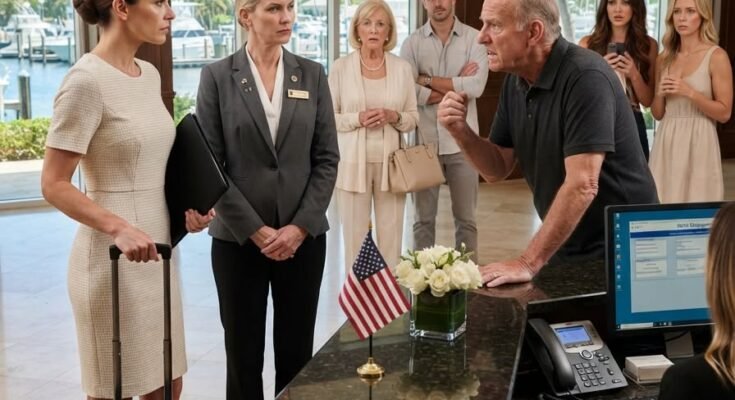
When I pulled into the resort again, Derek was standing near the valet station.
He stared at my Subaru.
“You came back?”
“Yes.”
His expression hardened.
“Dad canceled your room.”
“No, he didn’t.”
“He was just at the front desk.”
“I know.”
Derek frowned.
Before he could respond, James Hendricks walked through the lobby doors.
The general manager followed him.
So did two members of the resort’s executive staff.
James came directly toward me.
“Welcome back, Miss Patterson.”
Derek glanced between us.
“You know her?”
James smiled politely.
“Of course.”
My father appeared behind Derek.
“What is going on?”
James looked at me.
I gave him a small nod.
He turned toward my family.
“Miss Patterson’s reservation cannot be canceled by anyone except Miss Patterson.”
Dad crossed his arms.
“I’m her father.”
“That doesn’t give you authority over her reservation.”
My father’s face reddened.
Then Brittany walked over.
“What is the big deal? It’s just a hotel room.”
James’s expression remained professional.
“Actually, Mrs. Patterson, Miss Patterson has considerably more authority concerning this property than any guest.”
Silence.
Derek laughed awkwardly.
“What does that mean?”
I sighed.
There was apparently no avoiding the conversation anymore.
So I told them.
Seven years earlier, I had written a children’s book.
I wrote it at my kitchen table after work because one of my preschool students had been struggling with the death of his mother.
I couldn’t find a story that explained grief in a way he understood, so I created one.
The first publisher rejected it.
So did the second.
And the third.
The fourth accepted it.
The book became popular with teachers, counselors, libraries, and parents.
I wrote another.
Then another.
Eventually, there were nine books.
My family knew I sometimes wrote children’s stories.
They simply never asked what happened to them.
The books were published under the name M.P. Lane.
The royalties became substantial.
But I kept teaching because writing had never replaced the reason I became a teacher.
Children had inspired the books in the first place.
Several years earlier, my accountant introduced me to a hospitality investment group looking for investors to purchase a struggling regional resort company.
I invested.
Then I invested again.
Eventually, I became one of the principal owners of Grand View Luxury Resorts.
I wasn’t the sole owner.
I didn’t run the hotels.
That was James’s job.
I attended quarterly meetings, reviewed major financial decisions, and otherwise continued living my life exactly as I wanted.
Including driving my Subaru.
Including buying ordinary clothes.
Including teaching four-year-olds how to share crayons without starting international conflicts.
Nobody spoke.
Brittany looked as though she had forgotten how.
Derek finally whispered, “You’re an owner?”
“One of them.”
Dad stared at me.
“But you’re a preschool teacher.”
“Yes.”
He said it again.
As if the two things couldn’t exist in the same person.
“You’re a preschool teacher.”
“I know, Dad.”
My grandmother’s voice suddenly came from behind us.
“And she’s a very good one.”
Everyone turned.
Grandma Ruth stood beside Grandpa Walter.
Apparently, they had arrived while we were talking.
Grandma was holding Grandpa’s arm.
She looked from my father to Derek to me.
“What happened?”
Nobody answered.
My mother finally stepped forward.
“It’s complicated.”
Grandma shook her head.
“No, it isn’t.”
Then she looked at my father.
“Did you ask Maya to leave?”
Dad’s expression changed.
“Mom—”
“Did you?”
He looked down.
“Yes.”
“Why?”
Nobody wanted to explain.
Grandpa finally looked at me.
I could see the sadness in his eyes.
“Maya?”
I swallowed.
“They thought I couldn’t afford to be here.”
Grandma stared at my father.
“And therefore she shouldn’t celebrate our anniversary?”
Dad tried defending himself.
He talked about financial responsibility.
He talked about appearances.
He said he was trying to protect me.
Grandma listened quietly.
When he finished, she asked one question.
“Protect her from what?”
Dad didn’t answer.
Grandma squeezed Grandpa’s arm.
“For sixty years, this man and I have shared almost everything.”
She smiled at him.
“There were years when we had plenty.”
Grandpa nodded.
“And years when we had almost nothing.”
Grandma continued.
“Our first apartment had a kitchen table with three legs and a fourth leg made from stacked telephone books.”
Grandpa laughed.
“And that table leaned.”
“It leaned terribly.”
For the first time that day, I laughed too.
Grandma looked around at everyone.
“You children see this beautiful hotel and think luxury is evidence that you’ve succeeded.”
She shook her head.
“It isn’t.”
She pointed toward Grandpa.
“This is success.”
Sixty years.
Arguments.
Illness.
Raising children.
Losing friends.
Paying mortgages.
Starting over.
Holding hands when life was wonderful.
Holding tighter when it wasn’t.
Grandpa looked at us.
“We didn’t invite everyone here because we wanted to show off a hotel.”
He said it quietly.
“We invited you because we wanted our family together.”
Then he looked directly at my father.
“And you sent part of our family away because you didn’t think her clothes were expensive enough?”
Dad looked ashamed.
Nobody said anything.
Grandma walked toward me.
She put both hands around mine.
“Did you really write those books?”
I smiled.
“You knew I wrote books.”
“I knew you wrote stories. Nobody told me they were famous.”
“They aren’t famous.”
James cleared his throat.
“Several have been national bestsellers.”
I glared playfully at him.
Grandma’s eyes widened.
Then she laughed.
A full, delighted laugh.
“Oh, Maya.”
She hugged me.
And suddenly, none of the money mattered.
Not the resort.
Not the books.
Not the rooms.
Not the cars.
My grandmother was simply proud of me.
When she pulled away, she touched my cheek.
“But I’m prouder that you’re still teaching.”
That nearly broke me.
Because those were the words I had wanted someone in my family to say for years.
Not that I had money.
Not that I owned something impressive.
Not that I had secretly exceeded their expectations.
Just that the work I loved mattered.
Grandpa stepped forward and hugged me too.
“Someone has to teach the next generation not to behave like this bunch.”
Even Dad laughed at that.
Quietly.
Awkwardly.
But he laughed.
That evening, we had dinner together.
Nobody was removed from the reservation.
Nobody lost their suite.
Nobody was humiliated in front of the hotel staff.
I didn’t want revenge.
I wanted something harder.
I wanted my family to understand.
The next morning, my father knocked on the door of my cottage.
He was alone.
I let him inside.
For a moment, neither of us spoke.
Then he looked around the modest room.
“You could stay anywhere here.”
“I like this room.”
He nodded.
“I suppose that’s the point.”
He sat down.
Then my father did something rare.
He apologized without explaining himself.
No excuses.
No lectures.
No “but.”
He simply said, “I was wrong.”
I waited.
He looked toward the lake.
“I spent so many years worrying about whether my children looked successful that I stopped asking whether they were happy.”
His voice became quieter.
“And somehow I convinced myself that your life was smaller because your paycheck was smaller.”
I sat beside him.
“Even if the books had never sold, Dad, you still would’ve been wrong.”
He nodded.
“I know.”
That mattered more than anything else he said.
Because finally, he understood.
I wasn’t worthy of respect because I happened to have money.
I had deserved respect when he believed I didn’t.
Later that afternoon, my family gathered near the lake for my grandparents’ anniversary photographs.
Grandma wore her pearls.
Grandpa wore the same watch she had given him on their tenth anniversary.
Derek stood beside me.
After the photographer finished, he glanced toward the parking lot.
“So you’re seriously keeping the Subaru?”
“Absolutely.”
He shook his head.
“That thing has 160,000 miles.”
“162,000.”
He smiled.
Then, after a moment, he said quietly, “I’m sorry.”
Brittany apologized too.
Charlotte hugged me and admitted she should have defended me.
Things weren’t magically perfect afterward.
Families don’t change in a single weekend.
But something shifted.
People started asking about my classroom.
My mother wanted copies of my books.
Derek donated art supplies to my school.
Brittany eventually volunteered at one of our literacy events.
And my father?
Every year after that, he came to my preschool’s spring reading day.
The first time, he arrived wearing the same expensive watch he’d worn at the resort.
Within twenty minutes, a four-year-old had covered his shirt in washable blue paint.
Dad looked horrified.
Then the little boy hugged him.
And my father laughed.
Really laughed.
Grandma kept a photograph from that day beside the picture from her sixtieth anniversary.
Years later, she told me it was one of her favorites.
Not because of the hotel.
Not because of the celebration.
Not because her granddaughter owned part of a luxury resort company.
But because, in that picture, everyone had finally stopped worrying about looking important.
We simply looked like a family.
And that weekend taught me something I carried with me long afterward.
People will sometimes judge your worth by your clothes, your job title, your car, your house, or the number printed on your paycheck.
You don’t always need to prove them wrong.
Sometimes the greatest victory is knowing they were wrong before they ever discovered what you had.
I was Maya Patterson when I arrived in that old Subaru.
I was Maya Patterson when my family asked me to leave.
And I was still Maya Patterson when they learned I could have bought every room they were sleeping in.
My bank account hadn’t changed that afternoon.
Only their perception had.
And that was how I finally understood something my preschoolers seemed to know naturally.
The most valuable person in the room isn’t always the one wearing the nicest clothes.
Sometimes it’s simply the person who chooses kindness when they have every reason not to.