Part One — The Note on the Refrigerator
Six days earlier, I had been sitting on the floor of my late mother’s house in Milwaukee surrounded by cardboard boxes and forty years of memories.
Mom had died unexpectedly on May 24.
For nearly two weeks, I had been meeting with attorneys, closing accounts, sorting photographs, and discovering how much of a person’s life can fit into boxes after they’re gone.
My phone rang just after seven.
Unknown number.
I almost let it go to voicemail.
“Hello?”
“Ma’am, my name is Nora. I’m calling from a supermarket in Columbus. Please don’t panic, but we have your son here.”
I sat upright.
“My son?”
“His name is Liam. He’s eight. He’s been outside our store since around four this afternoon. He says there isn’t an adult at home.”
“That can’t be right. My husband is with him.”
Silence.
Then Nora said:
“Ma’am, Liam says your husband went on vacation.”
My stomach dropped.
“What vacation?”
“The beach. He says he’s been alone for several days.”
I could barely breathe.
“Put him on the phone.”
A moment later, I heard the voice I loved more than anything.
“Mom?”
“Liam, sweetheart, where is Brandon?”
“He’s in San Diego.”
“With Lucas and Alyssa?”
“Yes.”
“Who is staying with you?”
Nobody.
“Liam?”
“Nobody.”
I gripped the edge of a cardboard box.
“How long?”
“Since Sunday.”
It was Friday.
Six days.
My eight-year-old had been alone in our house for six days.
He had been making peanut-butter sandwiches until the bread ran out.
Eating dry cereal.
Keeping every light downstairs on at night because noises outside scared him.
He had walked nearly a mile to the supermarket with the money from his allowance jar because he wanted to buy bread.
“Why didn’t you call me?”
He began crying.
“Brandon said Grandma died and you already had too many problems.”
I covered my mouth.
“He said this wasn’t important enough to bother you.”
Then Liam whispered the sentence that still hurts years later.
“I tried really hard to be good, Mom. I thought maybe if I didn’t complain, he’d let me go next time.”
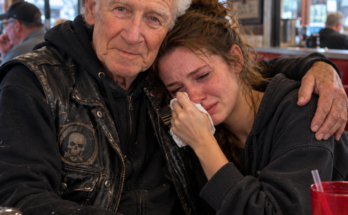
I broke.
Nora had already contacted police.
I arranged for Liam to stay safely with a trusted neighbor until I could get home, booked the first available flight, and spent the entire trip staring at messages Brandon had sent me during those six days.
Liam’s great.
Kids are watching movies.
Everyone already ate.
Don’t worry about us. Take care of your mom’s things.
Meanwhile, his social media showed the truth.
Lucas holding a surfboard.
Alyssa eating ice cream.
Brandon beneath a beach umbrella.
Three smiling people in California.
Not one photograph of Liam.
At the police station, I learned Liam’s original airline reservation had existed.
Five tickets had been purchased.
Mine.
Brandon’s.
Lucas’s.
Alyssa’s.
Liam’s.
Two days after Mom died, Brandon canceled only Liam’s.
The refund went back to his card.
I printed everything.
Then I contacted a family-law attorney.
I did not change the locks and throw Brandon’s belongings onto the lawn.
I did not empty our bank account.
I did not blast him online.
I documented.
By the time Brandon returned the following afternoon, the police had already taken Liam’s statement in an age-appropriate way, child-welfare authorities had been notified, and legal proceedings had begun.
Liam was staying with our neighbor because I did not want him present for Brandon’s return.
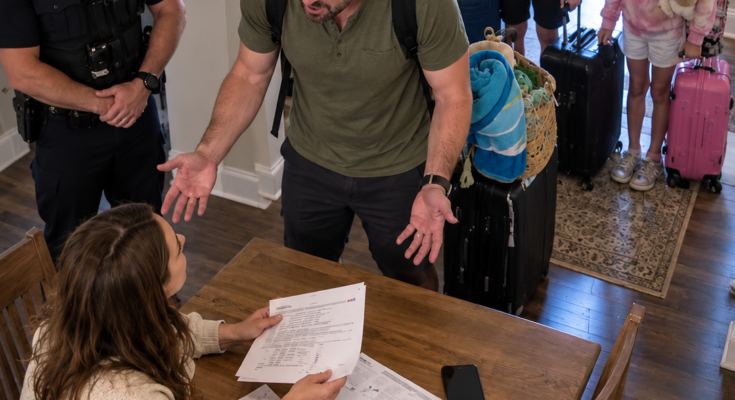
Brandon walked into the house carrying suitcases and souvenir bags.
Lucas and Alyssa followed, laughing.
Then he saw the officer.
“What the hell is going on?”
I placed the paperwork on the table.
“Six days, Brandon.”
His eyes fell on the canceled ticket.
Then the screenshots.
Then the summons.
His expression changed.
“It’s not what you think.”
“Then tell me what I think.”
“He had food.”
“He walked to a supermarket because he was hungry.”
“He knows how to make sandwiches.”
“He’s eight.”
“He’s mature.”
My hands were shaking beneath the table.
“You lied to me every single day.”
“I was trying not to stress you while your mother had just died.”
“You abandoned my son and called the lie kindness.”
Then Alyssa moved toward the refrigerator.
A small folded sheet of notebook paper was still held beneath our faded beach magnet.
She pulled it free.
“Dad?”
Brandon turned sharply.
“What is that?”
“A note from Liam.”
His face changed instantly.
“Alyssa, put that down.”
She unfolded it anyway.
Her eyes moved across the page.
Then stopped.
Lucas stepped closer.
“What does it say?”
Alyssa read aloud.
Mom, Brandon says I can’t go to California because it costs too much since I’m not his real kid. He says Lucas and Alyssa won’t mind because this is their family trip. I don’t want them to think I don’t like them. Please tell them I wanted to go. I’m going to be good until you come home. Love, Liam.
The kitchen went completely silent.
Alyssa looked at Brandon.
Then she asked:
“Why did you tell us Liam didn’t want to be our brother anymore?”
I stared at her.
“What?”
Lucas answered.
“Dad said Liam was jealous of us.”
Brandon snapped:
“That’s enough.”
But his children were no longer listening to him.
Alyssa’s face crumpled.
“You said he didn’t want to come because he wanted you to stop treating him like family.”
Brandon’s entire story collapsed in less than a minute.
He had told me Liam was with him.
He had told Liam the vacation was for his “real kids.”
And he had told Lucas and Alyssa that Liam had chosen to stay behind because he no longer wanted to be part of their sibling relationship.
Three separate lies.
Designed so none of us would compare notes.
Lucas looked at his father.
“You left him here by himself?”
Brandon rubbed his forehead.
“Your mother was supposed to be home sooner.”
“No,” I said. “You knew probate was delayed.”
“He had neighbors.”
“You didn’t arrange for a neighbor.”
“He had a phone.”
“The tablet died on Tuesday because you took its charger.”
Brandon said nothing.
Then Alyssa began crying.
“He thought we didn’t want him?”
I looked at her.
“Yes.”
She turned toward her father.
“I asked you if we could FaceTime him from the beach.”
Brandon’s jaw tightened.
Alyssa continued.
“You said he didn’t want to talk to us.”
And suddenly I understood the worst part wasn’t that Brandon had excluded Liam from a vacation.
He had tried to make three children believe the rejection came from each other.
━━━━━━━━━━━━━━━━━━━━
Part Two — “He Was Never My Responsibility”
Brandon’s explanations changed as quickly as the facts cornered him.
First, the resort room was too expensive for five.
Then Liam had “behavior problems.”
Then he claimed I had made it unclear when I was coming home.
Finally, during a meeting with attorneys present, he said what had been underneath all of it.
“He isn’t my responsibility.”
I stared at him.
“For five years, you called yourself his father.”
“I never adopted him.”
“No one is confusing biology with what you did.”
I leaned forward.
“I left my eight-year-old with my husband because my mother died. You told me you would care for him. Then you canceled his plane ticket, left the state, and lied to me for six days.”
That was the issue.
Whatever legal consequences followed would be decided through evidence and proper proceedings, not my anger.
Our marriage was over.
The harder question was what happened to the children.
Lucas and Alyssa had their own mother and their own legal arrangements. I had loved them for five years, but divorce did not magically make them mine to keep.
I refused to turn them into prizes in another adult fight.
A week later, Alyssa called me.
The first thing she asked was:
“Does Liam hate me?”
“No.”
“I ate ice cream at the beach.”
My throat tightened.
“You were nine. You didn’t know.”
“I would’ve shared.”
“I know.”
“He really wanted to come?”
“Yes.”
She started crying.
“Dad said he hated us.”
“No, sweetheart.”
“He doesn’t?”
“No.”
That was when I realized Brandon’s cruelty had injured all three children differently.
Liam had been abandoned.
Lucas and Alyssa had been manipulated into believing their brother had abandoned them.
━━━━━━━━━━━━━━━━━━━━
Part Three — The Seat That Was Canceled
Liam changed after those six days.
For months, he panicked when plans changed.
If I said I would return from the grocery store at six and arrived at 6:12, he was standing at the window.
If I traveled for work, he needed my flight number.
If someone knocked after dark, his whole body stiffened.
His therapist helped me understand something important.
Liam wasn’t being difficult.
His brain had learned a very specific lesson:
Adults can leave while telling you everything is fine.
So we taught him something different through repetition.
A whiteboard near the refrigerator listed where I was going and when I expected to return.
If plans changed, I called.
If I could not guarantee a time, I didn’t pretend I could.
My sister had a house key.
So did a trusted neighbor.
Liam knew exactly who he could call.
Safety became ordinary and predictable again.
One night, several months later, he asked:
“Mom?”
“Yeah?”
“Did Brandon leave me because I’m not his real son?”
I wanted to soften it.
Sometimes softening the truth only makes children think they’re imagining what happened.
“Yes,” I said. “He treated you differently because he decided biology meant you mattered less to him.”
Liam’s eyes filled.
“Why wasn’t I enough?”
I moved beside him.
“You were enough.”
“Then why did he do it?”
“Because being enough doesn’t control someone else’s choices.”
He looked at me.
“Did I do something?”
“No.”
“Nothing?”
“Nothing.”
That answer required repetition too.
Children are very good at turning adult failures into evidence against themselves.
Eventually, Lucas and Alyssa saw Liam again.
Everything was arranged properly through the adults responsible for them.
The first meeting was awkward.
Alyssa walked inside carrying a shopping bag.
She pulled out a seashell.
“I got this in San Diego.”
Liam looked at it.
She whispered:
“I bought one for you because I thought you’d come next time.”
He took it.
Then hugged her.
Lucas stood nearby pretending not to cry.
Within twenty minutes, all three were fighting over a video game.
I went into the kitchen and cried quietly where they couldn’t see me.
The children maintained their relationship.
Not perfectly.
Not constantly.
But enough.
I never asked Lucas or Alyssa to hate their father to prove they loved Liam.
That would have repeated Brandon’s mistake.
Years later, Brandon finally gave me the explanation I had once desperately wanted.
By then, Liam was a teenager.
Brandon and I were long divorced.
We were sitting in a mediator’s office dealing with an unrelated leftover financial issue when he said:
“I resented paying for him.”
I looked at him.
“Liam?”
“Yes.”
“Why?”
“He wasn’t mine.”
I stared.
“You married a widow with a two-year-old.”
“I know.”
“You let that child grow up believing you were his family.”
“I know.”
“Then you punished him for believing you.”
Brandon looked down.
He admitted the San Diego trip had become expensive.
He didn’t want to cancel.
Didn’t want to tell me while I was grieving.
Didn’t want to disappoint Lucas and Alyssa.
So he identified the person he considered easiest to remove.
Liam.
Then, once he canceled the ticket, he needed everyone to accept a different explanation.
To me:
Liam was still at home with Brandon.
To his children:
Liam didn’t want them anymore.
To Liam:
He wasn’t a “real” enough child to deserve the vacation.
The deception wasn’t brilliant.
It only needed to survive six days.
It almost did.
Years passed.
Liam became funny again.
That may sound like a strange milestone.
But for a while after the abandonment, he watched adults too carefully to relax.
By thirteen, sarcasm returned.
By fifteen, I was apparently embarrassing simply by breathing near his friends.
I loved every ordinary complaint.
At seventeen, his school band traveled to California.
San Diego.
When he showed me the itinerary, my stomach tightened.
Liam noticed.
“Mom.”
“I’m fine.”
“You’re doing the face.”
“What face?”
“The trauma face.”
I laughed despite myself.
Then he held up his boarding pass.
“Look.”
I looked.
His name.
His flight.
His seat assignment.
“Want me to laminate it?”
“No.”
“Frame it?”
“Absolutely not.”
Then he smiled.
“Nobody’s canceling this one.”
I couldn’t laugh at first.
He hugged me.
“Mom, I’m okay.”
I nodded.
“I know.”
And for the first time, I believed it.
After he left for college, I finally cleaned out the folder containing most of the old documents.
Police reports.
Court papers.
Printed texts.
Airline records.
I shredded almost everything.
But I kept two pieces.
The first was Liam’s handwritten refrigerator note.
Especially the line:
I’m going to be good until you come home.
No child should ever believe abandonment is something they can prevent by becoming easier to love.
The second thing was his canceled airline ticket.
For years, I saw it as evidence of Brandon’s cruelty.
Eventually it became evidence of something else.
A warning I should have listened to sooner.
The trip was not the first time Brandon treated Liam as less important.
There had been years of smaller moments.
Fishing trips Liam wasn’t invited on.
Christmas gifts that made the hierarchy obvious.
Family jokes that separated “my kids” from “your son.”
I saw them.
I explained them away.
I told myself blended families take time.
That Brandon simply connected differently with his biological children.
That Liam was sensitive.
That I was being protective.
I take responsibility for ignoring those signs.
Not for Brandon’s decision to abandon him.
That belongs entirely to Brandon.
But once I knew better, I stopped asking my son to endure unequal treatment just because keeping the marriage intact was easier than confronting it.
When Liam graduated high school, Lucas and Alyssa both attended.
They sat beside me.
Brandon sat several rows behind us.
After the ceremony, Liam hugged me, then Lucas, then Alyssa.
Eventually he walked over to Brandon.
They spoke briefly.
Then Brandon held out his hand.
Liam shook it.
On the drive home, I asked:
“What did he say?”
“He apologized.”
“And what did you say?”
“I told him I knew.”
“That’s all?”
Liam looked out the window.
“I don’t need him to suffer forever to know what he did was wrong.”
I had to blink back tears.
My eight-year-old boy once believed that being left behind meant he had failed to be good enough.
Ten years later, he understood something his stepfather never managed to understand while we were married.
Family isn’t biology competing for first place.
It’s responsibility.
It’s telling the truth.
It’s noticing when someone is missing.
It’s making sure a child never has to wonder whether there will be food tomorrow.
And it’s refusing to teach one child that another must be excluded for them to be special.
Brandon canceled Liam’s seat on that airplane.
For six terrible days, he also tried to convince my son that his place in our family had been canceled with it.
It wasn’t.
A boarding pass can be refunded.
A reservation can disappear from a computer.
But a child’s place in the family should never depend on whether the adult looking at him sees matching blood.
Liam had belonged the whole time.
The person who failed to understand that was never him.