Part One — The Three Words on the Envelope
Daniel checked the front doors, then the rear.
Nothing opened.
“He’s seven,” I sobbed. “My stepfather left him in there. Please!”
Daniel braced himself beside the rear passenger window.
“Back up, okay?”
The first blow left a white star in the glass.
The second spread cracks across the window.
On the third, the safety glass collapsed.
Hot air poured from the SUV, thick with the smell of vinyl, sweat, and spilled juice.
Daniel cleared the broken glass with his vest and reached inside.
Noah flinched so violently that Daniel immediately stopped.
“Hey, buddy. I’m not going to hurt you. I’m getting you out.”
Noah grabbed his wrist with both trembling hands.
Daniel lifted him through the window.
I sank onto the pavement beside them.
My little brother was burning hot.
His hair was soaked against his forehead, and there was a red mark across one cheek.
Then the sirens arrived.
Paramedics rushed toward us while officers began photographing the SUV.
At 2:31 p.m., an incident number was recorded.
“Where is your stepfather?” one officer asked me.
“I don’t know.”
Noah was lying beneath the ambulance awning when he suddenly reached into his sock.
His hand emerged holding a small brass key with a blue plastic tag.
“I took it,” he whispered.
The officer crouched.
“What does it open, Noah?”
My brother looked at me.
“The room Michael said nobody could know about.”
A cold sensation went through me despite the ninety-degree heat.
“What room?”
Noah’s lower lip trembled.
“He took me there when I wouldn’t say Dad.”
The officer’s face changed.
“How many times?”
Noah held up two fingers.
Mom arrived from the nursing home still wearing navy scrubs.
When she saw Noah’s cheek, she covered her mouth.
Then she saw the key.
“I’ve never seen that.”
I believed her.
Michael kept a locked metal cabinet in our garage and called it his work cabinet. Mom had trusted him with our bills, household documents, garage code, and nearly every boring adult thing nobody thinks about until trust becomes dangerous.
Inside the SUV’s glove compartment, police found a storage-company agreement bearing Michael’s name.
Unit 214.
Eleven months of payments.
At that point, officers stopped treating the key as something we could casually investigate ourselves. Based on Noah’s spontaneous disclosure, the vehicle evidence, and what they had already documented, investigators obtained authorization before the storage unit was entered.
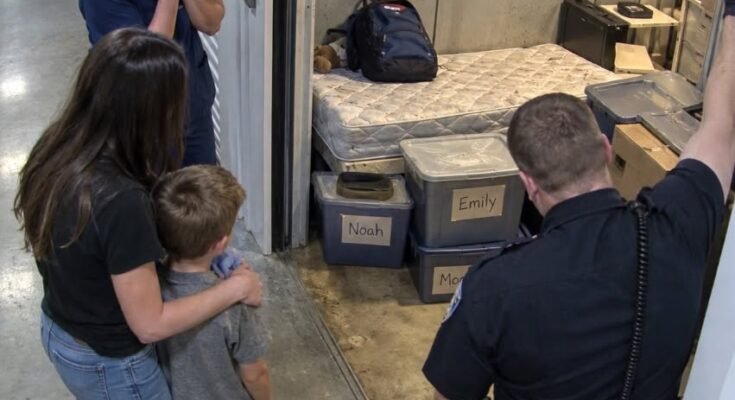
By 4:06, we stood beneath buzzing fluorescent lights in a narrow storage hallway.
Noah held Mom’s hand.
I held his.
The metal door rose.
First came a twin mattress.
Then a small backpack.
Then plastic bins.
Each labeled in black marker.
EMILY.
NOAH.
SARAH.
My name.
My brother’s.
Our mother’s.
Mom whispered:
“Why does he have Noah’s school bag?”
Noah pulled against her.
“Mommy, don’t go inside.”
An officer stopped her immediately.
“You don’t need to.”
Then the door lifted another foot.
A sealed envelope was taped to the rear wall.
Three words were written across it.
IF SARAH LEAVES
Mom stared at her own name.
The officer photographed the envelope before touching it.
Inside was not a confession.
It was worse in a quieter way.
A checklist.
Copies of Mom’s driver’s license and Social Security card.
Photocopies of our birth certificates.
Printed bank statements.
A list of account passwords.
School pickup schedules.
The name of Noah’s pediatrician.
My college address.
Mom’s nursing-home shift schedule.
And handwritten notes.
Cancel joint cards.
Move emergency fund.
Tell school Sarah is unstable.
Noah stays with me until she calms down.
Emily will take her side—limit contact.
Mom sat down hard on the concrete.
“He’s been planning this.”
The officer didn’t answer.
There were also three packed bags.
Mine contained old clothes I thought I had lost.
Mom’s held copies of financial documents and several bottles of medication.
Noah’s had pajamas, a toothbrush, two granola bars, and his stuffed dog, Rocket.
The one we had spent an entire weekend searching for six months earlier.
Noah saw it.
His whole body changed.
“Rocket.”
He tried to run toward the bag.
The officer gently stopped him.
“We’ll make sure you get him back, buddy. We just need to photograph everything first.”
Noah started crying.
“Michael said I lost him because I don’t listen.”
Mom made a sound I had never heard from her before.
Not crying.
Something deeper.
Then Noah pointed toward the mattress.
“That’s where he made me sit.”
Nobody asked another question.
The officer crouched beside him.
“You’ve already told us enough for right now.”
A child specialist would speak with Noah later.
Not us.
Not in that storage unit.
Not while his frightened brain was still trying to understand whether he was in trouble.
Mom knelt carefully.
“You’re not in trouble.”
Noah looked at her.
“I took the key.”
“I know.”
“Michael said stealing makes you bad.”
Mom’s voice cracked.
“Taking that key helped us find you.”
Then Noah whispered:
“He said if you ever tried to leave him, we’d all come here first.”
That was when Mom understood.
The bins were not preparations for an emergency.
They were preparations for control.
━━━━━━━━━━━━━━━━━━━━
Part Two — What Michael Had Been Calling “Protection”
Michael was found that evening at a motel forty miles away.
He had apparently left Noah in the SUV during what he later called a “discipline issue,” then panicked when he realized someone had broken the window and police were involved.
His first explanation was that the storage unit was for disaster preparedness.
Emergency supplies.
Family documents.
Go-bags.
That might have sounded plausible if not for Noah’s statements, the mattress, the hidden belongings, and Michael’s own notes.
Investigators also found months of messages in which he complained that Mom was becoming “too independent.”
One read:
Once Sarah starts thinking she can manage without me, everything falls apart.
Another:
Noah needs to learn who the man of the house is.
The phrase made me sick.
A later trained interview gave professionals a clearer picture of what Noah meant by “learning to listen.”
Michael had taken him to the storage unit twice.
He had not beaten him there.
That distinction mattered.
He had done something different.
He made Noah sit alone on the mattress with the door lowered most of the way while Michael stood outside.
Five minutes the first time.
Longer the second.
He told him he could come out when he was ready to call Michael “Dad” and stop “disrespecting the family.”
Noah had been too frightened to tell us.
Michael had warned him that if he did, Mom would lose the house because “everything belonged to him.”
It didn’t.
But Noah was seven.
To him, adults who controlled keys, cars, and bank cards controlled reality.
Mom’s attorney later discovered that Michael had gradually moved much of the household management into accounts and systems only he monitored.
He had not legally stolen the house.
He had not secretly become owner of everything.
But he had made Mom feel incapable of functioning without him.
That had been the point.
She sat at our kitchen table two nights after Noah came home from the hospital and said:
“I thought he was helping me.”
I sat across from her.
“He paid bills.”
“He organized the insurance.”
“He handled school forms.”
Her eyes filled.
“And every year I knew less about my own life.”
That sentence stayed with me.
Control does not always begin with someone taking something away.
Sometimes it begins with someone saying:
Don’t worry. I’ll handle it.
Again.
And again.
Until you no longer know the password to your own electricity account.
━━━━━━━━━━━━━━━━━━━━
Part Three — The Blue Key
The legal process lasted far longer than any of us wanted.
There were protective orders.
Interviews.
Medical records from the hot-car incident.
The storage-unit evidence.
Financial reviews.
Separate proceedings involving the conduct investigators could actually prove.
Michael was not transformed into a movie villain by one hidden room.
The case still required evidence.
His attorney challenged parts of Noah’s account.
Experts distinguished between spontaneous statements and things adults might accidentally reinforce.
Mom followed every instruction she was given, even when waiting felt unbearable.
Michael eventually faced consequences for child endangerment and other conduct supported by the investigation.
The marriage ended.
But the harder work happened after the court dates.
Noah stopped sleeping alone.
For nearly four months, he dragged a blanket into Mom’s bedroom every night.
At first she tried to carry him back.
His therapist suggested we stop making bedtime into another battle over control.
So Mom put a small mattress beside her bed.
“You can sleep here as long as you need.”
One night became a week.
A week became a month.
Eventually Noah stopped coming.
Nobody celebrated when he slept in his own room again.
We simply let normal return quietly.
For a while, he hated closed doors.
At school he asked teachers to leave classroom doors cracked open.
Elevators frightened him.
Storage facilities terrified him.
The smell of hot car upholstery made him nauseous.
Healing was not a single brave moment.
It was a hundred boring repetitions of:
You’re safe.
The door isn’t locked.
You can leave whenever you want.
You don’t have to earn your way out.
Mom changed too.
She opened her own bank account.
Learned every password.
Put copies of important documents in a safe deposit box and another set with her sister.
I helped her build a folder labeled:
THINGS SARAH KNOWS HOW TO HANDLE
At first it was a joke.
Utility accounts.
Insurance.
Car title.
School contacts.
Mortgage information.
By the end of the year, the folder was thick.
One afternoon Mom held it up and laughed.
“I feel like I’m studying for an exam.”
“You’re passing.”
She smiled.
“I should’ve known all this already.”
“No.”
I shook my head.
“You know it now.”
There was enough guilt in our house without manufacturing more.
I had my own.
I was seventeen when Michael married Mom.
I had seen things.
How he corrected Noah for calling him Michael instead of Dad.
How he answered questions directed at Mom.
How he complained whenever Mom spent money without “running it by him.”
Once I heard him tell Noah:
“Your mother is too soft. That’s why you need me.”
I had rolled my eyes and gone upstairs.
For months after the storage unit, I punished myself for that.
A therapist eventually asked:
“How old were you?”
“Seventeen.”
“And whose responsibility was Michael’s behavior?”
“His.”
I hated how obvious the answer sounded.
But sometimes obvious truths still need saying.
The blue key remained in police evidence for almost a year.
When it was finally released with belongings that no longer needed to be held, Mom asked Noah what he wanted to do with it.
“Throw it away,” I said immediately.
Noah shook his head.
“I want it.”
Mom looked uncertain.
“Why?”
He held the little brass key between two fingers.
“Because I found it.”
That answer made sense to him even if it didn’t yet make sense to us.
So Mom let him keep it.
He put it in the top drawer of his desk.
Years passed.
Noah grew.
The frightened seven-year-old who had once begged not to enter a storage unit became a teenager who left cereal bowls everywhere and complained that Mom texted too often.
Normal teenage ingratitude became one of the most beautiful things I had ever witnessed.
At fourteen, he found the key while cleaning his room.
He brought it downstairs.
“You guys remember this?”
Mom and I looked at each other.
“Yes.”
He rolled it across his palm.
“I barely remember the room.”
Mom’s face softened.
“That’s okay.”
“I remember the car more.”
That hurt.
But then he added:
“And Daniel breaking the window.”
Daniel had been an off-duty EMT who happened to be leaving the grocery store when I screamed for help.
For years, Noah remembered his face better than the storage unit.
The man who did not yank him through the broken window when he flinched.
The man who stopped and said:
I’m not going to hurt you.
Noah turned the key over.
“Can I throw it away now?”
Mom smiled.
“It’s yours.”
He walked toward the trash.
Then stopped.
“No.”
He came back and placed it on the kitchen counter.
“I want to make something.”
A month later, he returned from school woodshop carrying a small framed board.
The brass key was mounted in the center beneath a clear cover.
Below it, he had engraved one sentence:
A KEY SHOULD OPEN SOMETHING.
Mom cried when she read it.
So did I.
We hung it near the front door.
Visitors occasionally ask about it.
We don’t always tell the whole story.
Noah gets to decide which parts belong to other people.
That became another lesson Michael had accidentally taught us.
Privacy is not secrecy.
Boundaries are not disobedience.
Children do not owe adults access to every thought simply because adults are older.
And love does not require surrendering your keys.
The day police opened Unit 214, I thought the most frightening thing we would find was some monstrous secret hidden in the back.
There wasn’t one dramatic object.
There was no dungeon.
No mysterious second family.
No suitcase full of stolen cash.
What frightened me was how ordinary everything looked.
A mattress.
Plastic bins.
Copies of paperwork.
A child’s backpack.
A man had taken everyday objects and arranged them into a system designed to convince the people around him that leaving was impossible.
That was the secret.
Michael had not been preparing for us to disappear.
He had been preparing to make sure we couldn’t.
He failed.
Not because Mom suddenly became fearless.
Not because I exposed him with some brilliant plan.
And not because Noah should ever have needed to be brave enough to steal a key.
He failed because one frightened child kept one small piece of evidence.
Because a stranger broke a car window.
Because professionals listened carefully instead of turning Noah into a witness for our anger.
Because Mom believed him.
And because once the door finally opened, none of us agreed to step back inside.