Part One — The Bluebird Tattoo
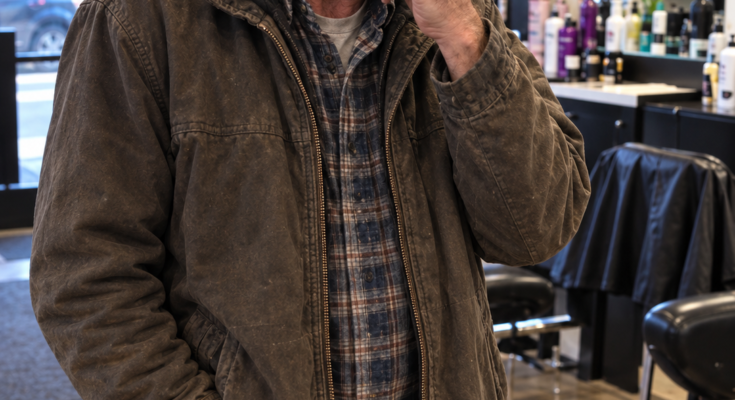
My shift was almost over when an older man stepped into the salon. His clothes were worn and dirty, his beard had grown unevenly over his cheeks, and one sole of his shoe was beginning to separate. But there was something gentle in his eyes that reminded me of my grandfather.
“I have a job interview tomorrow,” he told the receptionist. “I can pay one dollar today. Maybe the rest next week?”
She looked down at his shoes.
“A haircut costs fifty dollars. You need to leave.”
Behind me, another stylist quietly rolled her chair farther away from him.
The man nodded as though he had expected the answer. “I could sweep the floor. Please. Nobody has called me for an interview in months.”
Our manager came out from the back room.
“You’re holding up paying customers.”
The man folded his dollar bill into a tiny square and turned toward the door.
Then his sleeve slipped back.
A faded bluebird tattoo was visible on his wrist.
My heart dropped.
I had seen that tattoo before.
My late mother had the exact same one.
Whenever I asked her about it, she would cover it with her sleeve and smile.
“Old mistake,” she always said.
“Wait,” I called. “My chair is open.”
My manager grabbed my arm.
“Then the haircut comes out of your paycheck.”
“Fine.”
She stared at me.
“You’re serious?”
“Yes.”
The man turned back slowly.
“You don’t have to do that.”
“I know.”
That seemed to matter to him.
He lowered himself into my chair as though he was afraid somebody might suddenly decide he didn’t belong there after all.
“My name’s Maya,” I said.
He looked at me through the mirror.
“I know.”
My scissors stopped.
“What?”
His expression changed immediately.
“I mean—I heard someone call you that.”
I glanced toward the receptionist.
Maybe she had.
I couldn’t remember.
I fastened the cape around his neck.
“What’s your name?”
“Thomas.”
I began cutting.
His hair was thick but badly tangled at the back. I worked slowly, trimming around his ears, shaping the sides, taking years off his face one small section at a time.
Thomas barely spoke.
But he kept watching me through the mirror.
Not in a way that made me uncomfortable.
It was stranger than that.
He looked at me as if he were remembering something.
Finally I said, “Do I know you?”
His eyes dropped.
“No.”
“You keep looking at me.”
“Sorry.”
I wanted to ask about the tattoo.
I didn’t.
My mother, Elaine, had died four years earlier from a sudden aneurysm. She was sixty-one. One afternoon she was complaining about weeds in my flower bed, and by the following morning I was sitting beside a hospital bed learning there are some goodbyes you never get enough warning to prepare for.
After she died, I learned that grief turns ordinary things into questions.
Why had she kept that old recipe card?
Who was the man named Robert in three photographs from college?
Why had she hated driving near Indianapolis?
And why had she kept a faded bluebird tattoo on the inside of her wrist but refused to explain it?
I never found out.
Until Thomas.
As I trimmed the final strands near his collar, his eyes began filling with tears.
At first I thought he was emotional because someone had finally treated him kindly.
I was wrong.
“Your mother asked me never to contact you.”
My hand froze.
“What?”
He closed his eyes.
“I promised her.”
I stepped backward.
The salon suddenly felt too bright.
Too quiet.
“What are you talking about?”
Thomas slowly removed the cape.
“Do we know each other?” I asked.
He looked up at me.
“I’ve known who you were since you were born.”
My mouth went dry.
He reached inside his coat.
“I’ve been trying to find you for years. I almost gave up.”
Then he pulled something from his pocket and held it toward me.
It was an old photograph.
The edges were bent.
The colors had faded.
A young woman stood beside a pickup truck, laughing at something outside the frame.
My mother.
Maybe twenty-three.
Beside her stood a young man with his sleeve rolled up.
Thomas.
They were both holding their wrists toward the camera.
Matching bluebirds.
On the back, in my mother’s handwriting, were four words:
Before everything went wrong.
I looked at Thomas.
“Who are you?”
His face crumpled.
Then he said the sentence that rearranged my childhood.
“I’m your father.”
I laughed.
Not because anything was funny.
Because the alternative was screaming.
“My father died before I was born.”
Thomas closed his eyes.
“That’s what Elaine told you.”
I stared at him.
“No.”
“Maya—”
“No.”
I backed away from the chair.
“My mother wouldn’t lie about that.”
“She wasn’t trying to hurt you.”
“Don’t talk about her like you knew her.”
His face tightened.
“I knew her for nine years.”
I looked at the photograph again.
My mother.
Thomas.
Young.
Happy.
Real.
Then I noticed something else inside his hand.
An envelope.
Yellowed with age.
My name was written across the front.
Not in Thomas’s handwriting.
In my mother’s.
MAYA — IF THOMAS EVER BECOMES THE MAN HE PROMISED HE COULD BE.
I couldn’t breathe.
Thomas placed it on my workstation.
“I didn’t come here asking you for anything.”
His voice cracked.
“I just need you to read that before I run out of time.”
━━━━━━━━━━━━━━━━━━━━
Part Two — What My Mother Had Protected Me From
I did not open the envelope in the salon.
I couldn’t.
My manager was staring from the desk. My coworkers had stopped pretending not to listen. Thomas looked exhausted enough to collapse.
So I asked one question.
“What do you mean, run out of time?”
“Cancer.”
The word landed differently than everything else.
“Lung?”
“Pancreatic.”
“How long?”
He shrugged.
“Doctors stopped giving me numbers after I stopped asking.”
I sat down.
Suddenly the job interview made even less sense.
“Why are you looking for work if you’re dying?”
Thomas smiled faintly.
“Because dying isn’t free.”
Then he added, “And because I want one thing in my life to end with me showing up instead of running away.”
That sentence mattered later.
At the time, I was too angry to appreciate it.
I took Thomas to a diner after work.
Not home.
I wasn’t ready for that.
He ordered coffee and eggs.
Then apologized because the eggs cost eleven dollars.
I paid.
Not because he was my father.
Because I had just watched him offer to sweep a salon floor for a haircut.
I opened my mother’s envelope.
The first line said:
Maya, if you’re reading this, then Thomas is sober, alive, and finally brave enough to tell you the truth—or someone else decided for him.
I looked at him.
“How long have you been sober?”
“Seventeen years.”
My eyes returned to the letter.
Mom wrote that she met Thomas when they were nineteen.
They married at twenty-two.
I had never known she had been married before the man I called Dad.
Thomas started drinking heavily after an accident at the factory where he worked.
Then pills.
Then disappearing for days.
Money vanished.
Promises became excuses.
One night, while Mom was seven months pregnant with me, Thomas drove drunk with her in the passenger seat.
He crashed into a ditch.
Neither was badly injured.
But that was the end.
Mom left.
She wrote:
He never hit me. I need you to know that. I also need you to know that I was afraid of the life his addiction was building around us. Fear does not require bruises to be real.
I had to stop.
Thomas stared at his untouched coffee.
“I almost killed you both.”
I looked at him.
“You don’t get to make this easier by hating yourself.”
He looked surprised.
“So don’t.”
I kept reading.
Mom had told Thomas he could contact me only after sustained sobriety and only through her first.
He failed repeatedly.
Then when I was five, he finally entered long-term treatment.
By then, Mom had remarried.
My stepfather, David—the man I had always called Dad—was raising me.
Thomas wrote to her.
She refused contact.
Not forever, she claimed.
Just “not yet.”
Then years passed.
Mom admitted that fear eventually became control.
I kept telling myself I was protecting you. At first, I was. Later, I think I was protecting the life I had built from being complicated by the life I had escaped. Those are not the same thing.
My hands began trembling.
She wrote that David knew the truth.
That shocked me too.
He had died when I was twenty-six.
My mother had continued telling me my biological father was dead.
Thomas showed me copies of letters.
Not to prove Mom was cruel.
To prove he had not invented the story.
Some were angry.
Some ashamed.
Most ended with the same sentence:
If Maya ever asks about me, tell her I never stopped wanting to know her.
I looked across the table.
“Why didn’t you just find me when I became an adult?”
Thomas stared toward the window.
“Cowardice.”
That answer surprised me.
“I could give you a longer explanation. Shame. Respecting your mother’s wishes. Not wanting to disrupt your life. All of that’s partly true.”
He looked at me.
“But seventeen sober years contains plenty of days when I could’ve done better.”
He tapped the envelope.
“Your mother isn’t the only person who waited too long.”
I appreciated that he did not make himself a victim of her decision.
Then I reached the last page.
Mom had written it less than six months before her death.
Thomas, if something happens to me before I fix this, I am giving you permission I should have given years ago. Find Maya. Give her this letter. But do not demand that she call you Dad. Do not ask her to forgive you because you’re sorry. Do not tell her I kept you away as though you had no part in why I was afraid.
My throat closed.
Tell her the truth. Then let her decide what to do with it.
Underneath, Mom had written directly to me:
Maya, David was your father in every way that mattered while he lived. Thomas is also part of where you came from. One truth does not have to erase the other.
I folded the letter.
For several minutes, I couldn’t speak.
Then I asked Thomas why it had taken four years after Mom’s death to reach me.
His answer embarrassed him.
He had relapsed.
Once.
After seventeen years, his cancer diagnosis and my mother’s death arrived within months of each other.
He drank for three weeks.
Then returned to treatment.
“I decided if I ever came to you, I wasn’t coming while using.”
“So instead you became homeless?”
He smiled sadly.
“That part wasn’t the plan.”
Medical bills, job loss, and pride did the rest.
He had been staying at a shelter for three months.
A caseworker found him an interview for a part-time maintenance job at a senior-living complex that included a small employee room.
“That’s tomorrow?”
“Yes.”
I looked at his fresh haircut.
“Then you’d better not be late.”
His eyes filled.
“You’re not asking me to leave?”
“I haven’t decided anything about you.”
I folded my mother’s letter carefully.
“But she told me to decide for myself.”
Thomas nodded.
“That’s all I came for.”
━━━━━━━━━━━━━━━━━━━━
Part Three — The Things a Haircut Could Not Fix
Thomas got the job.
Barely.
His health was poor, and he told the employer about it honestly.
They hired him three mornings a week doing light maintenance.
Loose cabinet hinges.
Leaking faucets.
Replacing smoke-detector batteries.
Apparently a dying recovering alcoholic with forty years of mechanical experience can still be extremely useful when Mrs. Patterson in Apartment 12 can’t get her closet door to close.
I did not invite Thomas to live with me.
Some people found that surprising later.
They heard the story and assumed reunion should mean immediate rescue.
It didn’t.
I had met my biological father at thirty-four years old.
He was still a stranger.
A stranger with my eyes.
A stranger who knew what my mother looked like at nineteen.
A stranger who had failed us badly and then spent years trying, imperfectly, to become someone else.
I needed time.
So did he.
We met for breakfast once a week.
Public places at first.
He told me about Mom.
Not the polished mother I knew.
Elaine at twenty.
Elaine who smoked exactly three cigarettes in college and hated all three but refused to admit it.
Elaine who once stole a traffic cone and kept it in their apartment for six months.
Elaine who chose the bluebird tattoo because she said bluebirds meant “you can survive winter and still sing afterward.”
I had never heard that.
One afternoon I asked:
“Why did you get the same tattoo?”
Thomas smiled.
“Because I was in love with her and twenty years old.”
“That’s embarrassing.”
“It was worse in person.”
For the first time, I laughed with my father.
Then hated myself for laughing.
That happened often.
Grief and loyalty are strange.
David had raised me.
He taught me to ride a bicycle.
Sat through every dance recital.
Paid for braces.
Walked me down the aisle.
Calling Thomas my father felt disloyal to a dead man who had earned that word.
So I didn’t.
Not for a long time.
Thomas never asked.
He was simply Thomas.
That made everything easier.
Three months after we met, his cancer worsened.
Treatment options narrowed.
The maintenance job became too much.
The senior complex let him keep the little room temporarily while hospice and social services helped arrange what came next.
I visited more often.
Not out of obligation.
That distinction mattered to me.
One afternoon I found him sitting outside with another resident, repairing an old radio.
“You’re supposed to be resting.”
Thomas looked at me.
“Have you met me?”
“Unfortunately.”
The old man beside him laughed.
That was when I realized Thomas had built a small community there.
Not redemption.
Community.
I stopped thinking of his life as a courtroom where I had to decide whether seventeen sober years outweighed what happened before I was born.
People are not equations.
He had done harm.
He had also changed.
Both were true.
The question wasn’t whether he deserved the title of good man.
The question was whether I wanted whatever time remained.
I did.
Eventually I brought him to my house.
The first time, he stood in my hallway looking at family photographs.
David was everywhere.
My mother.
Me.
My husband.
My children.
Thomas stopped in front of a picture of David holding me at my college graduation.
“He looks kind.”
“He was.”
“He knew about me?”
“Yes.”
Thomas nodded.
“I’m glad she had him.”
That answer broke the last small piece of defensiveness I had been carrying.
He did not resent the man who raised his daughter.
He was grateful to him.
I touched the photograph.
“He was my dad.”
“I know.”
Then Thomas added, “He did the job I wasn’t fit to do.”
No self-pity.
Just truth.
That night, my husband asked how I felt.
I thought for a long time.
“Like I found a missing chapter after I’d already finished the book.”
“Does it change the ending?”
“No.”
“Then maybe it’s just another chapter.”
That was exactly right.
Thomas lived nine months after walking into my salon.
Longer than expected.
Not long enough.
Near the end, I visited almost every day.
My children met him.
I introduced him as Thomas at first.
My youngest eventually asked why Thomas had the same eyes I did.
Children are inconveniently observant.
So I told them the age-appropriate truth.
“He’s my biological father.”
My daughter frowned.
“But Grandpa David was your dad.”
“Yes.”
“Can you have two?”
I looked at Thomas.
His eyes filled.
“Yes.”
She accepted that much faster than I did.
About two weeks before Thomas died, I cut his hair again.
This time in his hospice room.
He had almost none left.
I teased him that the haircut should therefore cost more because it required precision.
He reached toward the nightstand.
There was a dollar bill folded into a tiny square.
The same way he had folded the dollar that first day.
I stared at it.
“You kept that?”
“I told you I could pay.”
I laughed.
Then cried.
“Your tab is slightly larger now.”
“Put me on a payment plan.”
His voice had become weak.
I finished trimming around his ears.
Then he said, “Maya?”
“Yes?”
“I’m sorry your mother had to become afraid of me before I became someone she didn’t need to fear.”
I put down the scissors.
That was the best apology he ever gave me.
Not I’m sorry she kept you from me.
Not I’m sorry I missed your childhood.
Something more honest.
He understood cause and consequence.
“I forgive you,” I said.
Thomas closed his eyes.
“You don’t have to.”
“I know.”
He opened them again.
That was why I could say it.
Thomas died six days later.
I was there.
I held his hand.
The bluebird tattoo was almost colorless by then.
Before the funeral home came, I traced it once with my thumb.
For years, that tattoo had represented a secret my mother refused to explain.
Now I knew everything it contained.
Young love.
Addiction.
Fear.
Distance.
Sobriety.
Cowardice.
Second chances.
Too much time.
Not enough.
After Thomas died, his caseworker gave me a small envelope.
Inside was that folded dollar.
And a note.
Maya—
You gave me a haircut when I looked like someone the world had decided wasn’t worth touching.
You didn’t know I was your father yet.
I’m glad.
It means the first kindness you gave me wasn’t because you owed me anything.
I had to stop reading.
Then:
Don’t let anybody turn this into a story where you saved me. You didn’t. I had people helping me long before I found your salon.
You simply gave me one more reason to keep showing up.
That’s plenty.
—Thomas
I keep that dollar in my wallet.
Not as a lucky charm.
Not because it belonged to my father.
Because it reminds me of the moment before I knew anything about him.
An old homeless man walked into a salon asking for dignity on credit.
Most people saw dirty clothes.
Bad shoes.
A customer who couldn’t pay.
I saw something in his eyes that made me stop.
The bluebird tattoo changed my life.
But the tattoo wasn’t why I let him sit in my chair.
That happened first.
Sometimes people tell me the whole thing was fate.
I don’t know.
Maybe.
Maybe not.
What I know is simpler.
My mother spent years protecting me from a man who, at the time, genuinely was unsafe.
Later she waited too long to let the situation change.
Thomas spent years becoming better, then waited too long because he was ashamed.
And I almost lost my chance to know him because two people who loved me both convinced themselves silence was safer than truth.
It wasn’t.
Truth hurt.
But it gave us nine months.
Nine imperfect, complicated, irreplaceable months.
I never called Thomas Dad while he was alive.
I thought about that after he died.
For a while, I regretted it.
Then I stopped.
He never needed the word.
He wanted the relationship.
There is a difference.
David was my dad.
Thomas was my father.
And eventually, in my own way, I loved them both.
A few months after Thomas died, a man came into my salon near closing time.
He looked exhausted.
His hair was overgrown.
He asked what a basic haircut cost.
When I told him, he quietly said he couldn’t afford it and turned to leave.
I looked at the empty chair.
Then at the folded dollar inside my wallet.
“Wait,” I said.
“My chair’s open.”
He looked embarrassed.
“I can’t pay.”
“I know.”
He sat down.
I fastened the cape around his neck.
And before I made the first cut, I remembered something my mother had once told me when I was little, long before I knew what the bluebird meant.
She said bluebirds survive hard winters by finding shelter wherever they can.
Then, when the weather changes, they sing again.
Thomas didn’t get enough spring.
But he got some.
And because I stopped him at the door that afternoon, so did I.