Part One — The Promise Frank Never Explained
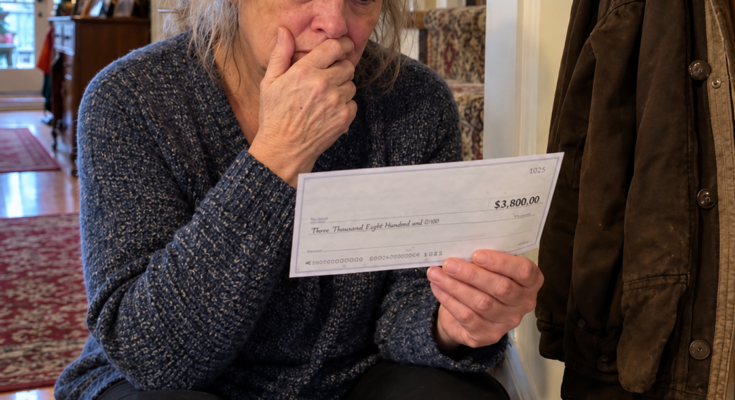
Jeanette Miller stood in the hallway holding her late husband’s winter coat when the envelope slipped from the inside pocket and landed at her feet. She recognized it immediately: cream-colored envelope, blue ink, and inside, an unsigned check for exactly $3,800.
Jeanette sat down on the bottom stair. For thirty-two Christmases, her husband, Frank, had disappeared for half a day with an envelope just like that one. Every year, she asked where he was going, and every year Frank gave the same answer. “It’s something I promised a long time ago.”
That was all.
Frank had never been a secretive man. For forty-three years of marriage, Jeanette knew where he kept his spare keys, how he liked his eggs, which knee hurt before rain, and why he always left the porch light on until everyone in the family was safely home. But every December there was that envelope, and $3,800 was not a small amount of money to them.
Frank had worked most of his life as a maintenance mechanic at a manufacturing plant. Jeanette worked part-time at a library after their children were grown. They paid their bills, kept an emergency fund, and took modest vacations, but they were never wealthy.
Once, during a winter when their furnace failed, Jeanette finally pressed him. “Frank, we could use that money here.”
He stood at the kitchen counter staring into his coffee. Then he reached across the table, squeezed her hand, and said softly, “I know. But some debts don’t belong on paper.”
She never asked seriously again.
Then, in October, Frank died suddenly at seventy.
One ordinary Tuesday morning, Jeanette woke beside him and realized the man who had slept next to her for more than four decades would never open his eyes again. The months after became a blur of casseroles, sympathy cards, paperwork, empty rooms, and people telling her to call if she needed anything.
By December, the house felt too quiet to decorate. Frank’s boots were still by the garage door. His reading glasses remained beside his chair. His brown winter coat still hung on the hall hook.
That was the coat Jeanette finally decided to donate.
Until the envelope fell out.
For the first time, she studied the address carefully. It belonged to a small town three counties away. No company name. No explanation. Just Walter Hayes and a street address.
Her imagination immediately betrayed her.
A gambling debt?
Someone Frank had wronged?
An old family obligation?
Another woman’s family?
She hated herself for that last thought. Frank had been imperfect, stubborn, and occasionally impossible, but he had been a good husband.
Still, grief has a way of putting shadows where there may be nothing at all.
Two days later, Jeanette put the unsigned check into her purse and drove.
The town was smaller than she expected. One grocery store, one gas station, a faded water tower, Christmas wreaths tied to old streetlamps. Walter’s address belonged to a little white house near the edge of town with peeling porch paint and a plastic Santa leaning sideways in the yard.
Jeanette sat in the car for almost five minutes before knocking.
An elderly man with silver hair and a cane opened the door.
“Are you Walter Hayes?”
He nodded.
“My name is Jeanette Miller.”
Nothing.
Then she added, “Frank Miller was my husband.”
Walter’s face changed.
He covered his mouth and leaned against the doorframe.
“Oh, God,” he whispered. “Frank.”
Then this eighty-something-year-old man began to cry.
He invited her inside and returned from a back room carrying a framed black-and-white photograph. Four impossibly young men stood shoulder to shoulder in military uniforms.
Jeanette recognized Frank instantly.
Same crooked grin.
Same raised eyebrow.
Walter pointed to himself, then the other two.
“Eddie Collins. Raymond Pike.”
He lowered himself beside Jeanette.
“We were together in Vietnam.”
Jeanette knew Frank had served. He occasionally told funny stories about terrible coffee, bad weather, and missing home. He almost never talked about anything else.
“There were four of us,” Walter said. “Frank, Eddie, Raymond, and me. Only one of us came home whole.”
Jeanette looked at him.
“Frank came home alive. I came home alive. But parts of us stayed there.”
Then Walter told her what Frank had carried silently for more than fifty years.
One night, their unit came under attack. Eddie and Raymond did not survive. Walter was badly injured, and Frank dragged him far enough to reach help.
Jeanette lowered her eyes.
“That sounds like Frank.”
Walter smiled sadly.
“No. What happened afterward sounds like Frank.”
Eddie had left behind a young wife and baby daughter. Raymond had left a widowed mother and a younger brother still in school. Frank returned home with their names lodged permanently inside him.
At first, he wrote letters.
Then he sent money.
When Eddie’s daughter needed braces, Frank helped. When Raymond’s mother fell behind on property taxes, Frank helped. When Walter struggled to hold a steady job after coming home, Frank quietly covered groceries and heating bills.
“But the $3,800?” Jeanette asked.
Walter nodded.
“That started later.”
Eventually, the families stabilized. Walter did too. Frank could have stopped.
Instead, he made a promise.
Every Christmas, Frank sent Walter $3,800. Walter kept track of the surviving families and used the money where it was needed most. One year it covered tuition. Another year a furnace. Sometimes medical bills. Sometimes groceries. Some years most of it sat untouched until somebody fell into trouble.
Jeanette stared at her hands.
“But where did Frank get that kind of money?”
Walter hesitated.
“You really don’t know?”
“We didn’t have another account.”
“It wasn’t coming from your household money.”
Then Walter explained.
For thirty-two years, Frank worked extra whenever he could. Overtime nobody wanted. Saturday repair jobs. Lawn equipment. Old tractors. Furnaces. Generators. Water pumps. If somebody needed a mechanic after his regular shift, Frank went.
He set aside part of what he earned from those extra jobs.
Not because he wanted to hide money from Jeanette.
Because he refused to let his promise reduce what his wife and children had at home.
Walter’s eyes filled.
“He told me once, ‘That money belongs to Jeanette and the kids. This promise belongs to me.’”
Suddenly memories began rearranging themselves.
Frank coming home after dark with grease on his hands.
Frank saying he had picked up “a little side job.”
Frank refusing to buy a newer truck.
Frank wearing boots until the soles nearly separated.
Frank fixing their washing machine three separate times because, according to him, “It still knows how to wash.”
Jeanette had thought he was simply stubborn.
Now she knew where some of those tired Saturdays had gone.
Walter walked to a desk and returned with several old notes.
The handwriting was Frank’s.
One read:
Walter—use this wherever it’s needed most. Don’t put my name on anything. We all came home owing somebody something.
Jeanette pressed the note against her chest.
Then Walter told her one final thing.
The $3,800 had never been random. Shortly after returning from service, Frank had earned roughly that amount through overtime and a small bonus. Nearly all of it ended up helping one of the families through a crisis.
Afterward, he decided that if he could somehow earn that amount again every year, he would.
So he did.
Thirty-two times.
More than $120,000, accumulated one repair job, one overtime shift, and one tired Saturday at a time.
Before Jeanette left, she pulled the unsigned check from her purse.
Walter shook his head.
“You don’t have to do that.”
Jeanette looked at it.
Then tore it in half.
Walter stared.
“I’m not signing my dead husband’s name.”
“I didn’t expect you to.”
“No.”
Jeanette placed the two pieces on the table.
“But I want to know who still needs help.”
Walter looked at her carefully.
“Jeanette, Frank never expected you to continue this.”
“I know.”
That was exactly why she wanted to hear the answer.
━━━━━━━━━━━━━━━━━━━━
Part Two — What the $3,800 Had Really Bought
Walter opened an old ledger.
Frank had never kept names beside dollar amounts. Instead, there were initials, dates, and brief explanations.
E.C. — furnace.
R.P. — tuition.
W.H. — roof.
E.C. — dental.
The entries stretched across decades.
Jeanette recognized years when money had been tight in her own home. The year their daughter started college. The year Jeanette needed surgery. The year the furnace died.
“You should have told me,” she whispered.
Walter nodded.
“Maybe he should have.”
That answer surprised her.
“He thought he was protecting everybody,” Walter continued. “You from carrying something that happened before you met him. Them from feeling indebted. Himself from having to talk about why he couldn’t stop.”
Walter closed the ledger.
“Frank was a good man, Jeanette. That doesn’t mean every choice he made was the right one.”
She appreciated that more than praise.
She had loved a man, not a saint.
Before leaving, Jeanette asked for copies of the remaining records.
Not because she intended to reproduce Frank’s promise exactly.
She needed to understand what it had meant to him.
Walter handed her one last note.
Frank had written it less than a year before he died.
If I go first, this ends with me. Jeanette has already shared enough of her life with things I brought home from that war. Don’t let her think she owes anybody my promise.
Jeanette cried harder reading that than she had at anything else Walter showed her.
Frank had known her well enough to predict precisely what she would try to do.
━━━━━━━━━━━━━━━━━━━━
Part Three — The Christmas After Frank’s Last Check
Jeanette drove home carrying photocopies of the ledger, Frank’s note, and the black-and-white photograph Walter insisted she keep.
The house was dark when she arrived.
For forty-three years, Frank had left the porch light on whenever somebody he loved was expected home.
Jeanette sat in her car looking at the dark porch.
Then she got out, walked inside, and turned the light on herself.
That first Christmas without him was terrible.
There is no more elegant word for it.
Their daughter, Melissa, came from Ohio with her husband and children. Their son, David, flew in from Arizona. Jeanette had not planned to tell them about Walter yet.
Then David noticed the photograph.
“Dad?”
Jeanette nodded.
She told them everything.
The annual check.
Walter.
Eddie.
Raymond.
The extra jobs.
When she finished, Melissa looked angry.
Not touched.
Angry.
“He worked all those weekends for this?”
Jeanette understood.
“I thought the same thing.”
“He missed my tenth birthday party because of an emergency repair.”
“He came home before cake.”
“That’s not the point.”
“No.”
Melissa’s eyes filled.
“Why could Dad do all these things for strangers and never tell us he loved us?”
That question silenced the room.
Frank had not been completely unaffectionate.
But feelings embarrassed him.
He fixed.
Provided.
Showed up.
He was the father who changed your brake pads before a road trip but might respond to an emotional conversation with, “You want coffee?”
David looked toward the photograph.
“He told me once.”
Melissa stared.
“When?”
“After my divorce.”
“What did he say?”
David smiled.
“‘You’re still my boy.’”
That sounded exactly like Frank.
Jeanette realized something then.
The discovery of Frank’s secret did not require the children to reinterpret every hurt they had ever felt.
He could have been extraordinarily generous to veterans’ families and still have failed to say things his own children needed to hear.
Both belonged to him.
A full person is inconvenient that way.
On Christmas morning, Jeanette placed Walter’s ledger on the dining-room table.
“I don’t want to continue your father’s exact tradition.”
Melissa looked surprised.
“I thought you would.”
“So did Frank.”
Jeanette showed them his final note.
Then she said, “But I don’t want this to simply disappear either.”
Together, they decided on something different.
They created a modest annual fund in Frank’s memory, but not solely for the families he had been helping. Some of those descendants no longer needed financial assistance, and Jeanette refused to turn people into permanent recipients simply because their grandparents had once suffered.
Instead, with Walter’s blessing, the fund would provide small emergency grants for veterans and their families in the region.
Heating bills.
Car repairs.
Temporary groceries.
A hotel room after a house fire.
The kinds of ordinary problems that can become disasters when somebody has nowhere else to turn.
They called it the Porch Light Fund.
Jeanette chose the name.
Frank would have hated having his name attached anyway.
The first year, Jeanette contributed $3,800.
Only once.
Not because she believed she inherited Frank’s debt.
Because she wanted to complete the check he died before delivering.
The following year, the amount was whatever the family could comfortably afford.
Sometimes more.
Sometimes less.
That mattered.
A promise built from love should not become another generation’s obligation.
Walter remained involved for several years.
He attended Christmas at Jeanette’s house once.
When he arrived, Melissa opened the door.
Walter looked at her for a long time.
“You have Frank’s eyes.”
Melissa immediately cried.
Walter looked alarmed.
“I’ve been here seven seconds.”
“That was enough.”
Over dinner, Walter told them stories Frank had never told.
Not battle stories.
The stupid ones.
Frank attempting to cut his own hair overseas and wearing a hat for three weeks afterward.
Frank writing Jeanette’s name on every spare piece of paper when they first started dating.
That one surprised her.
“He did not.”
Walter laughed.
“Jeanette Miller. Jeanette Miller. Jeanette Miller. Drove us crazy.”
Jeanette covered her face.
“Why didn’t he ever tell me that?”
“Probably because Frank would rather repair a transmission with a spoon than admit he was romantic.”
Everyone laughed.
For the first time since the funeral, Jeanette could hear a story about her husband and feel something other than loss.
That was when she understood what Walter had truly given her.
Not proof that Frank had been generous.
She already knew he was a good man.
Walter returned a piece of Frank that had been locked away for more than half a century.
Years passed.
Walter died at eighty-seven.
Jeanette attended the funeral.
So did Melissa and David.
Afterward, Walter’s daughter approached them carrying a small box.
“My father wanted you to have these.”
Inside were Frank’s letters.
All of them.
Thirty-two Christmases of short notes.
Most were practical.
Use $900 for the furnace.
Hold the rest.
Don’t tell Eddie’s girl where it came from. She’ll try to send it back.
But every few years Frank wrote something longer.
In one, after Melissa was born:
Had a daughter last month. Terrifying little thing. Didn’t know a person could be that small and still run the whole house.
Melissa cried reading it.
Another, years later:
David made the varsity team. Pretended it didn’t matter to him. Runs in the family.
David read that line three times.
Frank had been watching.
He simply had not always known how to say so.
Near the bottom of the box was the final letter Walter had received.
It had been written the Christmas before Frank died.
Getting old, Walt. Jeanette says I’m not, which is how I know she thinks I am.
Kids are good. Grandkids better. Don’t tell the kids I said that.
Sometimes I think about Eddie and Ray and wonder what they’d look like now. We got all these extra years and they didn’t. Used to think that meant we owed them something. Maybe we did.
These days I think it means we owe the years something. Use them well. That’s probably enough.
Jeanette folded the letter carefully.
Frank had spent decades believing he was paying a debt.
Near the end, perhaps he finally understood there was no amount large enough to balance survival.
There was only living responsibly with the time you had been given.
Jeanette lived another fourteen years after Frank.
She traveled more than he ever wanted to.
She went to Italy with Melissa.
Saw the Grand Canyon with David.
Joined a book club in which nobody read the assigned books but everybody brought excellent desserts.
At seventy-eight, she began dating a widower named Harold.
The first time she told her children, she sounded guilty.
Melissa said, “Mom, Dad’s been gone eight years.”
“I know.”
“You’re allowed.”
Jeanette thought about Frank’s years of side jobs and promises and the strange ways people confuse loyalty with suffering.
“I know,” she said again.
That time she meant it.
She kept Frank’s brown winter coat.
Not because she couldn’t let go.
Because it was warm.
Every December, she wore it when the family met to review the Porch Light Fund’s small grants.
One Christmas, her granddaughter Sophie slipped her hands into the coat pockets and felt something.
“Grandma?”
She pulled out a cream-colored envelope.
Jeanette’s heart stopped for half a second.
Then she remembered.
She had put it there herself.
Inside was a check.
Not $3,800.
$1,250.
That was what the fund needed that year to replace the transmission in a former Army medic’s old car so she could keep getting to work.
Sophie looked at the check.
“Why this amount?”
“Because that’s what’s needed.”
“Didn’t Grandpa always give thirty-eight hundred?”
“Yes.”
“Then why don’t we?”
Jeanette smiled.
“Because your grandfather wasn’t teaching us a number.”
Sophie waited.
“He was teaching us to notice.”
Years earlier, Jeanette had believed the greatest mystery of her marriage was where Frank went every Christmas.
It wasn’t.
The mystery was how two people could spend forty-three years beside each other and still contain whole rooms the other person had never entered.
At first that frightened her.
Later, it comforted her.
Knowing someone completely is probably impossible.
Loving them doesn’t require it.
It requires remaining curious enough to keep discovering them, even after you think you already know the story.
The $3,800 check led Jeanette to Walter’s house.
But what she found there wasn’t another family.
It wasn’t a secret debt.
It wasn’t some betrayal Frank had carried through their marriage.
It was a promise made by a young man who came home when two friends did not and spent the rest of his life trying to make survival mean something.
Jeanette never signed that last check.
She never needed to.
Frank’s promise ended when Frank did.
What continued was something better.
Not his guilt.
Not his debt.
His habit of noticing when someone needed a hand.
And every Christmas after that, before Jeanette turned off the lights and went to bed, she checked the front porch.
The light was always on.
Frank used to say it meant somebody was still expected home.
Eventually Jeanette gave it a different meaning.
Somewhere, somebody was still trying to find their way through a hard season.
You didn’t have to know their whole story.
You didn’t have to save them.
Sometimes you simply left a little light on so they could see where help was.