
Part One — The Twenty-Dollar Bill
Ethan Parker was nineteen years old when he learned that doing the right thing can make a room go completely silent.
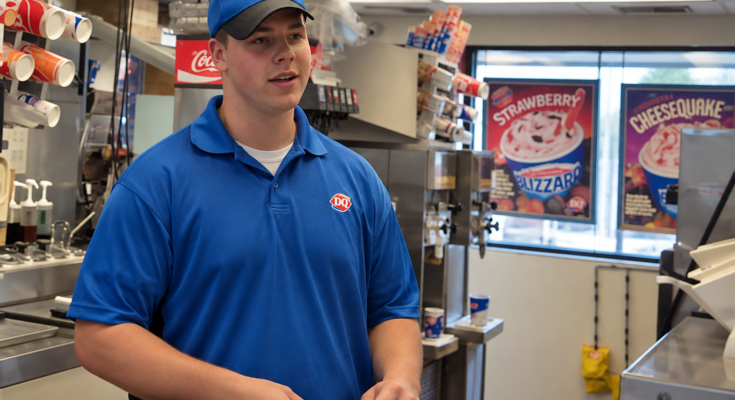
It happened during a busy Saturday afternoon at the small ice cream shop he managed in Minnesota. The lunch rush had ended, but the place was still full of families, teenagers, and people stopping for something cold on a hot day.
Ethan had worked there since he was sixteen.
He knew the regulars.
He knew which kids wanted extra sprinkles, which retirees ordered coffee even in July, and which customers would stand at the menu for five minutes before ordering exactly what they ordered every week.
One of those regulars was Mr. Henry Collins.
Henry was in his late sixties and blind.
He walked with a white cane, usually came in alone, and ordered the same thing every Thursday and Saturday: a small vanilla sundae with hot fudge and a coffee.
“Afternoon, Ethan,” Henry said as he approached the counter.
“Hey, Mr. Collins. The usual?”
“You know me too well.”
Ethan smiled.
Henry reached into his wallet and pulled out some bills. As he paid, a twenty-dollar bill slipped from his hand and floated to the floor.
Henry didn’t notice.
Ethan did.
So did the woman standing directly behind him.
She looked down.
Then looked around.
For half a second, Ethan assumed she was going to pick it up and hand it back.
Instead, she placed one shoe over the bill.
Henry took his receipt.
“Thanks, Ethan.”
“Of course.”
As Henry moved toward a table, the woman bent down, picked up the twenty, folded it quickly, and slipped it into her purse.
Ethan stared at her.
Surely he had misunderstood.
Maybe it was hers.
Maybe another bill had fallen.
But he had watched it leave Henry’s hand.
The woman stepped toward the register.
“I’ll have a medium chocolate shake.”
Ethan didn’t touch the screen.
“Ma’am?”
She looked at him.
“The twenty-dollar bill you just picked up belongs to the gentleman ahead of you.”
Her expression changed immediately.
“I don’t know what you’re talking about.”
“I saw it fall from his hand.”
“No, you didn’t.”
Ethan felt several people nearby become quiet.
He was nineteen.
The woman was probably in her forties.
Everything in him had been trained by customer-service jobs to smile, apologize, and avoid confrontation.
But Henry was sitting twenty feet away, unaware that somebody had just taken money from him because she thought he couldn’t see it happen.
Ethan kept his voice calm.
“Ma’am, please give him his money back.”
Her face hardened.
“I told you. It’s mine.”
“It isn’t.”
“Are you calling me a liar?”
Ethan swallowed.
“Yes, ma’am. In this case, I am.”
One of his coworkers stopped filling a cup behind him.
The woman leaned toward the counter.
“I want to speak to the manager.”
Ethan almost smiled.
“I’m the manager.”
That did not improve her mood.
She began arguing louder.
She said twenty dollars was nothing.
She said Ethan had no proof.
She said he was embarrassing her in front of everyone.
Finally Ethan looked at her and said, “You have two choices. You can give the money back, or you can leave. I’m not going to serve somebody who takes advantage of another customer.”
The woman stared at him.
Then she grabbed her purse.
“You just lost a customer.”
Ethan opened the door.
“I understand.”
She left.
The door closed.
For several seconds, nobody inside said anything.
Then Ethan remembered the important part.
Henry still didn’t know.
Ethan walked to his table.
“Mr. Collins?”
Henry turned toward his voice.
“Yes?”
“You dropped some money at the counter.”
Henry felt for his wallet.
“Oh.”
“It was twenty dollars.”
“Did you find it?”
Ethan hesitated.
The woman had taken it with her.
She had refused to return it.
Ethan could have explained all of that.
Instead, he reached into his own wallet.
There were thirty-eight dollars inside.
Payday was four days away.
He removed a twenty and placed it in Henry’s hand.
“Here you go.”
Henry smiled.
“Well, thank you, son.”
“You’re welcome.”
Ethan went back behind the counter.
He assumed the matter was finished.
It wasn’t.
At a table near the window sat a woman named Sarah Mitchell.
She had watched everything.
Before leaving, she asked Ethan one question.
“Did that twenty come out of your pocket?”
He shrugged.
“It wasn’t a big deal.”
“You’re nineteen.”
“So?”
“You gave away more than half the cash in your wallet.”
Ethan looked embarrassed.
“Mr. Collins shouldn’t lose twenty dollars because somebody thought he wouldn’t notice.”
Sarah studied him for a moment.
Then she said, “What’s your last name?”
Ethan laughed nervously.
“Why?”
“Because somebody should know what you did.”
“Please don’t make a big thing out of it.”
Sarah smiled.
“I can’t promise that.”
━━━━━━━━━━━━━━━━━━━━
Part Two — The Story Ethan Didn’t Tell
By Monday morning, everybody seemed to know.
Sarah had written about what she witnessed online.
She had not called Ethan a hero.
She simply described what happened.
A nineteen-year-old saw someone take money from a blind customer.
He confronted her.
When she refused to return it, he asked her to leave.
Then he replaced the twenty dollars himself.
The story spread.
Local reporters called the shop.
Customers came in asking for Ethan.
His manager congratulated him.
Someone mailed him twenty dollars to replace what he had given Henry.
Then another envelope arrived.
And another.
Ethan hated the attention.
When a reporter asked why he had done it, he gave the only answer he had.
“It seemed like the right thing to do.”
That was true.
But there was another reason he understood what twenty dollars could mean.
Ethan’s mother had raised him and his younger sister mostly on her own.
He remembered grocery-store trips where she silently removed things from the cart before reaching the register.
He remembered pretending he wasn’t hungry because he knew there wasn’t much food left before payday.
Twenty dollars wasn’t “nothing.”
Sometimes it was gasoline.
Medicine.
Lunches.
Two days of groceries.
And whether Henry needed that specific twenty dollars wasn’t the point.
It was his.
Ethan didn’t believe kindness meant deciding someone could afford to be stolen from.
It meant respecting what belonged to them.
━━━━━━━━━━━━━━━━━━━━
Part Three — The Man Who Came Back
Henry learned what had really happened three days later.
He entered the shop during a quiet afternoon.
Ethan recognized the sound of his cane before he reached the counter.
“Hey, Mr. Collins.”
Henry didn’t order.
Instead, he placed a folded twenty-dollar bill on the counter.
Ethan stared at it.
“What’s that?”
“Yours.”
“You don’t owe me anything.”
“Apparently I do.”
Ethan glanced toward his coworkers.
“Who told you?”
“About thirty people.”
Henry smiled.
“You know how small towns work.”
Ethan pushed the bill back.
“Keep it.”
Henry pushed it toward him again.
“No.”
“Mr. Collins—”
“You gave me twenty dollars because you thought I didn’t know mine had been stolen.”
“Yes.”
“And now I’m giving yours back because I know.”
Ethan sighed.
“You’re difficult.”
“I’m old. We’ve had more practice.”
Ethan laughed.
Then Henry became serious.
“Sit down for a minute.”
“I’m working.”
“You manage the place.”
“That doesn’t mean I can abandon it.”
Henry pointed toward an empty table.
“Five minutes.”
Ethan surrendered.
They sat.
Henry rested both hands over the top of his cane.
“I lost my sight gradually,” he said. “Started in my forties.”
Ethan had never asked why.
“At first, people treated me normally. Then I started using the cane.”
He paused.
“That’s when some people began treating me as though blindness had also made me stupid.”
Ethan said nothing.
“People speak louder to me even though my ears work. Waiters ask whoever I’m with what I want instead of asking me. Strangers grab my arm without permission because they’re ‘helping.’”
Henry shook his head.
“Most mean well.”
Then his expression changed.
“But every once in a while, somebody sees the cane and thinks it means I won’t notice what they’re doing.”
Ethan looked down.
“I’m sorry.”
“Don’t be.”
Henry smiled.
“You didn’t help me because you thought I was helpless. You simply refused to let somebody take advantage of me.”
That distinction mattered to Ethan.
Henry picked up the twenty.
Then he pushed it across the table one final time.
“Take your money.”
Ethan did.
“Thank you.”
“No. Thank you.”
A friendship began after that.
Not immediately.
Not dramatically.
Henry just kept coming in.
Sometimes Ethan sat with him during breaks.
He learned Henry had worked as an electrician for thirty-seven years.
That he had a daughter in Wisconsin.
That his wife had died six years earlier.
That he could identify nearly every employee by footsteps.
“You walk too fast,” Henry told Ethan.
“How do you know?”
“Because you’re always out of breath.”
Henry also had an irritating habit of correcting people who assumed he needed assistance.
One afternoon, a teenager grabbed his elbow without asking.
Henry said, “Son, unless we’re dancing, you can let go.”
Ethan laughed so hard he had to leave the counter.
Months passed.
The attention around Ethan’s story faded.
That was a relief.
He graduated from community college the following spring.
Henry came to the ceremony.
Ethan’s mother sat beside him.
At one point, she whispered, “Are you Henry?”
“I have been all morning.”
She laughed.
Then she said, “Thank you for being kind to my son.”
Henry looked surprised.
“He was kind to me first.”
After graduation, Ethan transferred to a university to study business.
He eventually left the ice cream shop.
His last shift was a Saturday.
Henry came in at his usual time.
Small vanilla sundae.
Hot fudge.
Coffee.
When Ethan brought it to the table, Henry handed him an envelope.
“What’s this?”
“A bill.”
“For what?”
“Thirty years of terrible service.”
Ethan opened it.
Inside was a card.
And a twenty-dollar bill.
He laughed.
“You’ve been planning this.”
“For months.”
Inside the card Henry had written:
Ethan—
Most people think character is what you do when everybody is watching.
I think it’s what you do before you realize anybody is watching at all.
Spend the twenty badly. You’re young.
—Henry
Ethan kept the bill.
He never spent it.
Years later, Ethan became the general manager of several restaurants.
One of the first things he changed was how new employees were trained.
There were lessons about food safety.
Customer service.
Cash handling.
Cleaning procedures.
Then Ethan added one more.
He called it The Twenty-Dollar Rule.
It wasn’t really about money.
He told every new employee:
“If you see someone being mistreated, don’t assume somebody older, richer, stronger, or more important will handle it. You’re already somebody.”
One young employee once asked him, “What if standing up costs us a customer?”
Ethan smiled.
“Then make sure it’s the right customer to lose.”
Years later, Henry’s daughter called Ethan.
Henry had died quietly at eighty-two.
She said she was going through his belongings and had found something Ethan might want.
A week later, a package arrived.
Inside was Henry’s old wallet.
There was a note from his daughter.
Dad carried this for years. Look behind the photographs.
Ethan opened it.
Behind a picture of Henry’s late wife was an old newspaper clipping.
The headline described the day a teenage restaurant manager stood up for a blind customer.
Folded behind the clipping was a twenty-dollar bill.
Not the same one, obviously.
It didn’t matter.
On it, Henry had written two words:
Pay attention.
Ethan sat in his office staring at it.
That was what the story had always been about.
Not twenty dollars.
Not one dishonest customer.
Not even generosity.
Attention.
The woman had noticed Henry couldn’t see.
And decided that made him easier to exploit.
Ethan noticed exactly the same thing.
And decided it meant somebody should be watching out for what Henry couldn’t see.
Same observation.
Two completely different choices.
One revealed selfishness.
The other revealed character.
Ethan framed Henry’s note but kept the twenty inside his wallet.
Occasionally one of his employees would ask why he carried an old bill he never spent.
He would tell them about Henry.
About the woman.
About being nineteen years old and terrified that he might lose his job for confronting a customer.
Then he would tell them something he had learned afterward.
Doing the right thing doesn’t always feel heroic.
Usually it feels uncomfortable.
Sometimes your voice shakes.
Sometimes people become angry.
Sometimes nobody applauds.
And sometimes you don’t even realize anyone has noticed.
But character is built in those ordinary seconds when you could look away and decide not to.
That Saturday afternoon, Ethan thought he was protecting a blind man’s twenty-dollar bill.
Years later, he understood Henry had given him something much more valuable in return.
A reminder that integrity isn’t about being watched.
It’s about who you are when you think nobody is paying attention.