Part One — Three Different Prices
The morning after my college graduation, my father asked me to meet him in the garage.
I assumed he wanted help moving something.
Instead, when he lifted the garage door, I saw the old Volkswagen.
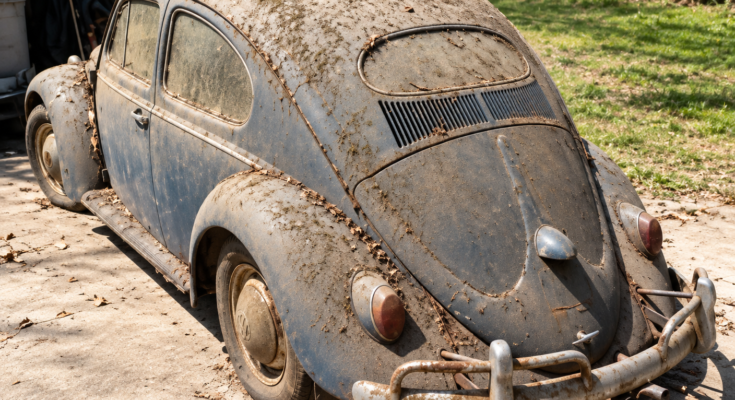
It was a faded blue Beetle that had occupied the far corner of my parents’ garage for as long as I could remember. As a child, I used to climb into the driver’s seat and pretend I was racing. By high school, I barely noticed it anymore.
The paint had dulled.
There was a small dent near the passenger-side headlight.
The seats smelled faintly of old vinyl and motor oil.
My father, George, stood beside it holding a set of keys.
“You graduated with honors,” he said. “I’m proud of you.”
“Thanks, Dad.”
He put the keys in my palm.
“The Volkswagen is yours.”
I stared at him.
“You’re giving me this?”
He nodded.
I laughed because I thought he was joking.
He wasn’t.
Dad had bought the Beetle many years earlier, before he married my mother. It was more than fifty years old now, and although he had maintained it carefully, nobody looking at it from across a parking lot would have mistaken it for something valuable.
I was twenty-two.
I had student loans.
No full-time job yet.
And my friends were celebrating graduation by talking about new apartments, careers, and cars that had Bluetooth.
My father was giving me something that still had a cassette adapter in the glove compartment.
“Don’t look so excited,” he said.
“I’m grateful.”
“You look like you’re receiving a kidney stone.”
I smiled.
“It’s just… unexpected.”
Dad nodded as if he understood exactly what I meant.
Then he said, “Before you decide what you think of it, do something for me.”
“What?”
“Take it to the Volkswagen dealership downtown. Don’t tell them anything about it. Ask what they’d pay.”
I frowned.
“You want me to sell it?”
“No.”
“Then why ask?”
“Humor your father.”
That was usually how discussions with Dad ended.
So I drove the Beetle downtown.
The dealership was enormous. Glass walls. Shiny SUVs. Salespeople wearing shoes that cost more than my monthly grocery budget.
A young salesman walked around the Beetle twice.
He checked the mileage.
Looked underneath.
Opened the engine compartment.
Finally he said, “It’s in decent shape for its age.”
“That sounds promising.”
He smiled politely.
“We’d probably offer around ten thousand.”
I was surprised.
Honestly, ten thousand dollars sounded pretty good for an old car I had spent most of my life treating like garage furniture.
When I told Dad, he simply nodded.
“Okay.”
“You knew they’d say something around that?”
“Maybe.”
“Can I sell it?”
“No.”
Of course.
Then Dad said, “Now take it to the pawn and auto place on Jefferson.”
I laughed.
“You’re serious?”
“Very.”
The place on Jefferson looked exactly like somewhere my mother would tell me not to go.
Metal fencing.
Sun-faded signs.
A row of used lawn equipment beside the office.
The owner came outside, looked at the Beetle for less than three minutes, and shrugged.
“Old Volkswagen.”
“I noticed.”
“Hard to move.”
“What would you offer?”
He scratched his chin.
“Thousand bucks.”
I actually laughed.
The man didn’t.
“Maybe twelve hundred if the tires are new.”
I drove home offended on behalf of a car I hadn’t even wanted that morning.
“They offered a thousand dollars.”
Dad nodded again.
“Interesting.”
“No, it’s insulting.”
“Why?”
“Because the dealership offered ten times that.”
My father smiled slightly.
“Now you care.”
I stared at him.
“What’s going on?”
“One more place.”
He handed me a card.
It belonged to a regional classic Volkswagen club.
“There’s a gathering Saturday morning. Take the car.”
“Dad, if this ends with somebody offering me fifty dollars, I’m driving the thing into a lake.”
“Your mother would object.”
“To the lake?”
“To losing the car.”
Saturday morning, I drove to an old fairground outside town.
The moment I entered the parking area, something changed.
People started looking.
Not casually.
Really looking.
A gray-haired man stopped halfway through a conversation and pointed.
Another man walked toward me before I’d even parked.
“Is that a ’67?”
“I think so.”
“You think so?”
He looked genuinely offended.
Within five minutes, six people surrounded the Beetle.
Someone asked whether the paint was original.
Another checked the chassis number.
A woman crouched beside one wheel and called her husband over.
“Look at this.”
I stood there feeling as though I’d accidentally brought a famous person to a grocery store.
Finally, a man named Arthur asked, “Are you selling?”
“I don’t know.”
“I’d give you seventy-five for it.”
“Seventy-five hundred?”
He stared at me.
“Thousand.”
I stopped breathing.
Another man laughed.
“Don’t insult the kid.”
Then he looked at me.
“Ninety.”
Someone else said, “I’d go a hundred if the documentation is right.”
One hundred thousand dollars.
For the same car that had been worth one thousand dollars two days earlier.
I called Dad from the parking lot.
“You knew.”
He laughed.
“How much?”
“Someone said a hundred thousand.”
“Good.”
“Dad, what is this car?”
“Come home.”
When I pulled into the driveway, he was sitting on the porch.
I walked toward him holding the keys.
“You could’ve told me.”
“Yes.”
“Why didn’t you?”
He motioned toward the chair beside him.
“Sit.”
I did.
Dad looked toward the Beetle.
“The car didn’t become more valuable between Wednesday and Saturday.”
I said nothing.
“The dealership saw an old used vehicle. The pawn shop saw something difficult to resell. Those collectors saw the original engine, the rare factory options, the condition, the history.”
He paused.
“Same car.”
“Different people.”
“Exactly.”
I thought the lesson was over.
It wasn’t.
Dad looked at me.
“Now let’s talk about why I actually sent you.”
━━━━━━━━━━━━━━━━━━━━
Part Two — What My Father Had Noticed
During my final year of college, I had interviewed for a competitive graduate position at a large consulting company.
I wanted it badly.
I reached the final round.
Then they rejected me.
A week later, I learned that another student from my program had been hired.
He had lower grades than mine.
Less experience.
But his uncle worked there.
I pretended not to care.
Dad knew better.
“You’ve spent three months acting like one company made a final ruling on your future,” he said.
“I haven’t.”
“You stopped applying anywhere ambitious.”
I looked away.
He was right.
After the rejection, I had started sending applications only to jobs I thought were “safe.” Jobs below what my professors had encouraged me to pursue.
I told myself I was being realistic.
Dad saw something else.
“You’ve confused rejection with measurement,” he said.
Then he pointed toward the Beetle.
“That pawn shop didn’t discover the car was worth a thousand dollars. They told you what it was worth to them.”
I looked toward the garage.
“And the collectors?”
“They know what they’re looking at.”
Then Dad said the sentence I remembered for the rest of my life.
“Son, the wrong room can make something valuable look ordinary.”
He leaned forward.
“But don’t make the opposite mistake either. You’re not valuable because somebody offers you a big salary or praises you. You had value before anybody noticed.”
That distinction mattered.
The car’s price depended on the buyer.
My worth did not.
━━━━━━━━━━━━━━━━━━━━
Part Three — The Rooms We Choose to Stay In
I didn’t sell the Beetle.
That surprised everyone.
Especially my mother.
“A hundred thousand dollars?”
“It was an offer.”
“That is another word for money.”
Dad laughed for nearly a minute.
But I kept the car.
Not because it was rare.
Because after that weekend, I could no longer look at it without hearing my father’s voice.
A week later, I reopened the folder containing the applications I had abandoned.
I applied to twelve places.
Three rejected me immediately.
One never answered.
Two interviewed me and disappeared.
That hurt.
The Beetle lesson did not magically turn every rejection into confidence.
But I stopped interpreting every closed door as proof that I belonged outside.
Eventually, a smaller engineering firm invited me to interview.
It wasn’t famous.
Their office occupied the third floor of an old brick building.
The lobby carpet needed replacing.
But the interview felt different from the first ten minutes.
The engineering director, Helen Ramirez, had actually read my senior research project.
Not skimmed it.
Read it.
She asked why I had chosen a particular modeling method.
She challenged one of my assumptions.
Then she said, “You know this work unusually well for someone coming straight out of school.”
I almost looked behind me.
The consulting company had spent three interviews asking where I saw myself in five years.
Helen asked what problems I wanted to solve.
They offered me a job.
The salary was slightly lower than the famous company would have paid.
I accepted.
When I told Dad, he smiled.
“Classic car club?”
“Something like that.”
I stayed there for eleven years.
Helen became my mentor.
I worked on projects that terrified me at first.
I failed.
Improved.
Led teams.
Eventually, I became the person interviewing nervous twenty-two-year-olds.
And I began noticing how easily institutions decide what somebody is worth based on things that have very little to do with ability.
A prestigious school.
A polished accent.
A familiar company on a résumé.
Confidence that sometimes came from privilege rather than competence.
I thought about the Volkswagen.
So I started asking different questions.
Not:
Why haven’t you worked somewhere impressive?
But:
Tell me about something difficult you taught yourself.
Not:
Why is there a gap here?
But:
What happened during this period, if you’re comfortable telling me?
Not:
Why should we hire you?
But:
What do you do unusually well that people sometimes overlook?
Some of our best employees came from places other companies had ignored.
Community colleges.
Small towns.
Career changes.
Military service.
Years spent raising children.
One man had worked at an auto parts store for seven years while finishing his engineering degree at night.
His résumé had been rejected automatically by two companies.
He became one of the best engineers I ever managed.
I never told him he was a Volkswagen Beetle.
That would have been strange.
But I thought it.
My father got older.
Slowly at first.
Then suddenly, the way parents seem to.
His hair went white.
His hands became unsteady.
He stopped working in the yard without taking breaks.
One afternoon, he called and asked me to come over.
The Beetle was in his driveway.
“I thought it was mine.”
“It is.”
“Then why is it here?”
“You left it in my garage for three months.”
“I have children.”
“You also have a garage.”
“My children have bicycles.”
“Poor planning.”
Dad was eighty-one then.
We sat on the same porch where he had explained the lesson to me decades earlier.
I had two children of my own by then.
My oldest, Sophie, was seventeen.
Dad nodded toward the car.
“You still know what it’s worth?”
“I get offers occasionally.”
“How much?”
“Enough that my wife keeps asking why we’re not selling it.”
“Sensible woman.”
Then he became serious.
“You know the lesson wasn’t really about staying only where people praise you.”
“I know.”
“Good.”
I looked at him.
He continued.
“Some people use that idea as an excuse. They say, ‘Nobody appreciates me,’ when what they really mean is, ‘Nobody tells me I’m wonderful.’”
That sounded exactly like Dad.
“So what was the lesson?”
He thought for a moment.
“Learn the difference between a place that challenges you and a place that diminishes you.”
I remembered that sentence.
There were jobs where people had criticized me and made me better.
Teachers who told me my work wasn’t good enough because it wasn’t.
Friends who told me truths I didn’t want to hear.
My wife, more than once, had pointed out that confidence and stubbornness were not identical.
Those people valued me enough to be honest.
Then there were places where nothing I did could have changed how I was seen.
That was different.
Dad tapped the arm of his chair.
“The right place doesn’t always applaud you. Sometimes it expects more from you because it sees more in you.”
That may have been the better lesson.
Dad died two years later.
Heart failure.
Quietly.
At home.
After the funeral, I went into his garage alone.
His tools were still arranged in the irritatingly precise system nobody else understood.
The old radio sat on the shelf.
There were coffee cans filled with screws he’d been saving since approximately the invention of screws.
Then I saw a small envelope taped to the workbench.
My name was on it.
Inside was the original bill of sale for the Volkswagen.
And a note.
Daniel,
If you’re reading this, I’m probably finally too old to tell you what to do.
I laughed despite myself.
Then I kept reading.
The car is yours. Sell it. Keep it. Give it away. I don’t care.
But remember: I didn’t send you to those three places because I wanted you to learn that you’re secretly worth $100,000. People aren’t cars, and life isn’t an auction.
I wanted you to see how dangerous it is to let one room decide what you believe about yourself.
Some rooms won’t understand you.
Some won’t need what you offer.
Some will simply be wrong about you.
Leave when you need to. Learn when you need to. And when you find people who see you clearly, don’t take them for granted.
Dad
I sat on his workbench stool for a long time.
That note is still in the glove compartment.
The Volkswagen is nearly sixty years old now.
The paint has been restored, though I insisted they leave the little dent near the headlight.
My daughter Sophie drove it to her high school graduation.
Before she left for college, she asked me something.
“Dad, how much is this thing actually worth?”
I smiled.
“Depends where you take it.”
She rolled her eyes.
“Please don’t turn this into a life lesson.”
“I would never.”
“You absolutely would.”
So I told her the story.
Dealership.
Pawn shop.
Classic car club.
A hundred thousand dollars.
When I finished, she nodded.
“I get it. Go where people appreciate you.”
“Not exactly.”
She frowned.
“That was clearly the point.”
“That was Grandpa’s first point.”
“What was the second?”
I handed her the keys.
“Don’t let anyone else decide your value in the first place.”
She became quiet.
Then she looked at the Beetle.
“So why does the right place matter?”
“Because knowing your own worth doesn’t mean you should spend your whole life proving it to people committed to misunderstanding you.”
She considered that.
Then smiled.
“Okay. That’s actually pretty good.”
“Your grandfather was occasionally useful.”
Sophie drove away.
I stood in the driveway watching the old Beetle disappear around the corner.
For decades, people had told me that story was about finding the place where you’re valued most.
I think that’s only half of it.
Yes, environment matters.
A pawn shop can overlook what a collector recognizes instantly.
A workplace can miss an ability another organization knows how to develop.
A relationship can make someone feel small while another gives them room to become themselves.
But human beings are not antiques waiting for the highest bidder.
Your value does not rise because an important person notices you.
It does not fall because somebody overlooks you.
The lesson my father actually gave me was simpler.
Listen carefully to the room you’re standing in.
Learn what you can from it.
But never confuse its opinion with your identity.
And if a place repeatedly treats what is best in you as though it means nothing, you are allowed to take the keys, start the engine, and find another road.