
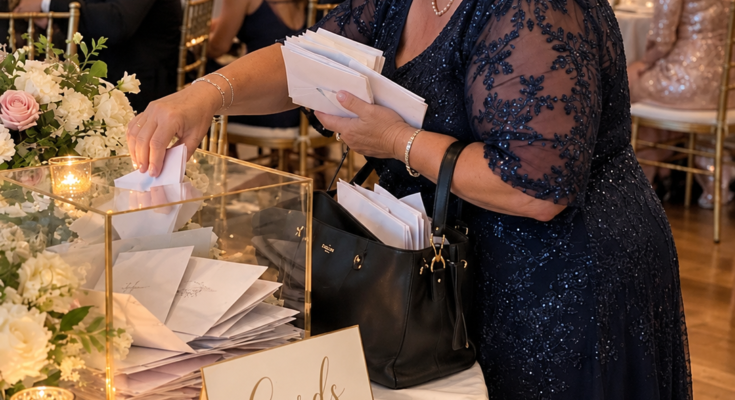
Part One — The Envelopes
Around ten that night, my cousin approached me near the bar and lowered her voice.
“Is your mother-in-law supposed to be taking the envelopes?”
I stared at her.
“What?”
She nodded toward the gift table.
Linda was standing beside it with her large tote bag open on a chair. She was going through the card box. She wasn’t reading anything. She was simply pulling out envelopes by the handful and dropping them into her bag.
I stood there in my wedding dress, watching my husband’s mother empty our card box into her purse while nearly two hundred guests celebrated only a few feet away.
I walked toward her.
Strangely, I felt completely calm. I still remember being surprised by the steadiness of my own voice.
“Linda, what are you doing?”
“Oh, sweetheart, don’t worry. I’m just putting these somewhere safe.”
“They were already safe. They’re inside the card box.”
She actually laughed.
“Honey, we paid for half this wedding. I’m just keeping our half.”
Our half.
As though the money inside those envelopes were some kind of repayment on her investment. As though my aunt had driven four hours and written a check to my husband and me so Linda could reimburse herself.
For several seconds, I couldn’t answer.
This was my wedding reception. Almost two hundred people were nearby. Somewhere behind me, our photographer was probably taking pictures of people dancing while I tried to understand whether my new mother-in-law had just openly stolen our wedding gifts.
Then I noticed my mother.
She stood near the ballroom doors.
She had seen everything.
Mom had paid her portion of the wedding with money she’d been saving since I was eleven. She had never once called it an investment. She called it a gift.
Yet she did not storm over.
She didn’t shout.
She simply caught my eye from across the room and gave the smallest shake of her head.
Don’t.
So I didn’t.
I swallowed every word I wanted to say.
Linda zipped her tote bag.
Then she walked away as though she’d done absolutely nothing wrong.
My new husband, Michael, had been outside talking to his college friends and missed the whole thing. By the time he came back, Mom was beside me.
“Not tonight,” she whispered.
“She took the cards.”
“I know.”
“Mom—”
“You have one wedding reception. Don’t give her the rest of it.”
“But that’s our money.”
“And tomorrow it will still be your money.”
The confidence in her voice stopped me.
“What did you do?”
Mom looked toward our photographer.
“Enjoy your wedding.”
That was all she would say.
So I did my best.
I danced with Michael.
I hugged relatives.
We cut the cake.
I smiled in photographs.
But every time I saw Linda across the room, I thought about that tote bag.
She left before we did.
Of course she did.
The next morning, I went to Mom’s house so angry I could barely eat. Michael came with me and looked worse than I felt.
He hadn’t believed me at first.
Not because he thought I was lying.
Because his brain seemed unable to make his mother and the thing she had done fit inside the same sentence.
“She really said she was keeping half?”
“Those exact words.”
He rubbed both hands across his face.
“Oh God.”
I wanted him to call her immediately.
Mom poured coffee.
“No.”
I stared at her.
“No?”
“You don’t solve this by screaming at her.”
“She stole our wedding gifts.”
“I know.”
“Then why are you so calm?”
Mom almost smiled.
“Because angry people make mistakes.”
She reached across the counter, picked up my phone, and put it into my hand.
“Call Linda.”
“And tell her what?”
“Invite her here for dinner tomorrow.”
I stared at Mom.
“After what she did?”
“Especially after what she did.”
Michael looked suspicious now too.
“Mrs. Collins, what exactly are you planning?”
Mom took another sip of coffee.
“Dinner.”
“That’s it?”
“And a conversation.”
I knew my mother.
That expression meant there was absolutely more than dinner involved.
I called Linda.
She sounded delighted.
“Oh, good. I was hoping we wouldn’t have awkwardness after last night.”
I nearly choked.
Mom took the phone from me before I could answer.
“Six o’clock, Linda. Bring Robert too.”
Robert was Michael’s father.
There was a pause.
Then Mom smiled.
“Yes. All of you.”
She hung up.
“What did you do?” I asked again.
Mom walked into her home office and returned carrying a large brown envelope.
She placed it on the table.
Inside were printed photographs.
The first showed Linda standing beside our wedding card box.
The second showed her hand inside it.
The third showed a stack of envelopes going into her tote bag.
The fourth was even clearer.
Linda’s face.
Her open purse.
Our cards.
Every detail.
“Our photographer saw what was happening after I signaled him,” Mom said. “I asked him not to interfere. I asked him to document it.”
Michael turned pale.
Mom wasn’t finished.
“The venue also has security cameras covering the gift-table area.”
“You asked them for footage?”
“I asked them to preserve it. They won’t release anything improperly, but they confirmed the relevant footage exists.”
I stared at her.
Mom had been quiet at the reception because while I thought she was doing nothing, she had been making sure nobody could later pretend nothing happened.
Then she opened a second folder.
Inside was the wedding budget.
Every deposit.
Every vendor.
Every contribution from my parents and Michael’s parents.
Mom tapped one figure.
“Linda is also mistaken about something else.”
“What?”
“She didn’t pay half.”
Michael leaned closer.
According to the records, my parents had paid $18,600.
Linda and Robert had contributed $12,000.
Michael and I had covered another $7,400 ourselves.
Linda had apparently begun calling her $12,000 “half the wedding” because she counted only certain expenses when explaining it to people.
Mom shrugged.
“That doesn’t matter legally or morally. Even if she had paid every penny, the envelopes weren’t hers. But if we’re going to have an unpleasant conversation, we’re at least going to have an accurate one.”
Michael slowly sat down.
Then Mom looked at him.
“This next part is yours.”
He looked up.
“What?”
“She’s your mother.”
I expected Mom to tell him to demand the money.
She didn’t.
“You decide what kind of husband you’re going to be before she walks through this door tomorrow.”
That landed harder than anything else she’d said.
━━━━━━━━━━━━━━━━━━━━
Part Two — My Mother’s Dinner
Linda arrived at six carrying flowers.
She hugged me as though nothing had happened.
Robert came behind her looking confused.
Dinner was almost painfully normal.
Mom served roast chicken, potatoes, green beans, and rolls.
Nobody mentioned the envelopes.
Then Mom cleared the plates.
She brought coffee.
And placed one photograph in front of Linda.
The room went silent.
Linda’s face changed.
Michael spoke first.
“Mom, where are our wedding cards?”
Linda recovered quickly.
“I already explained this. Your father and I spent thousands on that wedding.”
Robert looked at her.
“What cards?”
That was the first surprise.
He hadn’t known.
Linda turned toward him. “It’s just the cash gifts. I told you we’d recoup some wedding expenses.”
“No, you didn’t.”
Mom placed the budget folder on the table.
Then she spoke calmly.
“Linda, nobody here is going to scream at you. Nobody is going to humiliate you. But every envelope you removed belongs to Michael and your new daughter-in-law.”
Linda folded her arms.
“I paid for that reception.”
“You contributed twelve thousand dollars toward their wedding as a gift.”
“Exactly.”
Mom shook her head.
“A gift does not become a loan because you regret giving it afterward.”
Linda’s face reddened.
Mom continued.
“You can return the envelopes tonight, or you can return the equivalent amount once Michael and his wife determine what is missing. Those are the two peaceful options.”
Linda looked at Michael, expecting rescue.
He didn’t give it.
“Mom,” he said quietly, “give us our cards.”
For the first time, she seemed genuinely shocked.
“You’re choosing her over your own mother?”
Michael looked at me, then back at Linda.
“I married her yesterday. There shouldn’t be a competition.”
Linda started crying.
Then she said something none of us expected.
“My mother took our wedding money.”
Robert’s head lifted.
“What?”
“All of it.”
Linda wiped her eyes.
“She said she’d paid for the wedding, so the envelopes belonged to her. I thought that’s what families did.”
Mom’s expression softened.
But not her boundary.
“Then what your mother did to you was wrong too.”
Linda looked down.
No one spoke for a long moment.
Finally she whispered, “The envelopes are at home.”
“Opened?” Michael asked.
Most were.
But they were still there.
And the next evening, Linda brought them back.
━━━━━━━━━━━━━━━━━━━━
Part Three — What the Envelopes Were Actually Worth
We counted everything at Mom’s kitchen table.
Not because I enjoyed it.
I hated every second.
Some envelopes had checks inside, still payable to Michael and me. Others had cash. Linda had opened enough cards to know which relatives had given larger amounts, but she had not deposited or spent anything yet.
The total was $11,740.
I remember that number because for weeks I thought it represented everything that had gone wrong.
It didn’t.
The real damage couldn’t be totaled.
One envelope contained twenty dollars from Michael’s ninety-one-year-old grandmother.
She had written:
Buy yourselves breakfast somewhere beautiful on your honeymoon. Love, Grandma Rose.
Linda had taken that too.
Another held a hundred dollars from my younger cousin, who had recently graduated college and could barely afford rent.
One couple gave us a check and wrote:
For your first piece of furniture that isn’t held together with hope.
We laughed when we read that one.
Then I cried.
Those envelopes weren’t just money.
They were people showing up for us.
That was the part Linda had failed to understand.
When she looked at the card box, she saw a pile of cash.
We saw Uncle Frank’s shaky handwriting.
My childhood babysitter.
Michael’s college roommate.
The neighbor who watched me after school when Mom worked late.
People had placed small pieces of their relationships with us inside those envelopes.
Linda had treated all of it like reimbursement.
We didn’t call the police.
That was our decision, not Mom’s.
The money had been returned, there was evidence of what happened, and Michael and I decided we wanted a firm boundary more than a prolonged battle.
But things did change.
Immediately.
Linda no longer handled anything financial for us.
No access to honeymoon bookings.
No joint purchases.
No “I’ll pay now and you can owe me later.”
When she offered money, Michael asked one question:
“Is this a gift with no conditions?”
The first time he said it, she looked offended.
Then embarrassed.
Eventually, she learned to answer.
Sometimes yes.
Sometimes no.
If the answer was no, we politely declined.
That simple question probably saved our marriage from a dozen future fights.
Robert struggled with what had happened too.
He apologized to us privately.
“I should have known how she thinks about money.”
I told him the same thing Mom told me.
“You can’t be responsible for something someone hid from you.”
That sentence turned out to apply to several people.
Linda’s relationship with Michael had always been complicated.
She had helped him through college.
Covered rent once when he lost a job.
Bought groceries during a difficult year.
But every act of generosity came with a memory attached.
When they argued, she remembered exactly what she’d paid.
“You know how much I sacrificed for you.”
“I paid your deposit.”
“We gave you that car.”
Michael had grown up thinking help and debt were basically the same thing.
I hadn’t understood that before our wedding.
He hadn’t understood how deeply it shaped him either.
For several months after the envelope incident, he went to counseling on his own.
One evening he came home and said something that surprised me.
“I think I spent my whole childhood trying not to owe my mother anything.”
“That sounds exhausting.”
“It was.”
He sat beside me.
“And then I let her pay for the wedding.”
I understood.
It wasn’t about twelve thousand dollars.
It was about an old pattern finally becoming visible.
Linda didn’t suddenly become a different woman.
That would make the story neater than real life.
She got defensive.
Then embarrassed.
Then quiet.
For nearly three months, we saw very little of her.
At Easter, she came to dinner.
She brought nothing but a pie.
Before setting it down, she said, “This is not a loan.”
Michael laughed.
So did I.
That mattered.
Several months later, Linda asked if she could take me to lunch alone.
I almost said no.
But Mom told me, “You don’t have to trust somebody completely to hear what they have to say.”
So I went.
Linda apologized.
Not perfectly.
There were still too many explanations.
She talked about her childhood, about money always being scarce, about her mother taking every dollar from her own wedding because “parents had earned it.”
Then she stopped herself.
“I keep telling you why I did it.”
“Yes.”
“That isn’t the same as saying I shouldn’t have.”
“No.”
She took a breath.
“I shouldn’t have.”
That was the first apology I believed.
I didn’t hug her.
I didn’t tell her everything was fine.
I said, “Thank you.”
And we started from there.
My relationship with Linda is different now.
Better in some ways.
More limited in others.
I no longer confuse keeping the peace with pretending nothing happened.
Neither does Michael.
And my mother?
Mom became something of a legend in our family.
For years, Michael referred to that evening as The Dinner.
Whenever somebody started getting heated at a holiday, he’d say, “Careful. Diane might bring out a folder.”
Mom hated that.
Secretly, she loved it.
One afternoon several years later, I finally asked why she had stopped me from confronting Linda during the reception.
“I was furious with you.”
“I know.”
“I thought you were letting her get away with it.”
Mom smiled.
“I wasn’t protecting Linda.”
“Then who were you protecting?”
“You.”
I didn’t answer.
“She had already taken something she had no right to take,” Mom said. “I wasn’t going to let her take your wedding reception too.”
That stayed with me.
“If you’d confronted her there, what would you remember about your wedding?”
I pictured it.
Shouting beside the card table.
Michael caught between us.
Guests staring.
Linda crying or arguing.
The photographer capturing a family explosion instead of our last dance.
Mom continued.
“You had the rest of your life to deal with her. You only had that night once.”
I reached across the table and squeezed her hand.
Then I asked, “How did you know she’d actually return everything?”
Mom smiled.
“I didn’t.”
“What?”
“I knew she might refuse.”
“You looked completely confident.”
“Honey, I raised three children. Half of parenting is looking like you know what’s going to happen.”
I laughed.
Then she became serious.
“What I did know was that you had evidence, your husband knew the truth, and you didn’t need to fight someone in the middle of a ballroom to prove you were right.”
Mom died seven years after my wedding.
Cancer.
Fast.
Too fast.
While going through her kitchen afterward, I found an envelope in the back of a drawer.
My married name was written across the front.
Inside was a copy of our original wedding budget.
Of course she kept it.
Behind it was one of our wedding photographs.
Michael and me dancing.
I’m laughing.
His forehead is against mine.
In the background, barely visible, is the gift table.
I turned the photograph over.
Mom had written something on the back.
This is what I wanted you to remember.
I sat on her kitchen floor and cried.
Because she had been right.
When I think about my wedding now, I don’t picture Linda beside that card box first.
I remember Michael fumbling one of his vows.
My father’s terrible dancing.
My cousin splitting her dress.
My mother crying during the ceremony and denying it afterward.
I remember the last song.
And yes, I remember the envelopes.
But they became a lesson rather than the whole story.
Linda thought paying part of our wedding bought her a claim on what came afterward.
It didn’t.
Money does not purchase ownership of people.
A gift given freely does not create a permanent debt.
And generosity that comes with an invisible invoice isn’t really generosity.
The morning after my wedding, I thought my mother was asking me to be nice.
She wasn’t.
She was teaching me the difference between being quiet and being weak.
Weakness would have been pretending Linda did nothing wrong because confronting her was uncomfortable.
Strength was waiting until the music stopped, the guests went home, and everyone was sober enough to hear the truth.
Then putting the evidence on the table.
And calmly asking for what belonged to us.