Part One — Leave That One
“Leave that one.”
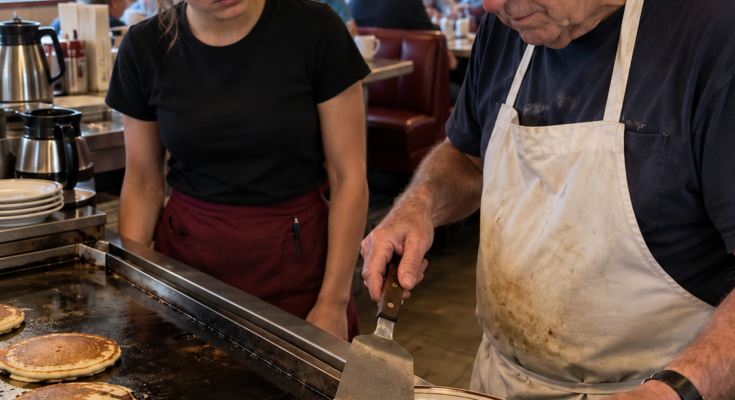
The new waitress had her spatula halfway under the pancake when Benny Lawson reached across the grill and stopped her. It was already too dark around the edges. Not ruined exactly, but close.
“You want me to throw it out?”
Benny shook his head.
At sixty-seven, he had cooked enough pancakes to know exactly when one crossed from golden brown into burned. That was what made it strange. He had burned this one on purpose.
Every Sunday morning, Benny did the same thing. One pancake. A little too dark. No butter. No syrup. No customer. He placed it on the same chipped white plate beside the coffee machine and went back to eggs.
The diner sat along a two-lane road in western Pennsylvania, the kind of place with cracked vinyl booths, mismatched coffee cups, and a bell above the door that had been ringing longer than most of the employees had been alive. Benny had worked there for nearly four decades. He knew who wanted onions in their potatoes, which retired mill worker secretly needed decaf, and which widower always ordered two pieces of toast so he could wrap one in a napkin and take it home.
Benny remembered almost everything.
He just couldn’t always hear it anymore.
His hearing had deteriorated enough that he often turned his left ear toward customers and read their faces when he missed a sentence. He hated making people repeat themselves, so he learned how to smile at the right moment and pretend he had heard.
His children lived several states away. They called when they could. Benny always told them he was fine.
Most days, he almost believed it.
Then a sixteen-year-old dishwasher named Caleb started working weekends.
Caleb was skinny, quiet, and permanently tired. His mother worked nights at a nursing home, and he had taken the diner job to help with groceries and car insurance. At first, Benny hardly noticed him.
But Caleb noticed Benny.
He noticed the grill was turned down for exactly thirty seconds before the Sunday pancake. He noticed Benny left it longer on one side. He noticed the same chipped plate.
Most importantly, he noticed that after the breakfast rush slowed, Benny sat alone at the corner of the counter with that pancake in front of him.
For five minutes, he did nothing.
Just looked at it.
One rainy Sunday, Caleb sat two stools away.
“Why do you make that every week?”
Benny looked at the pancake.
Caleb immediately regretted asking.
“Never mind.”
Then Benny said, “My daughter liked them that way.”
Caleb waited.
“Everybody else wanted pancakes golden. Emily wanted hers nearly black. Said the crispy ones tasted better.”
“How old is she?”
Benny’s smile disappeared.
“She was seven.”
Emily had become sick when Benny was thirty-six. Months of treatment followed. Good weeks. Bad weeks. Hospitals several hours from home. Promises made by parents who know, somewhere inside themselves, that love cannot guarantee outcomes.
On Sundays, if Emily could eat, Benny made pancakes before taking her to the hospital.
He always burned hers.
“She loved when the smoke alarm went off,” he told Caleb. “Said that meant breakfast was ready.”
Emily died on a Thursday.
The following Sunday, Benny went to work.
His boss told him to stay home.
Benny didn’t know what home was supposed to feel like without her.
So he heated the grill.
Mixed the batter.
And burned one pancake.
He had done it every Sunday since.
“Not because I think she sees it,” he told Caleb. “I just couldn’t stand the idea that the world would keep going until nobody remembered how she liked breakfast.”
Caleb said nothing for a long time.
Then he reached over, tore off a piece, and ate it.
Benny stared.
Caleb chewed bravely.
“Pretty good.”
Benny narrowed his eyes.
“You’re a terrible liar.”
Caleb laughed.
After a moment, Benny did too.
The following Sunday, Caleb brought two forks.
That became their ritual.
They didn’t always talk about Emily. Usually they discussed cars, baseball, school, or the ancient pickup Benny kept promising to restore. When Caleb graduated high school, Benny attended and sat near the back of the gym where the noise blurred into one enormous vibration. He still stood when Caleb crossed the stage.
Caleb eventually left for trade school.
But before leaving, he told another dishwasher about the pancake.
That dishwasher told a waitress.
She told the next cook.
Quietly, the story became part of the diner.
The jokes stopped.
Whenever a new employee reached toward the dark pancake on Sunday morning, somebody said gently:
“Leave that one.”
Benny never asked why everyone suddenly understood.
Maybe he knew.
Years passed.
At seventy-two, his hearing worsened. At seventy-four, his knees began punishing him after long shifts. At seventy-six, his son started asking him to move closer.
“Maybe next year,” Benny always said.
Then one winter morning, he dropped a skillet because his right hand briefly went numb.
The doctor said it wasn’t a stroke and wasn’t anything catastrophic, but it was enough.
Benny decided the following Sunday would be his last shift.
He wanted no party.
No balloons.
No cake.
“No speeches,” he told the manager. “Just let me cook breakfast.”
That Sunday, Benny arrived at 5:10 in the morning.
He turned on the lights.
Started the coffee.
Ran one hand across the steel counter.
At six, the first regulars arrived.
At seven, the booths filled.
At eight, Benny was sweating over eggs and bacon exactly as he had on thousands of mornings before.
Then the manager touched his shoulder.
“Benny.”
He turned.
She pointed toward the dining room.
Seventeen people sat together at a long arrangement of tables.
Benny recognized some immediately.
Caleb was there, now in his thirties, wearing work boots and a wedding ring. Beside him sat former waitresses, dishwashers, cooks, busboys, and hosts. Kids Benny had trained. Kids he’d fed when they forgot lunch money. Kids he’d driven home when their cars wouldn’t start.
Some had traveled from other states.
Benny stepped out from behind the grill.
Then he saw the plates.
Seventeen plates.
Seventeen pancakes.
Every single one burned around the edges.
Benny stopped walking.
Caleb stood.
“We thought one wasn’t enough today.”
Benny looked at him.
“What is this?”
Caleb smiled.
“Breakfast.”
Someone at the table laughed.
Then Caleb pulled out the empty chair at the head of the table.
“Sit down, Benny.”
“I have orders.”
The manager called from behind him, “Not anymore.”
He turned.
She was already wearing his apron.
“You’re terrible on eggs,” Benny said.
“I’ll survive.”
Benny looked back at the table.
Then, very slowly, he sat.
Caleb placed one of the burned pancakes in front of him.
No butter.
No syrup.
Just the way Emily liked it.
Benny’s hands began shaking.
“Why seventeen?”
Caleb looked around the table.
“Because seventeen of us could get here.”
Then he smiled.
“And because every person here knew about Emily before today.”
Benny’s head lifted.
“What?”
Caleb nodded.
“We’ve known for years.”
Benny stared around the table.
A former waitress named Tasha leaned forward. “You thought nobody was paying attention.”
Another former employee smiled. “We were.”
Benny looked down at the pancake.
For thirty-one years, he had believed he was the only person keeping one little girl’s strange breakfast preference alive.
He had been wrong.
━━━━━━━━━━━━━━━━━━━━
Part Two — The Things Benny Never Knew We Remembered
Caleb had asked everyone to bring one story about Benny.
Not about the diner.
About him.
Tasha remembered being nineteen and pregnant, terrified her manager would fire her. Benny quietly rearranged shifts so she could make every prenatal appointment.
Marcus, a former busboy, remembered his father being arrested one night and Benny driving him home without asking questions.
Another woman remembered Benny noticing she hadn’t eaten during a ten-hour shift. He put a plate beside the sink and said, “Kitchen made an extra.”
“The kitchen was you,” she said.
Benny shrugged. “Could’ve been anybody.”
“That’s the point,” Caleb replied. “You always made kindness look accidental.”
Then Caleb placed a small wooden box on the table.
Inside were thirty-one index cards.
One for every year Benny had made Emily’s pancake.
Each card carried a Sunday date and the initials of whichever employee had worked that morning and noticed.
Benny ran one finger over the stack.
“You kept track?”
“Not at first. The first few years are from old schedules and people’s memories. But after I left, somebody started writing the dates down.”
“Why?”
Caleb looked at him.
“Because you said you couldn’t stand the idea that nobody would remember how she liked her pancakes.”
Benny’s eyes filled.
“So we remembered.”
That finally broke him.
The man who had spent nearly forty years hiding burns beneath jokes and grief beneath a cook’s apron lowered his head and cried at the counter.
Nobody tried to stop him.
Eventually Caleb pushed his fork across the plate.
“Come on.”
Benny looked up.
“What?”
“You don’t get to make us eat these things without suffering too.”
Seventeen people cut into seventeen nearly burned pancakes.
The reactions were immediate.
One woman coughed.
Marcus reached for coffee.
Somebody muttered, “Emily had terrible taste.”
Benny laughed so hard he had to wipe his eyes.
“No,” he said. “She would’ve loved all of you.”
━━━━━━━━━━━━━━━━━━━━
Part Three — One Pancake Became a Table
Benny’s retirement lasted eleven days before he came back to the diner.
Not to work.
He sat in his usual corner and complained about the eggs.
The new cook shouted from the grill, “You don’t work here anymore!”
“That doesn’t make the eggs good!”
Everybody laughed.
He came back most Sundays after that.
Sometimes his son drove in from Maryland. Sometimes Benny’s daughter, Karen, visited from North Carolina. His children knew about the pancake, of course, but they had never understood how many other people knew.
Karen cried the first time she saw the box of index cards.
“I always thought Emily disappeared from everybody else’s life after she died.”
Benny looked surprised.
“She didn’t disappear from mine.”
“I know. But yours was the only place I ever heard her name.”
That sentence changed him.
Their family had coped with Emily’s death differently.
Benny made pancakes.
His late wife, Ruth, packed photographs away because she could not bear seeing them.
Karen had been ten when her sister died. Adults repeatedly told her to be strong for her parents, so she became very good at not talking about Emily at all.
Thirty-one years later, everybody had carried the same little girl privately.
The diner accidentally gave them a place to carry her together.
Karen began visiting more.
She and Benny went through old photographs.
Not every visit became emotional.
Mostly they laughed at hairstyles.
Emily in giant glasses.
Benny with a mustache nobody had the courage to tell him looked terrible.
Ruth holding both girls in front of a Christmas tree.
Grief became less like a locked room and more like another room in the house.
Still there.
But you could enter and leave.
A few months after retirement, Caleb approached Benny with another idea.
“No.”
“I haven’t told you yet.”
“Whenever you start a sentence like that, I end up crying in public.”
“Fair.”
Caleb wanted to start a small fund through the diner.
Nothing grand.
A few former employees had already offered money.
It would provide emergency help for young workers—groceries, a bus pass, work shoes, a small car repair, the sort of thing that could make the difference between a teenager keeping a job and losing it.
Benny immediately objected to having his name attached.
Caleb expected that.
“So we won’t.”
“What are you calling it?”
Caleb slid a napkin across the table.
Written on it were three words:
THE EXTRA PLATE FUND
Benny stared.
“That’s corny.”
“Yes.”
“I hate it.”
“So we’re using it?”
Benny sighed.
“Fine.”
The fund began quietly.
No giant check presentations.
No photographs.
No teenager required to explain their worst week in front of the staff.
If somebody needed a pair of non-slip shoes, the shoes appeared.
If a young cook’s transmission failed, a local mechanic who knew Benny charged only for parts and the fund covered them.
If someone arrived hungry, there was food.
“Kitchen made extra.”
That phrase became part of the place too.
Benny once complained that everyone was stealing his material.
Caleb said, “We’re preserving institutional knowledge.”
“You went to trade school. Stop talking like a banker.”
Benny’s hearing continued to deteriorate.
For years, he resisted hearing aids because he insisted they made the whole diner sound “like silverware falling down a staircase.”
Then his granddaughter finally convinced him to try newer ones.
The first Sunday he wore them into the diner, he stopped just inside the door.
The bell rang overhead.
Benny looked up.
He had seen that bell swing thousands of times.
He had not clearly heard it in years.
Caleb was sitting at the counter.
“You okay?”
Benny nodded.
“Forgot how annoying this place is.”
Then he heard bacon sizzling.
Coffee cups hitting saucers.
A child laughing in booth four.
Someone calling an order.
He stood there absorbing sounds he had learned to live without.
Then the cook placed something on the counter.
One pancake.
Dark around the edges.
Benny looked at it.
“You burned that.”
“On purpose.”
“Waste of good batter.”
The cook stared at him.
Benny smiled.
He sat.
By then, the Sunday pancake had changed.
For thirty-one years, it belonged to Benny alone.
After his retirement, whoever happened to be there shared it.
Sometimes four people.
Sometimes twelve.
Nobody ate much because, as multiple generations of diner employees had established, nearly burned pancakes are objectively worse than correctly cooked pancakes.
That wasn’t the point.
The point was that somebody always asked:
“Who was Emily?”
And somebody always answered.
She was Benny’s daughter.
She liked crispy pancakes.
She laughed at smoke alarms.
She died at seven.
Her father didn’t want the world to forget one ordinary thing about her.
So the world didn’t.
Benny moved closer to his son when he was seventy-nine.
That was harder than retirement.
The diner had been his structure for most of his adult life.
The morning he left Pennsylvania, Caleb came to help load the last boxes.
Benny handed him an old object wrapped in a towel.
The chipped white plate.
“The pancake plate?”
“Don’t make a shrine out of it.”
Caleb laughed.
“I learned from you.”
“Use it.”
“For what?”
Benny shrugged.
“Food would be traditional.”
Caleb kept the plate.
He did not put it behind glass.
It stayed behind the diner counter.
Every Sunday, the burned pancake went on it.
Benny called Caleb frequently after moving.
Usually Sunday mornings.
Caleb would answer from the diner and complain he was busy.
Benny would ask whether someone had ruined a pancake yet.
“Every week.”
“Idiots.”
“Your fault.”
Benny lived another six years.
He died at eighty-five after a short illness.
His son called Caleb.
By then, Caleb had become part-owner of the diner after the original owner retired.
He closed the restaurant for three hours on the morning of Benny’s funeral.
Not all day.
Benny would have hated that.
The funeral home filled with people his children didn’t know.
Former employees.
Regular customers.
A retired teacher.
A man whose car Benny once fixed in the parking lot.
A woman who said Benny fed her every Saturday during a year when her mother was sick and money was scarce.
Near the front, beside family photographs, Karen placed one picture of Emily.
Seven years old.
Missing one front tooth.
Sitting at a kitchen table.
In front of her was a pancake burned almost black.
Caleb stared at the photograph for a long time.
He had known the story for decades.
He had never seen the girl.
Suddenly Emily was no longer only a name attached to a ritual.
She was a kid.
A real kid.
A little girl laughing over terrible breakfast.
The following Sunday, the diner opened at six.
Nothing special was announced.
No memorial sign.
No speech.
The first rush came.
Coffee poured.
Eggs fried.
The bell over the door kept ringing.
At 9:30, Caleb turned the grill down.
Thirty seconds.
He poured one circle of batter.
Waited too long.
Flipped it.
Waited too long again.
Then he placed it on the chipped white plate.
A new sixteen-year-old dishwasher watched him.
“Uh, Caleb?”
“What?”
“You burned that.”
“I know.”
“Should I throw it away?”
Caleb looked toward the corner stool where Benny used to sit.
For half a second, he could almost see the old cook there—apron stained, left ear turned toward the room, pretending he heard more than he did.
Caleb shook his head.
“Leave that one.”
The kid frowned.
“Why?”
Caleb smiled.
“Come sit down when you get a break. I’ll tell you.”
That is how the story continues.
Not because a diner needed a tradition.
Not because grief should be preserved forever exactly as it was.
But because Benny had accidentally taught generations of young people something important.
Remembering somebody does not require freezing your life around the moment you lost them.
You can keep working.
Raise children.
Grow old.
Move away.
Laugh.
Fall in love.
Complain about eggs.
And still make room for one small thing that says:
You were here.
For thirty-one years, Benny thought he was burning one pancake so his daughter would not disappear.
On his final shift, seventeen people showed him the truth.
Emily had not survived only in his memory.
Every person who learned why that pancake sat untouched on the counter had carried a tiny piece of her forward.
And long after Benny was gone, on Sunday mornings in a little diner in western Pennsylvania, somebody still turns down the grill, waits a little too long, and makes one pancake darker than it should be.
Not for a ghost.
For a little girl who once thought crispy pancakes tasted better.
And for the father who loved her enough to make sure somebody remembered.