
Part One — The Daughter They Thought Had Chosen Wrong
My brother Jason stood in the doorway holding a beer, wearing the same smug expression he had worn throughout dinner, as though everything that had happened somehow proved his point about me. “If you can’t respect your brother in this house,” my father said, “take your daughter and go.”
I looked down at the canvas bag by my feet. Red wine was soaking through it. Then I looked at Emma’s small hand wrapped tightly around mine. I did not argue. That seemed to surprise them more than anything else could have.
For eighteen years, my family had treated my Army career like some embarrassing phase I had somehow failed to grow out of. Jason called it “playing soldier.” My father preferred quieter disapproval, usually delivered with a sigh whenever someone asked what I did for a living. I had learned how to absorb it—deployments, missed holidays, months away from Emma, the death of my husband, Marcus. Somehow, every sacrifice became proof in their minds that I had chosen the wrong life.
Still, I kept showing up. That Christmas, I had flown home with presents packed between my uniforms. I bought a cashmere scarf for Mom, a leather-bound journal for Dad, books and art supplies for Jason’s children. Inside my coat was a check to cover the roof repair my parents had postponed since spring. They knew nothing about that check. They knew nothing about a lot of things.
Dinner had been peaceful for maybe twenty minutes before Jason started. “Still playing soldier, Abby?” I passed the potatoes. He kept smiling. “Must be nice disappearing for months and calling it patriotism.”
Emma became completely still beside me.
That was the part I couldn’t ignore.
“I’m not abandoning my daughter,” I said quietly. “I’m serving. There’s a difference.”
Jason laughed. Then he reached for the wine bottle. What happened next was so deliberate that nobody at that table could honestly call it an accident. He tipped the bottle over the chair beside him, directly onto the duffel bag holding my dress uniform.
Red wine spread across the canvas.
I stood.
“That was uncalled for.”
That was all I said.
My father exploded.
At me.
Not Jason.
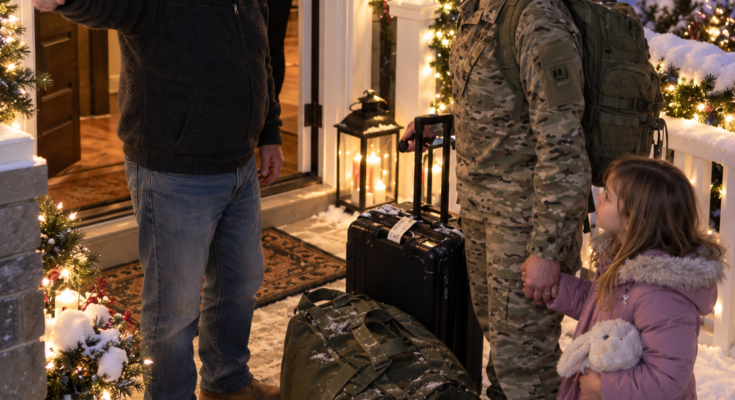
Only minutes later, I was kneeling in the snow gathering my belongings while Emma asked why Grandpa was angry. I had no answer I could give an eight-year-old, so I loaded the bags into the car and drove away from the suburban house where I had grown up.
We checked into a roadside motel where half the letters on the vacancy sign had burned out. Emma eventually fell asleep curled against me. At 11:47 p.m., my phone rang.
A National Guard helicopter had gone down in whiteout conditions near the mountains. Two crew members had survived, but both were injured. The weather was worsening. They needed someone with experience coordinating mountain rescue operations.
They needed me.
By dawn, I was standing beneath floodlights in blowing snow. Radios cracked around me while rescue teams moved up a ridgeline. I never noticed the local news camera positioned near the staging area. I did not know my name and rank had appeared across the bottom of television screens, and I definitely did not know my parents were sitting in their living room watching.
Only hours earlier, my father had thrown my uniform into a snowbank.
Now he was watching that same daughter coordinate a Christmas-morning rescue.
Mom later told me Dad set his coffee cup down so hard the saucer cracked.
Jason stared at the television.
Then he muttered, “That can’t be the same Abby.”
But it was.
By the time both crew members were safely brought off the mountain, my phone showed forty-three missed calls from my family.
I returned none of them.
I picked up Emma, and we went to a diner for pancakes. She was the one who noticed the television above the counter.
“Mom. Look. It’s you.”
My face was on the midday news.
Emma grinned. “You look cool.”
For the first time since Christmas dinner, I laughed.
But the rescue was not what frightened my family most.
Three days later, an estate and trust attorney named Walter Hensley arrived at my parents’ door carrying a slim leather briefcase. Mom assumed he was there about old family paperwork. Jason barely looked up when Walter sat at the kitchen table.
Then Walter removed a thick manila folder.
Dad recognized my name.
Jason’s smile disappeared.
Walter adjusted his glasses.
“Colonel Turner asked me to show you where the money has actually been coming from.”
My father slowly sat down.
My mother covered her mouth.
Then Walter turned to the first transaction.
Eight years earlier, my parents had nearly lost their house.
Dad had suffered a heart attack, missed months of work, and accumulated medical debt. Jason had just started a contracting business and told everyone he was “helping keep the family afloat.”
He wasn’t.
I was.
After Marcus died, I received life-insurance proceeds and survivor benefits. I invested most of it for Emma’s future. With the rest, I created a small family support trust administered through Walter’s office.
I did it anonymously because Dad would never have accepted regular money from me.
The trust had paid $1,150 toward my parents’ mortgage every month for eight years.
It covered the property-tax shortage twice.
It paid $14,700 toward Mom’s surgery after insurance.
And when their furnace failed during a January cold snap, the “community veterans assistance grant” Dad proudly told everyone about had actually been me.
Walter placed the records on the table.
Jason stared at them.
Dad whispered, “Abby did this?”
Walter nodded.
Then he turned another page.
That one had Jason’s name on it.
And for the first time, my brother stopped looking smug.
━━━━━━━━━━━━━━━━━━━━
Part Two — The Money Nobody Asked About
Jason’s business had almost failed five years earlier. He told our parents a bank had refinanced his equipment and given him “breathing room.”
The bank had declined him.
The $22,000 that kept his trucks from being repossessed came from my trust after Mom called me crying and begged me not to let Jason lose everything.
He never knew.
There was more. Two emergency school-tuition payments for his children. A hospital bill when his youngest broke an arm. The deposit that kept his family from being evicted after he fell three months behind on rent.
Walter was careful about what he said.
“Colonel Turner did not send me here to humiliate anyone. She asked me to explain the structure because she is changing it.”
Dad looked frightened.
“Changing it how?”
“The automatic monthly support ends in ninety days.”
Mom started crying.
Walter held up a hand.
“She is not abandoning you. The roof repair she had already arranged will still be paid. Your existing medical assistance remains. She is also paying for a financial counselor to help you restructure the remaining mortgage.”
Dad stared at the table.
“Then why stop the monthly payment?”
Walter closed the folder.
“Because it was intended as temporary family support, not a permanent substitute for honest relationships.”
Jason stood.
“This is revenge.”
Walter looked at him calmly.
“No. Your sister could have ended every discretionary payment immediately. She chose not to.”
Then he slid one final document toward Jason.
“Your separate assistance ends now.”
Jason’s face hardened.
“Why?”
“Because you are forty-one years old, currently employed, and Colonel Turner is no longer willing to subsidize someone who insults her career while privately benefiting from it.”
Nobody had much to say after that.
Dad called me that night.
I answered on the fourth ring.
His first words were not an apology.
They were worse.
“Why didn’t you tell me?”
I closed my eyes.
“Because you would have refused.”
“You let me think—”
“I let you keep your dignity.”
“And now you’re taking it away.”
“No, Dad. Money was never your dignity.”
Silence.
Then I said, “Throwing your granddaughter into a snowstorm because her mother objected to being humiliated at dinner—that’s the part we need to talk about.”
Dad began crying.
It was the first time in my adult life I had heard him do that.
“I was wrong.”
“Yes.”
“I thought you always chose the Army over us.”
I looked across the motel room at Emma coloring on the bed.
“No. You decided that. Then you stopped noticing every way I kept choosing you anyway.”
━━━━━━━━━━━━━━━━━━━━
Part Three — What My Father Was Really Afraid Of
I did not go back to my parents’ house that week.
Emma and I moved into a furnished apartment near my duty station until school resumed. I had enough leave to spend several days with her, and for once I stopped treating work, family, grief, and motherhood like plates I had to keep spinning perfectly.
Emma asked difficult questions.
“Does Grandpa love us?”
“Yes.”
“Then why did he make us leave?”
Because loving somebody does not automatically make you fair to them.
I tried to explain it more simply.
“Sometimes grown-ups get angry and make bad decisions.”
“Like kids?”
“Exactly like kids, except we’re more expensive.”
She laughed.
Then she asked, “Is Uncle Jason always mean?”
“That question is above my pay grade.”
A week later, Mom came to see us.
Alone.
She brought the dress uniform bag.
She had taken it to a professional cleaner. The wine stain was mostly gone.
“I should have stopped him.”
I touched the canvas.
“Yes.”
Mom started crying.
“I thought your father would calm down.”
“That has been this family’s solution to Jason for forty years.”
She looked away.
Jason was always the difficult child.
I was the reliable one.
When he got angry, everyone adjusted.
When I got hurt, everyone expected me to absorb it.
Mom finally admitted something I had known since childhood.
“We asked more from you because you could handle more.”
I shook my head.
“That doesn’t mean it hurt less.”
“I know.”
“No. I don’t think you did.”
That was hard for her to hear.
It was also necessary.
Dad waited almost a month before asking to see me.
He did not come with Mom.
He did not call Walter.
He drove three hours alone.
When I opened my apartment door, he looked smaller than I remembered.
He held the leather-bound journal I had bought him for Christmas.
“I haven’t written in it.”
“Okay.”
“I didn’t feel like I deserved the gift.”
I let him inside.
We sat at my little kitchen table while Emma played in the next room.
Dad looked at his hands.
“I was ashamed of your career.”
I had expected excuses.
That wasn’t one.
“Why?”
He took a long time answering.
“Because I didn’t understand it.”
I waited.
“When you joined, I thought you’d do four years and come home. Then you stayed. Then you became an officer. Then there was Afghanistan. Then Marcus died.”
His voice cracked at my husband’s name.
“I blamed the Army because blaming it was easier than being scared every time the phone rang.”
That surprised me.
“You never said you were scared.”
“Men my age weren’t raised to say that.”
“That isn’t much of an excuse.”
“No.”
He nodded.
“It isn’t.”
Then Dad told me something I had never known.
The morning Marcus died, Army notification officers had come to my parents’ house first because they could not immediately reach me.
Dad had seen the uniforms.
For several seconds, he thought I was dead.
“It was you I thought we’d lost.”
I stared at him.
“Then they said Marcus.”
He started crying.
“I was relieved.”
That confession cost him something.
“I was relieved my son-in-law was dead because it meant my daughter wasn’t. Then I hated myself for being relieved.”
I said nothing.
“After that, every uniform reminded me.”
“So you mocked it.”
“I think I needed your career to be foolish. If it mattered, then all that danger mattered too.”
I understood him better.
I did not excuse him.
“You punished me for surviving what scared you.”
Dad nodded.
“Yes.”
That was the first honest conversation we had ever had about my service.
Then Emma appeared in the doorway.
She looked at him.
Dad immediately stood.
“Hi, sweetheart.”
Emma did not move toward him.
“Are you going to kick us out again?”
My father’s face collapsed.
“No.”
“How do I know?”
He looked at me.
I did not answer for her.
Dad crouched.
“You don’t know yet.”
That was exactly the right answer.
“I did something wrong. Saying sorry doesn’t make you trust me immediately. I have to show you.”
Emma thought about that.
Then she returned to her coloring.
Dad sat back down.
“That hurt.”
“It should.”
He nodded.
“I know.”
Dad started showing us.
No grand gestures.
He called.
He listened.
He stopped sighing when I mentioned work.
When Emma had a school presentation about family careers, Dad drove three hours to attend.
She introduced me as “my mom who helps rescue people.”
Dad applauded louder than anyone.
Jason took longer.
For nearly a year, we barely spoke.
Without the extra money, he had to sell one of his trucks, reduce his business expenses, and take subcontracting work he considered beneath him.
He blamed me at first.
Then something interesting happened.
He became better at running his company.
Not richer.
Better.
He stopped using our parents as a financial safety net because they no longer had one to offer. He started tracking expenses. He sold equipment he didn’t need. His wife took over bookkeeping.
Eighteen months after Christmas, Jason called.
“I owe you money.”
“You owe several people money.”
“You know what I mean.”
I did.
“You don’t have to repay every gift.”
“The business money wasn’t a gift.”
Technically, it had been.
But I understood what he was trying to do.
So we made an agreement.
Jason would repay a portion monthly—not to me.
Into education accounts for his children.
That seemed more useful than pretending the past could be balanced with checks.
Before we hung up, he said, “Abby?”
“Yes?”
“I shouldn’t have poured the wine.”
“No.”
“And Dad shouldn’t have thrown you out.”
“No.”
“And I was a jerk about the Army.”
I smiled.
“You’re getting good at this.”
“Don’t ruin it.”
It wasn’t a dramatic reconciliation.
Those are overrated.
It was a beginning.
Three years later, Dad’s roof needed another repair.
This time, he called me.
Not to ask for money.
To ask whether I knew a trustworthy contractor.
“I do,” I said.
“Not Jason.”
Dad laughed.
“He heard that.”
Apparently Jason was sitting beside him.
They paid for the roof themselves.
That mattered to Dad.
It mattered to me too.
The trust still exists, but differently now. It holds a modest emergency fund for my parents and education money for Emma. Nobody receives secret monthly support anymore.
I learned something from that too.
Quietly rescuing people can become its own form of hiding.
I thought keeping the money anonymous protected Dad’s pride.
Maybe it did for a while.
It also allowed our family to keep pretending Jason was the provider, I was the irresponsible soldier, and everybody’s roles made sense.
The truth disrupted that.
Good.
Families sometimes need disruption.
Emma is eleven now.
A photograph from that Christmas morning sits on her desk.
Not the news image of me coordinating the rescue.
Something better.
It was taken later at the diner.
I’m still wearing part of my cold-weather uniform. My hair is a disaster. Emma has syrup on her cheek.
We are laughing.
That is the photograph I care about.
Not because I led a rescue that morning.
Because the night before, my daughter watched me make a decision I hope she remembers.
When someone humiliated me, I did not scream louder.
When my father told us to leave, I did not make Emma stand in the snow while adults fought over who was right.
I took her hand.
I walked away.
Then I dealt with everything else from somewhere safe.
Years later, Dad apologized again for that night.
I told him he didn’t need to keep apologizing.
“I know,” he said. “But sometimes I remember her little coat.”
So do I.
The part my family once misunderstood about military service was that strength is rarely about being the loudest person in a room.
Sometimes strength is staying calm while everyone else loses control.
Sometimes it is coordinating people through a storm.
And sometimes it is simply picking up your bags, taking your child’s hand, and refusing to teach her that family love requires standing still while somebody humiliates you.
My father thought the terrifying morning was the one when he saw me on television leading a rescue.
It wasn’t.
The moment that truly frightened him came later.
It was when Walter opened that folder and Dad realized something far more uncomfortable:
The daughter he had spent years treating as though she needed to prove her value had quietly been holding parts of his life together.
But that was not the lesson I wanted him to learn.
I didn’t want my father to respect me because of my rank.
Or the rescue.
Or the money.
I wanted something much simpler.
I wanted him to understand that even if I had never worn a uniform, never commanded anyone, and never sent a single dollar home, I still would not have deserved to be treated that way.
Respect shouldn’t begin when people discover what you have done for them.
It should have been there before they needed anything from you.