Part One — The Man With the Mop
Nurse Chloe slapped her clipboard against her thigh. It was 2:15 in the morning on the third-floor cardiac wing of a quiet community hospital nestled in the West Virginia hills. “Earl, you’re behind on Room 304,” she said, her voice sharper than she intended. “The floor needs disinfectant, not a conversation.”
Earl Benton paused with both hands resting on the yellow handle of his mop bucket. He was sixty-seven, with stooped shoulders, calloused knuckles, and a faded gold wedding band on his left hand. “Just giving Mrs. Gable a minute to catch her breath, ma’am,” he said. “She’s waiting on test results, and her daughter couldn’t get a ride from the county line tonight.”
“That’s what social services is for,” Chloe replied, checking her watch. “We have a schedule.”
Earl did not argue. He simply nodded, pushed the mop into the wringer, and pressed the lever down with a slow, practiced motion. To most of the younger night staff, Earl was the quiet custodian who squeaked through the halls between ten at night and six in the morning, emptying bins, cleaning spills, scraping black heel marks from the linoleum, and somehow knowing which vending machine stole quarters.
What Chloe did not know was that Earl had worked in those hallways for thirty-one years. What she certainly did not know was that six months earlier, Earl had stood inside Room 214 and watched the monitor beside his wife flatten into one long tone. Martha Benton had been his wife for forty-three years. After she died, the quiet in Earl’s house became unbearable.
So he kept working nights.
Not because he needed the overtime.
Because the hospital was the only place left where somebody might still need him at three in the morning.
For weeks, Chloe had watched Earl with growing impatience. She was twenty-eight, ambitious, exhausted, and good at her job. She measured a shift in vitals taken on time, medications administered correctly, charting completed, orders followed, rooms turned over, and patients transferred without delay.
Earl seemed to measure it differently.
He remembered that Mr. Lawson in 310 had worked coal for thirty-eight years. He knew Mrs. Gable hated applesauce but would take her pills with vanilla pudding. He knew the man in 302 was pretending not to be afraid because his daughter was driving in from Charleston and he didn’t want her hearing fear in his voice.
“He’s slowing down room turnarounds,” Chloe whispered to Brenda, the charge nurse, one night. “He spends more time talking than mopping.”
Brenda had worked nights for thirty years. She only smiled.
“Keep watching, honey.”
“What does that mean?”
“Earl cleans more than floors.”
Chloe almost rolled her eyes.
Then, at 3:45 in the morning, the emergency light above Room 318 began flashing.
Inside was Arthur Hargrove, eighty-two, a retired mechanic with an aortic tear that could not safely wait until morning. He was scheduled for emergency surgery at four, but when Chloe entered with two orderlies, Arthur was sitting upright, pulling at his IV line and breathing so quickly the monitor was screaming.
“Mr. Hargrove, you have to lie down.”
“No.”
“The surgical team is waiting.”
“I said no.”
His face had gone gray.
Chloe reached for his wrist. “Sir, if we delay much longer—”
“You get Earl.”
She stopped.
“What?”
“Earl Benton. Get him.”
“Mr. Hargrove, Earl is environmental services. He isn’t medical staff.”
Arthur slammed one trembling fist against the bed rail.
“I don’t care what he is. Get him.”
With the surgeon already calling from downstairs, Chloe ran.
She found Earl near the chapel doors spraying cleaner onto the glass.
“Earl, please. Room 318. He won’t go to surgery unless he sees you.”
Earl put the spray bottle down immediately. No questions. No irritation. He wiped his hands, changed from his work boots into the clean rubber-soled shoes he kept in his locker, and followed her.
The second Earl entered the room, Arthur’s expression changed.
“Earl.”
The word came out like a child calling for his father.
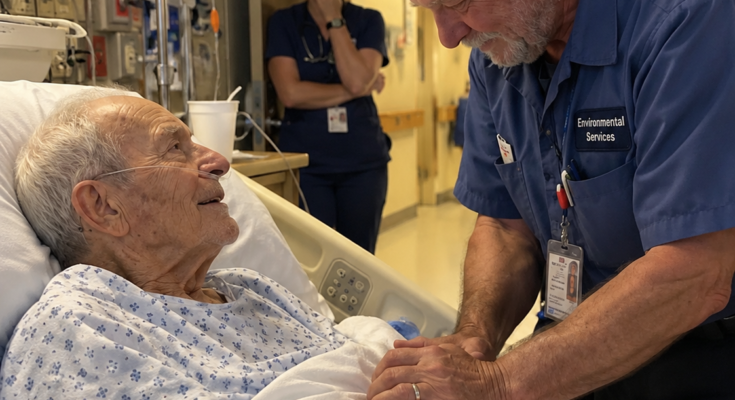
Earl pulled a vinyl chair beside the bed and took Arthur’s hand between both of his.
“I’m right here, buddy.”
Arthur’s mouth trembled. “They said I might not wake up.”
Earl leaned closer.
“Four years ago, Clara was in 208 during that ice storm. Remember?”
Arthur closed his eyes.
“The roads were frozen. You couldn’t get here. She was scared too. I sat with her until the ambulance from your county finally got through.”
Arthur began to cry.
Earl rubbed his thumb across the back of his hand.
“She told me if she ever went first, I was supposed to tell you she’d be waiting by that creek where you two used to fish.”
Arthur’s shoulders shook.
“She said that?”
“She did.”
“You never told me.”
“You weren’t ready to hear it then.”
Arthur cried harder.
Earl waited.
No rushing.
No correcting.
No telling him to calm down.
After a minute, Earl said, “You aren’t going into that operating room alone. I’ll walk with you as far as they’ll let me, and I’ll be right outside when you come back.”
Arthur took a deep breath.
Then another.
Finally he nodded.
“Okay.”
The orderlies unlocked the wheels.
Earl walked beside the gurney all the way to the surgical doors.
Then he sat down in the hallway.
Chloe stood nearby, still holding her clipboard.
For the first time, it felt heavy.
She looked at Earl’s faded wedding ring.
Then at the polished floor beneath her shoes.
Then at the empty chair beside him.
An hour later, Chloe walked into the supply closet.
She filled a fresh bucket with warm water.
Then she took a mop.
━━━━━━━━━━━━━━━━━━━━
Part Two — The Things Nobody Put in the Chart
Brenda found Chloe halfway through cleaning Room 304.
“You know environmental services is going to yell at you.”
Chloe kept mopping.
“They can write me up.”
Brenda leaned against the doorway, smiling.
“So?”
“So what?”
“Did you finally see it?”
Chloe stopped.
She hated how quickly tears came.
“I thought he was wasting time.”
“No. You thought time only counted when it showed up in a chart.”
That hurt because it was true.
Arthur survived surgery.
It took nearly six hours.
Earl stayed until the surgeon finally came out and said the repair had gone better than expected. By then Earl’s shift had ended almost three hours earlier.
When Arthur woke later that afternoon, the first person he asked for was Earl.
The second person was Chloe.
That surprised her.
She went into his room.
Arthur looked pale and exhausted, but he smiled.
“You found him.”
“Yes.”
“Thank you.”
Chloe pulled the chair closer.
“I should have found him sooner.”
Arthur studied her.
“You’re young.”
“I’m twenty-eight.”
“Exactly.”
She almost laughed.
Then Arthur said, “People think old men are scared of dying.”
“Aren’t you?”
“Of course.”
He looked toward the window.
“But sometimes we’re more scared nobody will remember who we were before we became a patient.”
That sentence stayed with her.
Over the next few weeks, Chloe started noticing things she had ignored before.
Earl didn’t just talk randomly.
He listened for specific things.
If a patient was waiting on family, he asked who was coming.
If somebody had no visitors, Earl made sure their water pitcher was within reach before leaving.
He knew which veterans wanted to talk about service and which absolutely did not.
He knew that Mrs. Gable’s daughter had finally gotten a ride.
He knew one man in oncology had a dog named Pickles and that showing him a photograph of the dog could get him through blood draws without shaking.
None of it was officially Earl’s responsibility.
That was the problem.
Because when something belongs to nobody’s job description, it often belongs to whoever notices.
One night Chloe found Earl sitting outside Room 221.
He wasn’t inside talking.
He was simply sitting in the hallway.
“What are you doing?”
“Waiting.”
“For what?”
“The lady in there lost her husband last month.”
“So?”
“She finally fell asleep.”
Chloe frowned.
“And?”
“She asked me to sit where she could see somebody through the doorway if she woke up.”
Chloe looked at the clock.
“Your shift ended twenty minutes ago.”
“I know.”
“Earl.”
He looked at her.
“What?”
“You can’t keep staying late like this.”
He smiled sadly.
“Why not?”
That was when Chloe realized she had never asked him anything about his own life.
She sat beside him.
“Because eventually you’re going to wear yourself out taking care of strangers.”
Earl looked through the doorway toward the sleeping patient.
“Martha used to say that.”
“Martha?”
“My wife.”
Chloe glanced at his ring.
“She died here?”
“Room 214.”
Six months earlier.
Earl told her the story in pieces.
Martha had been admitted with heart failure that worsened quickly. Their daughter lived in Arizona and barely made it back in time. Earl spent twelve days in that room, sleeping badly in a reclining chair and learning every sound the machines made.
On the final night, Martha woke around two in the morning and asked him to open the blinds.
“There wasn’t anything to see,” Earl said. “Parking lot. Ambulance bay. Rain.”
“What did she say?”
“She said she wanted to see the world one more time.”
Chloe swallowed.
“So I opened them.”
“And then?”
Earl stared at his hands.
“She asked if I’d be okay.”
“What did you tell her?”
“I lied.”
Chloe smiled faintly.
“Good lie?”
“Terrible one.”
He rubbed his wedding ring.
“I said I’d be fine.”
They sat in silence.
Then Earl said, “After she died, I went home. First morning, I made two cups of coffee.”
Chloe looked at him.
“Habit.”
He nodded.
“I poured one down the sink.”
That was when she understood why Earl stayed so long with lonely patients.
He wasn’t playing social worker.
He wasn’t pretending to be a nurse.
He knew what a room felt like after the person you loved was gone.
He knew the sound of fear nobody could medicate.
And perhaps because of that, he could recognize loneliness before anybody else did.
A month after Arthur’s surgery, hospital administration received a complaint.
Not about Earl.
About staffing delays.
Several room turnovers had exceeded targets during night shift, and someone had specifically noted that environmental services personnel were “engaging in nonessential patient conversation.”
Chloe knew immediately who the sentence referred to.
Six weeks earlier, she might have agreed.
Instead, she walked into Brenda’s office and said, “I want to write a statement.”
Brenda looked up.
“About Earl?”
“Yes.”
“Why?”
“Because ‘nonessential’ isn’t accurate.”
The administration review became bigger than anyone expected.
Nurses gave examples.
Patients submitted letters.
Arthur Hargrove’s daughter wrote that her father would have refused surgery if Earl hadn’t helped him.
Mrs. Gable wrote that Earl sat with her while she waited to learn whether a mass was cancerous.
It wasn’t.
A widow from the medical floor wrote that Earl had found a phone charger so she could speak to her son before a procedure.
An oncologist admitted Earl had once alerted staff that a normally talkative patient had become withdrawn and confused. The patient was later found to have a medication-related complication.
Earl was horrified by all the attention.
“I mop floors,” he kept saying.
Brenda told him, “Yes. Apparently while accidentally becoming indispensable.”
The hospital did not turn Earl into a therapist or ask custodians to perform clinical work. That would have been irresponsible.
Instead, something smarter happened.
They created a small volunteer companionship program for evenings and nights.
Retired staff.
Community volunteers.
Chaplains.
People trained to sit with patients who were alone, listen, contact appropriate staff when needed, and stay within clear boundaries.
They called it Night Companion.
Earl hated the name.
“Says too much.”
Chloe asked, “What would you call it?”
He shrugged.
“Just sitting with folks.”
The name stayed.
But Earl became its first volunteer after finishing his regular shift.
On one condition.
“I’m still keeping my mop.”
Nobody argued.
━━━━━━━━━━━━━━━━━━━━
Part Three — The Empty Chair Beside Earl
Two years passed.
Chloe changed too.
Not in the dramatic way stories sometimes pretend people change.
She was still impatient when exhausted.
Still obsessed with having medications on time.
Still capable of terrifying nursing students with one look when they forgot to chart something important.
But she began pulling chairs closer.
That was the difference.
Sometimes care took thirty seconds longer.
Sometimes she asked, “Who are you worried about right now?”
Sometimes she stopped saying, “Don’t be scared,” because she realized frightened people already knew they were frightened.
Instead, she started saying, “Tell me what part scares you most.”
That question changed conversations.
Earl kept working.
Everyone told him to retire.
He refused.
Then, at sixty-nine, his knee finally decided for him.
One February night, he nearly fell while lifting a trash bag.
Brenda saw it.
“Enough.”
“I’m fine.”
“You are limping sideways.”
“That’s just how I walk.”
“Earl.”
He knew that tone.
He retired from environmental services three months later.
The hospital threw him a party in the cafeteria.
He hated every second.
There were balloons.
A sheet cake with a badly drawn mop on it.
Arthur Hargrove came.
So did Mrs. Gable.
So did former patients Chloe had never met.
One woman drove nearly ninety miles because Earl had sat beside her teenage son after a motorcycle accident while she raced to the hospital.
At the end, Chloe handed Earl a small box.
Inside was a brass plaque.
EARL BENTON
31 YEARS OF SERVICE
THANK YOU FOR SEEING PEOPLE
Earl read it.
Then said, “That’s too many words.”
Chloe laughed.
“You complain a lot for someone retiring.”
“I’ve earned it.”
But Earl didn’t really leave.
Every Tuesday and Thursday evening, he returned wearing khaki pants instead of hospital blues.
No mop.
No cart.
Just a visitor badge that said:
EARL — NIGHT COMPANION VOLUNTEER
He hated that too.
Then one winter morning, three years after Arthur’s surgery, Chloe was working when Brenda called her into the break room.
Brenda had retired six months earlier but still occasionally came in to harass everyone, which she called “maintaining standards.”
That morning she wasn’t smiling.
“Earl’s downstairs.”
Chloe frowned.
“For volunteering?”
“No.”
Something in Brenda’s face made Chloe stand.
Earl had been admitted overnight after severe chest pain.
The tests showed significant coronary disease.
He needed bypass surgery.
When Chloe entered Room 412, Earl was sitting in the bed wearing a hospital gown, looking deeply offended by the entire concept.
“This thing doesn’t close in the back.”
“That is not new information.”
“I’ve spent thirty-one years knowing these gowns were stupid. Somehow wearing one makes them worse.”
Chloe pulled a chair beside him.
“You scared?”
Earl looked at her.
“No.”
She waited.
He sighed.
“Yes.”
“Good.”
“Good?”
“Means you’re not lying to me.”
He smiled faintly.
Then his expression changed.
“Martha was in this building.”
“I know.”
“I’ve never been upstairs as a patient since.”
Chloe suddenly understood.
Earl wasn’t only afraid of surgery.
He was afraid of lying in the same kind of bed where he had watched his wife die.
He looked toward the window.
“I’ve held a lot of hands in here.”
“You have.”
He swallowed.
“Funny thing is, mine feels pretty empty.”
Chloe didn’t answer.
She simply placed her clipboard on the floor.
Then she took his hand.
Earl looked at her.
“You’ve got work.”
“It can wait five minutes.”
A smile appeared.
“That’s what I used to tell you.”
“I remember.”
A few minutes later, a transport orderly arrived.
“Mr. Benton, they’re ready downstairs.”
Earl nodded.
But his fingers tightened around Chloe’s.
She looked at him.
“You want me to walk?”
His eyes filled.
“If you don’t mind.”
So Chloe walked with Earl.
Past the nurses’ station.
Past the chapel doors he had cleaned thousands of times.
Past the hallway where he had once sat waiting for Arthur Hargrove to return from surgery.
At the elevator, Earl stopped.
“You don’t have to go farther.”
“I know.”
He looked at their hands.
“Chloe?”
“Yes?”
“Martha would have liked you.”
That nearly ended her.
She squeezed his hand.
“I wish I’d met her.”
“She would have told you to stop working so much.”
“Then maybe I wouldn’t have liked her.”
Earl laughed.
The doors opened.
Chloe walked with him all the way to the surgical suite.
Then she sat in the waiting room.
Exactly where Earl had once promised Arthur he would sit.
The surgery took nearly five hours.
It went well.
When Earl woke, confused and groggy, Chloe was still there.
He squinted at her.
“You’re behind on your rooms.”
She laughed so hard the nurse beside her jumped.
“Go back to sleep.”
Earl recovered slowly.
He returned to volunteering six months later, against everyone’s advice.
But only once a week.
At seventy-four, he finally stopped coming regularly.
His daughter convinced him to move closer to her in Arizona.
Before he left West Virginia, the hospital held one last gathering for him.
No balloons this time.
Earl had threatened legal action.
On the wall outside the cardiac wing, they mounted a small plaque beside two chairs.
It read:
THE EARL BENTON CHAIRS
For patients, families, staff, and anyone who needs somebody to sit for a while.
Earl stood staring at it.
“Still too many words.”
Chloe smiled.
“You’ll survive.”
He looked at her.
“That’s never guaranteed.”
“No.”
Then Earl tapped one of the chairs.
“But somebody can sit with you while you find out.”
Years later, Chloe became charge nurse on that same cardiac floor.
New nurses sometimes complained about the two chairs in the hallway because they were always being moved into patient rooms.
Chloe never stopped them.
One night, a twenty-four-year-old nurse said, “People keep dragging those chairs everywhere. They’re in the way.”
Chloe looked down the corridor.
An elderly man sat in one of them beside his sleeping wife.
In the other, a volunteer was talking quietly with a patient whose family lived three states away.
Chloe smiled.
“Keep watching.”
The young nurse frowned.
“What?”
“Nothing.”
Then Chloe picked up her clipboard and continued her rounds.
Earl died at eighty-one.
His daughter called the hospital herself.
She said he went peacefully at home after several weeks of declining health. She had been holding one hand.
His grandson held the other.
When Chloe heard, she went into an empty supply room and cried.
The next morning, she placed something beneath the plaque outside the cardiac wing.
Not flowers.
A mop.
A tiny toy one, purchased from the hospital gift shop’s children’s cleaning set.
Brenda came by later and saw it.
“You know he’d hate that.”
“I know.”
“He’d say it was sentimental nonsense.”
“I know.”
They stood there together.
Then Brenda sat in one of Earl’s chairs.
Chloe sat in the other.
For a while, neither woman spoke.
That felt appropriate.
Because Earl Benton had spent more than three decades teaching people something simple that hospitals, families, and busy lives sometimes forget.
Not every kind of suffering needs an answer.
Not every frightened person needs advice.
Not every lonely room needs to be filled with words.
Sometimes the most useful thing one human being can offer another is a chair pulled close, a hand held without hurry, and the quiet promise:
“I’m right here.”