Part One — My Mother’s Final Safeguard
My name is Miranda. I was thirty-four when I walked out of a county courthouse with empty hands and a chest so tight it felt like I had forgotten how to breathe. Richard’s lawyer wore the satisfied expression of someone who had checked every box. Richard himself didn’t look ashamed. He looked lighter, like he had finally put something heavy down.
The temporary custody arrangement left our children primarily with him while I established stable housing. He kept the suburban house under the divorce settlement, along with most of the life we had spent thirteen years assembling inside it. I watched my children climb into his SUV in the courthouse parking lot, their faces pressed against the glass, and realized I didn’t even have a real destination to give them when they asked where I was going.
So I drove two hours out of the city to my mother’s old country place.
Richard hated that house. He called it “the haunted farmhouse,” “your mother’s money pit,” and once, during an argument, “a pile of rotten lumber surrounded by weeds.” After Mom died eighteen months earlier, he refused to spend a single weekend there. He repeatedly suggested I sell it and use whatever little money I got to renovate our kitchen.
I never did.
That turned out to be one of the smartest decisions of my life.
The farmhouse looked exactly as neglected as I remembered. Peeling white paint. Uneven shutters. Weeds crawling over the porch steps. A wind chime tapping the same dull notes again and again. Inside smelled like dust and old fabric, like time had been folded carefully and left there.
That first night, I slept on the couch with my coat still on and my suitcase beside my feet. I didn’t trust comfort yet. Every time I closed my eyes, I heard the judge’s voice. Every time I opened them, I saw my children leaving in Richard’s SUV.
By morning, numbness became survival.
If this was where I had to begin, then I would begin.
I cleaned everything. Cabinets. Floors. Windows. Mouse droppings beneath the sink. Every time I found something belonging to Mom—a recipe card, a bent hairpin, an old photograph—I felt both smaller and steadier.
On the third day, I noticed the hallway panel.
One piece of wood didn’t match the others. It was only slightly newer, but once I noticed it, I couldn’t stop staring. Mom had been meticulous. Nothing in her house was accidentally crooked.
I found a screwdriver and pried carefully.
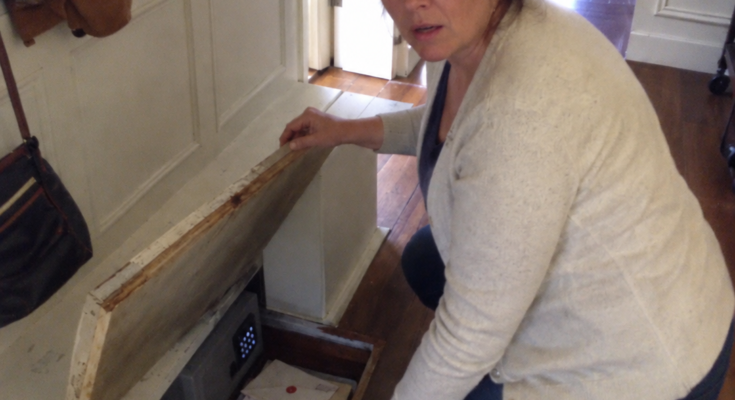
Behind the panel was a narrow cavity.
Inside sat a small metal safe.
My mouth went dry.
Mom was private, but she had never been secretive with me. I carried the safe to the kitchen table. It required four numbers.
Her birthday didn’t work.
My father’s birthday didn’t work.
Then I entered mine.
Click.
My knees actually weakened.
Inside was an envelope bearing my name in Mom’s careful handwriting. Beneath it were several items wrapped in soft cloth, an old property survey, and a shiny brass key that looked far too new to belong anywhere in that house.
I opened the letter first.
My dearest Miranda,
If you have found this, I hope you are merely cleaning. But if you are reading it because Richard has finally succeeded in making you believe you have nowhere else to stand, then this secret has always been my final safeguard for you.
I stopped breathing.
Mom had died before Richard and I separated.
I had never told her how bad things had become.
Or at least I thought I hadn’t.
I continued.
You have spent years telling me Richard is practical. I have spent years watching him call every thing that belongs only to you useless until you are tempted to give it up. He hated this house because he could not control it. That is precisely why I never encouraged you to sell it.
My hands started trembling.
The first wrapped item was a deed.
Not just for the farmhouse.
For sixty-three acres.
I read the legal description three times because I assumed I was misunderstanding it. The little house sat on only two visible cleared acres, but the wooded land behind it, the creek, the abandoned pasture, and a long strip stretching almost to the county road were all part of the same property.
Mom had quietly assembled the parcels over twenty-seven years.
I had inherited all of it.
Richard knew about the house.
He did not know about the land.
But that wasn’t the real secret.
The second document was dated seven months before Mom died.
OPTION AND LEASE AGREEMENT — MIDSTATE ENERGY COOPERATIVE.
I had no idea what I was looking at.
Then I found the payment schedule.
Mom had negotiated an option allowing an energy cooperative to study a portion of the back acreage for a battery-storage and electrical infrastructure project. They had been paying annual option fees while permitting and utility studies moved forward.
If the project received final approval, the long-term ground lease would pay considerably more.
Mom had never spent a dollar of it.
The payments had been going into an account at a small bank in town.
I looked at the brass key again.
Underneath the lease was a bank statement from shortly before Mom died.
Balance: $186,442.71.
I covered my mouth.
The key belonged to a safe-deposit box.
Mom’s letter continued.
Before you get angry that I did not tell you, remember how many times Richard asked whether I had “finally done something useful with that dirt.” If he had known this property had value, I believe he would have pressured you until it became part of your marriage instead of something held separately for you. I wanted you to have one place, one account, and one decision that nobody could bully you into surrendering.
Then came the sentence that made me cry harder than I had since leaving the courthouse.
A woman should never remain in a marriage because leaving would make her homeless.
I put my head on the kitchen table.
Mom had known.
Maybe not everything.
But enough.
There was one final page.
A business card was taped to it.
Margaret Sloan, Attorney at Law.
Mom had written underneath:
Call Margaret before you call anyone else. Especially Richard.
I called.
When I gave Margaret my name, she went silent for a second.
Then she said, “I’ve been wondering when you’d find the safe.”
━━━━━━━━━━━━━━━━━━━━
Part Two — What Richard Had Never Bothered to Ask About
Margaret Sloan was seventy-two, sharp-eyed, and drove an ancient Volvo that sounded as if it resented every mile. She arrived at the farmhouse that afternoon carrying a leather folder and two coffees.
She had been my mother’s attorney for almost fifteen years.
“Your mother worried about you,” she said.
“Why didn’t she tell me?”
“She tried.”
That hurt.
Margaret reminded me of conversations I had dismissed. Mom asking whether my name was on the house Richard and I shared. Mom asking if I had retirement savings in my own name. Mom telling me not to sell the country property merely because Richard disliked maintaining something he didn’t use.
I had always answered the same way.
We’re fine, Mom.
We weren’t fine.
Margaret reviewed the safe contents and explained what mattered. The farmhouse and acreage had passed to me through my mother’s estate and had been kept separately. The bank account contained lease-option payments derived from that property. She cautioned me not to assume anything about how every dollar would be treated legally without reviewing my divorce judgment and state law, but Mom had deliberately structured and documented everything to avoid mixing the property with marital accounts.
“So I have a hundred and eighty-six thousand dollars?”
“You have access to an account you inherited, subject to us confirming the final estate and divorce documents.”
I almost laughed.
Even after the number was sitting in front of me, Margaret refused to let me turn it into a fantasy.
“What about the lease?”
“Still an option. Not guaranteed. Do not start spending future money that doesn’t exist.”
That sounded exactly like something Mom would have hired her to say.
Then Margaret looked around the kitchen.
“But Miranda, you are not homeless.”
That broke me.
I cried into a paper napkin while a seventy-two-year-old attorney politely pretended to study the sugar bowl.
The next morning, we went to the bank.
The brass key opened a safe-deposit box containing original deeds, tax records, Mom’s signed estate documents, photographs of boundary markers, correspondence with the utility company, and a second letter.
This one was shorter.
Miranda, security is not a husband, a house in his name, or a promise that somebody will always behave kindly. Security is knowing you can survive if they don’t.
I read that sentence until I could almost hear Mom saying it.
I did not rush out and buy a new car.
I did not call Richard and announce that I had money.
I did not hire a revenge lawyer.
Margaret helped me make a list.
First: stabilize housing.
Second: repair only what the farmhouse genuinely needed.
Third: obtain a full copy of the divorce and custody orders.
Fourth: establish a realistic budget.
Fifth: stop making decisions while furious.
The farmhouse needed work, but not nearly as much as Richard had always claimed. The roof over the back room leaked. The electrical panel was ancient. The furnace needed replacing. The porch railing was unsafe.
Those things cost money.
Peeling paint didn’t matter.
Ugly cabinets didn’t matter.
Mom’s chipped countertops definitely did not matter.
Within two months, the house was safe.
I turned Mom’s sewing room into a bedroom for my daughter, Lucy. The small room across the hall became my son Caleb’s. I let them choose paint colors when they visited.
Caleb chose dark blue.
Lucy chose a shade of yellow so bright I felt personally attacked by it.
I painted both.
The custody situation did not magically reverse because I discovered an inheritance. Courts do not treat children like prizes awarded to whoever has the nicest house. But stable housing mattered, and so did showing that I could provide a consistent home, school arrangements, transportation, and a workable parenting schedule.
My attorney helped me petition for a modification when circumstances supported it.
Richard fought.
Of course he did.
He called the farmhouse “isolated.”
His attorney referred to my finances as “uncertain.”
Then Richard made a mistake.
During a mediation session, he said, “Miranda can’t seriously expect the children to spend half their lives in that worthless shack.”
My attorney looked at me.
I said nothing.
Richard still had no idea.
Eventually, the parenting schedule expanded. First longer weekends. Then school breaks. Later, after additional review and agreements, we moved toward substantially shared parenting time.
The first Friday both children came to stay for an entire week, I had their rooms ready.
Lucy walked into the yellow room and screamed happily.
Caleb ran outside and disappeared toward the creek before I could tell him to change shoes.
That evening we ate frozen pizza on Mom’s old porch.
Caleb looked toward the woods.
“Dad said this place is basically falling apart.”
I looked at the repaired railing beneath his hand.
“Your father has opinions.”
Lucy asked, “Are we poor now?”
The question nearly stopped my heart.
“Why would you ask that?”
“Dad said you lost everything.”
I looked at both children.
There are moments during divorce when you desperately want to defend yourself by making the other parent look smaller.
I didn’t.
“I lost some things,” I said. “And some things changed. But you two don’t need to worry about adult money.”
Caleb frowned. “So we’re okay?”
“Yes.”
That was all they needed.
Six months after I moved in, the utility cooperative completed another stage of its approval process.
The lease was moving forward.
Still not final.
Still not money I intended to count before it arrived.
But the possibility was becoming real.
That was also when Richard finally discovered what Mom had left me.
Not because I told him.
Because he saw survey crews working near the back acreage when he dropped off the kids.
He called me that evening.
“What are those people doing on your mother’s property?”
“My property.”
“You know what I mean.”
“Yes.”
“Why are there utility trucks out there?”
I hesitated.
Then I realized I was tired of protecting information simply because Richard felt entitled to it.
“They’re working under an agreement Mom made before she died.”
“What agreement?”
“A land-use option.”
Silence.
“What land?”
I almost smiled.
“The sixty-three acres.”
The silence on the other end changed.
“Sixty-three?”
“Yes.”
“You told me your mother had five.”
“No. You told me she had five. You never asked.”
Another silence.
Then:
“How much is that land worth?”
There it was.
Not Are you okay?
Not Will this affect the children?
Value.
Money.
Ownership.
The questions that had always mattered most to Richard.
“I have to go.”
“Miranda, wait.”
I hung up.
He called three more times.
I didn’t answer.
For years, Richard had mocked the one thing he thought had no value.
The moment he learned it might be worth something, he suddenly wanted details.
Mom had predicted him perfectly.
━━━━━━━━━━━━━━━━━━━━
Part Three — The Place He Refused to Step Foot In
Richard’s interest in the property became intense for several weeks.
He asked whether the lease had existed during our marriage. He asked what the account balance was. He asked whether my mother had hidden assets from “the family.” Then, through lawyers rather than arguments, the relevant documents were reviewed.
The important thing was not that I had somehow discovered a magic loophole.
There wasn’t one.
The important thing was that Mom had documented everything.
Dates.
Ownership.
Inheritance records.
Account statements.
Correspondence.
She had spent years doing the boring work that prevents emotional people from rewriting history later.
Richard was entitled to whatever the law and our settlement gave him.
He was not entitled to more simply because the property turned out to be valuable.
The issue was handled through attorneys.
That was one of the best lessons of my divorce.
Not every accusation deserves a kitchen-table argument.
Sometimes you hand the paperwork to somebody who bills by the hour and go water tomatoes.
I planted a garden that spring.
Mom had always kept one behind the house.
At first, I told myself I was doing it for the children.
The truth was that I needed to put something in the ground and watch it remain.
Tomatoes.
Beans.
Zucchini.
Far too much zucchini.
The kids spent increasingly more time at the farmhouse as our parenting arrangement evolved. They built a rope swing beside the creek. Caleb discovered that frogs are easier to catch than to remove from a bathtub. Lucy insisted on planting sunflowers along the fence.
The house began looking less like the place I had fled to and more like somewhere we lived.
Then, nearly eighteen months after the divorce, the cooperative exercised the next stage of its agreement.
The payments increased.
Not millions overnight.
Not lottery money.
Something better.
Reliable money.
Enough to maintain the property, save, invest cautiously, and give me choices.
I started doing bookkeeping remotely for two local businesses. Eventually, I picked up several more clients. For the first time since my twenties, the money entering my account had my name attached to the work that produced it.
That mattered more than I expected.
Richard and I slowly became better at being divorced.
Not friends.
Better.
There is a difference.
The children forced us to learn.
When Caleb broke his wrist, we spent four hours together in an emergency room without fighting.
When Lucy had a school performance, we sat three chairs apart and both applauded.
Eventually, Richard stopped asking about the land.
Then one Saturday, almost two years after everything ended, he pulled into my driveway to collect the children and got out of the SUV.
That alone surprised me.
During our marriage, he had always refused to enter the farmhouse.
He looked around.
The shutters were straight now.
The exterior had been painted.
Mom’s old barn had a new roof.
Sunflowers lined the fence.
The children’s bicycles lay abandoned beside the porch.
“You fixed it up.”
“A little.”
He looked toward the woods.
“I really thought this place was worthless.”
“I know.”
He put his hands in his pockets.
“I said a lot of things.”
“Yes.”
He looked uncomfortable.
Then he said, “The kids love it here.”
That was not an apology.
But it was the first time he had acknowledged something about my new life without mocking it.
“They do.”
Caleb came running from the house carrying his backpack.
“Dad, Mom says there’s an owl in the barn but she won’t let me climb up to see the nest.”
Richard looked at me.
“Good.”
“Traitor,” Caleb muttered.
Lucy followed with a jar containing something that should never have been brought inside.
Richard sighed.
And for one absurd second, we almost looked like a normal family.
Not the old family.
A new arrangement.
Messier.
Separate.
Still responsible for two children who needed us to stop using them as evidence that one parent had won.
After they left, I sat on the porch alone.
Mom’s wind chime moved above me.
Same dull notes.
I remembered the woman who had arrived there after court with one suitcase, convinced her life was over.
I wanted to tell her something.
Losing your old life is not always the same thing as losing your future.
Three years after the divorce, Margaret called me.
“Are you sitting down?”
My stomach tightened.
“I hate when people ask that.”
“The cooperative finalized its long-term agreement.”
I sat anyway.
The lease would provide a substantial annual income for the portion of land they used, with scheduled increases over time.
I thought I would scream.
Instead, I cried.
Not because I was suddenly rich.
Because I remembered Mom’s safe.
My birthday opening it.
Her handwriting.
My final safeguard.
She had not left me a fortune hidden behind a wall.
She had left me options.
That was the real inheritance.
The property remains mostly unchanged.
The cooperative uses acreage far behind the house, screened by trees and accessed from another road. I kept the farmhouse, creek, barn, garden, and enough surrounding land that Mom’s place still feels like Mom’s place.
I also kept one ugly section of hallway paneling.
I repaired everything around it.
Not that piece.
Behind it, I placed the empty metal safe again.
Inside are copies of the important records.
My own updated estate documents.
Instructions for the children.
And a letter.
Not because I expect either of them to suffer through a divorce.
I hope they never do.
But life has taught me not to confuse hope with preparation.
The letter begins:
Dear Caleb and Lucy, if you are reading this because life has gone differently than you planned, please remember that losing something does not make you worthless.
I tell them where everything is.
Who to call.
What not to sign without advice.
Then I tell them about their grandmother.
At the end, I copied one sentence from Mom’s original letter:
A person should never remain somewhere unsafe simply because leaving would make them homeless.
Richard once told me my mother’s farmhouse was the most useless thing I owned.
For years, I believed him.
That was never really about property.
I had spent too much of my marriage allowing his opinion to determine the value of things.
My work.
My judgment.
My inheritance.
Eventually, myself.
The divorce took the suburban house.
It changed how often I saw my children.
It destroyed a version of my future I had spent thirteen years believing was secure.
But it also forced me onto a gravel driveway leading toward the one place Richard had always dismissed because he saw no value in it.
My mother saw something different.
She saw land.
She saw independence.
She saw a place where her daughter could stand if everything else disappeared.
Most importantly, she saw me before I remembered how to see myself.
The day I opened that safe, I thought Richard had won the divorce and Mom had secretly left me the thing that would help me beat him.
I understand it differently now.
There was never anything inside that safe meant to destroy Richard.
It was there to rebuild me.
And that turned out to be worth far more.