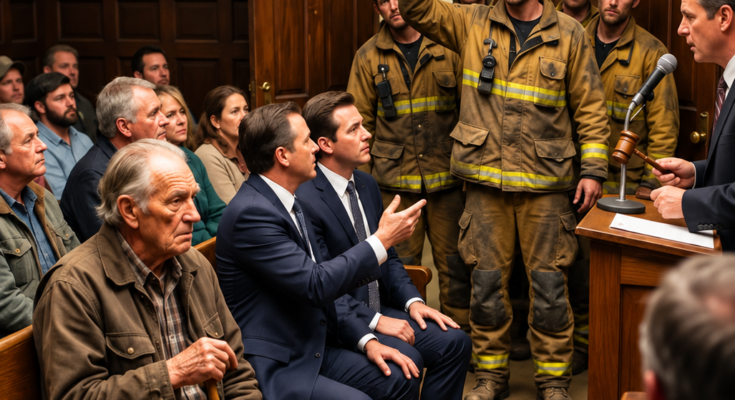
Part One — The Bid Nobody Expected
“Three hundred and twenty thousand, going once!”
The auctioneer’s voice echoed through the cold courthouse chamber.
I sat in the back row gripping my cane with both hands.
My name is Silas Mercer. I was seventy-one years old, widowed, and about to watch strangers purchase the fifty acres where I had spent most of my adult life.
The men bidding wore tailored suits and expensive watches. They barely looked at me.
To them, my farm wasn’t a home.
It was acreage.
Road frontage.
Development potential.
Luxury townhouses where my pasture used to be.
“Three hundred and twenty thousand, going twice!”
Eight months earlier, I had still believed I could save the farm.
Then my wife, Elowen, became terribly ill.
We used our savings for treatment. Sold equipment. Cashed out investments. I even sold the one thing I had sworn I never would.
Caspian.
He was a massive silver-gray draft horse who had been with me since shortly after I returned from military service.
I came home carrying things I didn’t know how to explain.
Nightmares.
Anger.
Long stretches when I couldn’t make myself leave the house.
Caspian never asked questions.
He simply stood beside me.
When things became bad, he would press that enormous forehead against my chest and breathe.
Somehow, I learned to breathe with him.
Later, Elowen and I opened the farm to struggling veterans and troubled teenagers.
We never called it therapy.
We just gave people work.
Fence posts to repair.
Stalls to clean.
Horses to groom.
Sometimes the person who arrived refusing to speak would spend an hour beside Caspian and leave saying a few words.
Sometimes that was enough.
For ten years, hundreds of people passed through our gate.
Then Elowen got sick.
To keep her comfortable at home, I sold Caspian to a wealthy horse estate three states away.
I stood beside the road as his trailer disappeared.
Elowen died two weeks later.
After that, I stopped fighting the bank.
“Three hundred and twenty thousand—”
The courtroom doors suddenly opened.
Six firefighters walked inside.
Wildland crew.
Heavy boots.
Soot-stained jackets.
The captain raised his hand.
“Four hundred and fifty thousand dollars.”
Every head turned.
One developer laughed.
“There isn’t four-fifty worth of profit in that land.”
The captain didn’t even look at him.
“Four hundred and fifty thousand. Cash. Funds are held in trust.”
Nobody bid again.
The gavel came down.
“Sold.”
I stumbled outside before anyone could see me cry.
Then the firefighters followed.
Their captain carried a manila envelope.
“If you’re looking for the keys,” I said, “they’re under the mat.”
“We’re not here for the keys.”
He pointed across the parking lot.
A long silver horse trailer was attached to their truck.
One firefighter lowered the ramp.
Then I heard it.
A deep, impatient whinny I had heard thousands of times.
My cane slipped from my hand.
A silver-gray head appeared in the doorway.
“Caspian?”
The horse stepped down.
And before anyone could stop me, seventy-one years disappeared.
I walked straight toward him.
━━━━━━━━━━━━━━━━━━━━
Part Two — The Men I Had Forgotten
Caspian recognized me before I reached him.
His ears came forward.
Then he made that low rumbling sound he used to make every morning when I entered the barn.
I put both hands against his face.
“You old fool.”
My voice broke.
Caspian pushed his forehead against my chest.
Exactly where he always had.
And I cried.
Not politely.
Not quietly.
Eight months of grief came out in that parking lot.
Elowen.
The farm.
The hospital bills.
Watching Caspian leave.
Everything.
I buried my face against his mane.
For several minutes, nobody interrupted.
Eventually, the fire captain stepped closer.
“Do you remember me?”
I wiped my eyes and looked at him.
Tall.
Broad shoulders.
Scar through one eyebrow.
Something about the eyes.
“I’m sorry.”
He smiled.
“Most people remember me with more hair.”
Then he said:
“Luke Brennan.”
My breath caught.
Luke had come to our farm at sixteen.
Angry at everybody.
His father was in prison. His mother was struggling with addiction. He had been suspended so many times that his school counselor had almost given up.
The first afternoon he came to the farm, Luke told me:
“I hate horses.”
Caspian immediately knocked his baseball cap into the mud.
Luke stayed three years.
I hadn’t seen him in almost twenty.
“You became a firefighter?”
“Eventually.”
He pointed toward the other men.
“Actually, you know some of them too.”
One stepped forward.
“Marcus Hill.”
I remembered him.
Army infantry.
Came home after losing two friends overseas.
Barely spoke for months.
Another smiled.
“Darren Cole.”
Former Marine.
Another had been a teenager who used to sleep in his car.
As they introduced themselves, pieces of the past came back.
Not everyone had visited at the same time.
Not everyone had stayed long.
But all six had walked through my barn at some point.
All six had known Elowen.
All six had known Caspian.
I stared at them.
“You bought my farm?”
Luke shook his head.
“We’re the ones who placed the bid.”
He handed me the envelope.
Inside was a document bearing a name I’d never seen before.
THE ELOWEN MERCER LAND & RECOVERY TRUST
I looked up.
“What is this?”
Luke smiled.
“About eighteen months ago, some of us started talking about reopening something like your program.”
“We had no idea what you were going through,” Marcus said. “Then we heard Mrs. Mercer had died.”
Luke continued.
“We learned the bank was taking the farm.”
“How?”
“Small towns are terrible at keeping secrets.”
Despite myself, I laughed.
Luke explained.
Former veterans.
Former teenagers.
Parents.
Counselors.
Local businesses.
People who had spent one summer, one month, or sometimes only one afternoon at our farm.
They had organized.
Some donated twenty dollars.
Some donated thousands.
A veterans’ foundation contributed.
A local businessman matched donations.
Then Luke contacted the estate that had purchased Caspian.
“The owner remembered you.”
I frowned.
“He bought Caspian from me once.”
“He said you refused his first offer because you wanted to know how the horse would be treated.”
That sounded like me.
Luke smiled.
“When he found out what we were doing, he said Caspian belonged here more than he belonged with him.”
“He sold him back?”
“No.”
Luke looked toward Caspian.
“He donated him.”
My knees weakened again.
I opened the last page in the envelope.
The farm would belong to the trust.
Its purpose was written clearly:
To provide restorative agricultural programs for veterans, first responders, grieving families, and vulnerable young people.
Then I reached one final clause.
I read it twice.
Silas Mercer shall retain lifetime residence and stewardship rights to the property.
I looked at Luke.
“You mean I’m not leaving?”
He shook his head.
“No, sir.”
Then he smiled.
“You’ve got work to do.”
━━━━━━━━━━━━━━━━━━━━
Part Three — What We Saved
I moved back into my own house that afternoon.
That sentence still sounds strange.
Technically, I had never moved out.
But for months, I’d lived there like a man waiting for eviction.
I stopped repairing things.
Stopped planting.
Stopped imagining another spring.
That evening, six firefighters sat around my kitchen table eating sandwiches while Caspian stood in the pasture outside as though he’d never left.
One chair remained empty.
Elowen’s.
For a moment, I couldn’t stop looking at it.
Luke noticed.
“She would’ve loved this.”
I nodded.
“She would’ve told all of you to take those filthy boots off before coming inside.”
Everyone looked down.
Six grown firefighters immediately removed their boots.
I laughed until my ribs hurt.
The work began that winter.
The barn needed repairs.
Fencing had collapsed.
One paddock was almost entirely overgrown.
I tried doing too much.
Luke caught me carrying lumber one morning.
“You’re seventy-one.”
“I know my age.”
“Apparently nobody told your back.”
He took the boards away from me.
For years, I had been the person helping other people.
I wasn’t very good at being helped.
Elowen used to tell me that.
“Receiving is part of generosity too,” she would say. “Otherwise you’re just being controlling with better manners.”
I hated when she was right.
By spring, the farm looked alive again.
Volunteers repaired the barn.
A local school donated garden supplies.
A veteran-owned construction company rebuilt the accessible ramp.
Someone painted a sign at the entrance:
ELOWEN’S FIELD
COME AS YOU ARE. LEAVE WITH SOMETHING TO CARRY FORWARD.
I pretended not to cry when I saw it.
Our first official group arrived in May.
Eight veterans.
Three firefighters dealing with injuries.
Four teenagers referred by local schools.
One boy named Caleb reminded me painfully of Luke.
Fifteen.
Hood pulled over his eyes.
Arms crossed.
Didn’t want to be there.
“This is stupid,” he told me.
“Probably.”
That surprised him.
He pointed toward Caspian.
“I don’t like horses.”
I almost laughed.
“That’s what the last troublemaker said.”
Caspian wandered over.
Caleb stepped backward.
“He bites?”
“Only people named Caleb.”
The boy stared at me.
Then realized I was joking.
For half a second, he smiled.
Caspian lowered his enormous head.
Caleb slowly reached out.
His fingers touched the horse’s nose.
And something in the boy’s shoulders relaxed.
Only a little.
But I noticed.
That’s how it starts.
Not with speeches.
Not with miracles.
Sometimes healing begins when your shoulders drop half an inch because, for the first time all week, you realize you’re safe.
The farm grew from there.
We never tried to become enormous.
Elowen would’ve hated that.
She believed good work became bad work when people became more interested in expansion than people.
So we stayed small.
A few groups at a time.
Gardening.
Woodworking.
Horse care.
Walking trails.
Coffee at the kitchen table.
There were counselors involved now, professionals who understood things I didn’t.
I was glad.
Caspian and I were never therapists.
We were simply good listeners.
Years passed.
Luke became one of the trust’s directors.
Marcus started bringing newly hired firefighters out twice a year.
Caleb eventually graduated high school.
On graduation morning, he came to the farm wearing a tie he’d clearly never tied before.
“What happened to you?” I asked.
“Shut up.”
Then he hugged me.
I let him.
The developers eventually built their townhouses somewhere else.
I sometimes see advertisements for them.
Granite countertops.
Private pools.
“Luxury living surrounded by nature.”
I don’t resent them.
Land changes hands.
Towns change.
People need homes.
But I’m grateful this particular piece of earth remained what Elowen and I intended it to be.
A place where someone having the worst season of their life can arrive without explaining everything first.
I lived on the farm for another nine years.
Caspian didn’t make it quite that long.
He died peacefully beneath the maple trees at thirty.
I was sitting beside him.
Luke was there.
So was Caleb.
I kept my hand against Caspian’s forehead until his breathing stopped.
That night, I thought losing him a second time would destroy me.
It didn’t.
It hurt.
Terribly.
But grief was different now.
The first time he left, I believed everything was being taken from me.
The second time, I understood something Elowen had tried to teach me for years.
Love doesn’t become meaningless because it ends.
Sometimes the ending is exactly what reveals how much was given.
We buried Caspian at the edge of the pasture.
On the marker, Luke wanted to write something grand.
I refused.
We settled on:
CASPIAN
HE STOOD STILL UNTIL WE COULD.
That was enough.
Today, I no longer handle the daily work.
My knees finally won that argument.
I sit on the porch more than I used to.
Sometimes people who came through the farm years ago return with children of their own.
Sometimes they don’t remember me.
That’s fine.
One afternoon, Luke asked whether I ever wished I had known everyone was raising money before the auction.
“No.”
“Why?”
“Because I probably would’ve stopped you.”
He laughed.
“Definitely.”
Then he became serious.
“We didn’t save you, you know.”
I looked at him.
“You saved me first.”
I shook my head.
“No, son.”
I pointed toward the pasture.
“You did the saving yourself. We just gave you somewhere to do it.”
That is the closest thing I’ve learned to truth.
For years, people thanked Elowen and me for helping them.
But farms don’t fix people.
Horses don’t erase trauma.
Old men certainly don’t possess magic.
Sometimes people simply need a safe place long enough to remember that their life can still become something different.
At the courthouse, I thought six soot-covered firefighters had arrived to save my land.
They did much more than that.
They returned Caspian.
They gave me back my home.
They put my wife’s name on a future she never lived to see.
But the greatest gift was something harder to describe.
After Elowen died, I believed the meaningful part of my life had ended.
I thought all that remained was losing things one by one.
My wife.
My horse.
My farm.
Eventually myself.
Then six men I barely recognized walked through a courthouse door.
Men I had once known as frightened teenagers, exhausted veterans, and people who weren’t sure they wanted another tomorrow.
They had grown up.
Built lives.
Found purpose.
And come back.
That was when I understood.
The work Elowen and I had done hadn’t ended when she died.
It had simply gone somewhere we couldn’t see.
Into other people.
And sometimes, years later, what you gave away comes walking back toward you.
Covered in soot.
Carrying an envelope.
And leading your old horse home.