
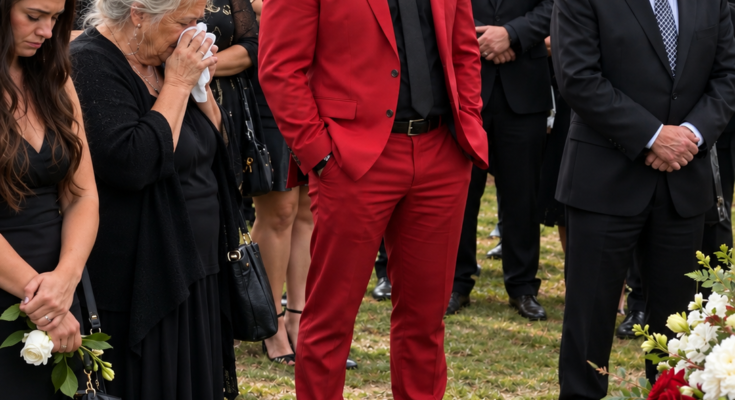
Part One — The Suit Nobody Was Supposed to Understand
My brother wore a bright red suit to Dad’s funeral.
Not burgundy.
Not dark red.
Bright red.
Every other man in the chapel wore black or gray, and there was Eric walking past our father’s casket looking like he was headed to some holiday party.
I was furious.
Dad had been traditional about everything.
Church on Sundays.
Dinner at six.
Shoes polished before weddings and funerals.
When I was sixteen, he made me change clothes because he thought my skirt was inappropriate for Grandma’s birthday.
So seeing Eric arrive dressed like that felt almost deliberately disrespectful.
I pulled him aside before the service.
“What the hell are you wearing?”
Eric looked exhausted.
There were dark circles beneath his eyes, and he hadn’t shaved properly.
“Not now, Sarah.”
“Dad would’ve hated this.”
He looked at me for a long moment.
Then he quietly said:
“No. He wouldn’t.”
Before I could ask what that meant, the minister called everyone to their seats.
I spent half the funeral angry at myself for being angry.
Dad was dead.
Nothing about Eric’s suit should have mattered.
But grief makes strange things feel enormous.
Every time I looked at that red jacket, I thought of all the things I believed Eric hadn’t done.
Dad had been sick for almost eighteen months.
I lived twenty minutes away and handled most of the visible responsibilities.
Doctor appointments.
Groceries.
Insurance paperwork.
Prescription pickups.
I was the one relatives called when they wanted updates.
Eric lived almost two hours away.
He was forever canceling family dinners.
Missing birthdays.
Showing up late.
Whenever I complained, Dad defended him.
“Your brother has his reasons.”
That sentence infuriated me.
What reasons?
I had a job too.
I had children.
I had responsibilities.
Yet somehow Eric always received understanding.
So when Dad died, a bitter little part of me thought:
At least now nobody can make excuses for him.
Then he arrived in that red suit.
After the service, we drove to the cemetery.
Dad’s attorney, Mr. Lawson, joined us there.
He had handled our family’s legal affairs for nearly thirty years.
He was seventy himself, with silver hair and the permanently serious expression of someone who had spent half his life reading contracts.
The second he saw Eric, he stopped walking.
His eyes went directly to the red jacket.
“Where did you get that suit?”
Eric frowned.
“Why?”
“Just answer me.”
“It was in Dad’s closet.”
That made no sense.
I’d gone through most of Dad’s clothing myself after he died.
There had been no red suit.
“Which closet?” I asked.
“The downstairs one.”
“Dad’s study doesn’t have a closet.”
Eric looked at me.
“Apparently it does.”
He explained that two days earlier he’d been searching for Dad’s military discharge papers.
Behind one of the bookcases in the study, he noticed a narrow wooden seam.
The entire shelf swung outward.
Behind it was a tiny storage space.
Three suits hung inside garment bags.
Two black.
One red.
Pinned to the red one was a small envelope.
On the front, Dad had written:
ERIC — WEAR THIS WHEN IT’S TIME. DON’T ARGUE WITH ME FOR ONCE.
Mr. Lawson’s face had gone pale.
“Did you check the pockets?”
Eric shook his head.
“No.”
“Take off the jacket.”
Eric blinked.
“What?”
“Please.”
Reluctantly, he removed it.
Mr. Lawson checked the outside pockets.
Then the inside ones.
Nothing.
His fingers moved along the lining.
Suddenly, he stopped over Eric’s chest.
Something crackled beneath the fabric.
The attorney turned the jacket inside out.
A small section of the lining had been stitched shut by hand.
Mr. Lawson stared at it.
Then he whispered:
“Your father told me I’d know when it was time.”
He opened his briefcase and removed a tiny pair of scissors.
My stomach tightened.
“What did Dad tell you?” I asked.
Mr. Lawson didn’t answer.
He carefully cut three stitches.
Then he reached inside the lining.
He pulled out a small brass key.
And a folded piece of paper.
Eric and I looked at each other.
Mr. Lawson unfolded the note.
His eyes moved across the handwriting.
Then he looked at my brother.
“Eric, your father kept his promise.”
Eric’s face changed.
“What promise?”
Mr. Lawson handed him the note.
There were only two lines.
If Eric wears the red suit, take both of my children to Box 317.
And Sarah, before you judge your brother one more time, let him tell you what he did for me.
I stopped breathing.
Eric stared at the ground.
And suddenly the red suit wasn’t the strangest thing about my father’s funeral.
━━━━━━━━━━━━━━━━━━━━
Part Two — What My Brother Had Been Hiding
The next morning, Eric and I met Mr. Lawson at Dad’s bank.
Neither of us spoke much.
I had spent most of the night replaying the last sentence.
Before you judge your brother one more time, let him tell you what he did for me.
I had judged Eric plenty.
Not only during Dad’s illness.
For most of our adult lives.
Eric had always been the unpredictable one.
He changed jobs more often than I did.
Moved twice.
Never married.
Drove an old truck that constantly needed repairs.
Dad defended him whenever I complained that Eric wasn’t “settled.”
Meanwhile, I had done everything correctly.
Marriage.
Mortgage.
Children.
Retirement account.
Color-coded calendar.
I had quietly built an identity around being the dependable child.
Maybe that was why Dad’s note bothered me so much.
Dependable people don’t like learning that they missed something important.
Mr. Lawson led us into a private room.
Box 317 was already waiting on the table.
The brass key from Eric’s jacket fit perfectly.
Inside was no pile of cash.
No jewelry.
No secret second will.
There were notebooks.
Receipts.
Medical records.
A flash drive.
And a thick envelope with both our names written across it.
Mr. Lawson pushed the envelope toward us.
“Your father asked that you read this together.”
I opened it.
The letter began:
Sarah and Eric, if you’re sitting together long enough to read this, I’ve already accomplished something that became surprisingly difficult in my final years.
I’ve gotten my children into the same room.
Despite myself, I almost laughed.
That sounded exactly like Dad.
Then the letter changed.
Sarah, you carried more than I should have allowed you to carry. You handled appointments, medicine, groceries, and all the practical things I was too proud to admit had become difficult. I knew you would do them because you always do. I should have thanked you more.
My eyes immediately filled.
Then I reached the next paragraph.
But there was another part of my illness you did not know about.
I stopped reading.
Eric looked away.
“What didn’t I know?”
He rubbed both hands over his face.
Then he said:
“Dad started falling.”
“What?”
“About ten months ago.”
“Why didn’t anyone tell me?”
“He wouldn’t let me.”
My anger returned instantly.
“And you listened?”
Eric’s voice stayed quiet.
“At first.”
Then he began telling me everything.
Dad’s heart condition had worsened faster than he’d admitted.
He’d begun waking confused at night.
Twice, he fell trying to reach the bathroom.
Once, Eric found him on the kitchen floor at two in the morning.
“Found him?”
I stared at him.
“You live two hours away.”
Eric looked at me.
“I hadn’t been living two hours away.”
My stomach dropped.
For almost a year, Eric had been sleeping four nights a week in Dad’s basement.
He drove from Dad’s house to work before sunrise.
Then drove back after his shift.
That was why he missed dinners.
That was why he canceled plans.
That was why he always looked tired.
“But why didn’t I see your truck?”
“Dad made me park behind the old hardware store.”
I stared at him.
“Why?”
“Because he didn’t want you to know how bad things were.”
“That’s ridiculous.”
“I told him that.”
“Then why agree?”
Eric’s eyes reddened.
“Because every time I said we should tell you, he said you were already doing too much.”
I didn’t know whether to scream or cry.
Eric continued.
Dad had eventually needed help bathing.
Getting dressed.
Using the stairs.
There were nights when he became frightened and disoriented.
Eric installed grab bars in the bathroom.
Built a second handrail.
Put motion lights along the hallway.
He learned how to change Dad’s wound dressings after a minor surgery.
He cooked breakfast before leaving for work.
And when Dad’s insurance stopped covering enough home health assistance, Eric paid the difference.
“How much?”
He shrugged.
“Does it matter?”
“How much, Eric?”
“About thirty-eight thousand.”
I stared at him.
“You don’t have thirty-eight thousand dollars.”
“I did.”
“What happened to your motorcycle?”
He looked down.
I understood.
“The one you spent six years restoring?”
“Sold it.”
I couldn’t speak.
Suddenly, memories rearranged themselves.
Eric arriving at Christmas without the motorcycle he talked about constantly.
Eric saying he’d “lost interest.”
Eric wearing the same coat for three winters.
Eric declining a family vacation because money was tight.
I’d rolled my eyes.
I had called him irresponsible.
Eric reached into the box and handed me one of Dad’s notebooks.
Inside were dates.
Every page was written in Dad’s shaky handwriting.
January 14 — Eric stayed again. Told him to go home. He ignored me.
January 29 — Fell at 3:20. Eric got me up. Made him promise not to tell Sarah.
February 8 — Sarah brought groceries and yelled because I hadn’t eaten enough vegetables. She’s her mother’s daughter.
I laughed through tears.
Then I turned another page.
March 17 — Eric slept in the chair because I couldn’t breathe lying down. Pretended he wasn’t awake every time I checked.
Another page.
April 2 — Sarah thinks Eric doesn’t care. This is my fault. I keep telling myself I’m protecting her from worry. I may only be protecting my pride.
I stopped.
Eric was crying now.
Quietly.
I had seen my brother cry only twice in my life.
At Mom’s funeral.
And now.
“Why didn’t you tell me after Dad died?”
Eric stared at the table.
“Because then it would’ve sounded like I wanted credit.”
I shook my head.
“You let me think you weren’t there.”
“Sarah, you already had your own grief.”
“So did you.”
“I know.”
Then Mr. Lawson finally spoke.
“There’s something else.”
He connected the flash drive to a laptop.
One video file appeared.
The date was twelve days before Dad died.
Mr. Lawson pressed play.
Dad appeared on the screen.
He looked terrible.
Thin.
Pale.
Wrapped in the old flannel robe I had tried to throw away at least ten times.
But his eyes were clear.
“Sarah,” he said, “if you’re watching this, I’m about to ruin several of your favorite arguments.”
I covered my mouth.
Eric actually laughed.
Dad continued.
“You spent your life thinking being responsible meant being the person who never needed help.”
He paused to catch his breath.
“And Eric spent his life pretending things didn’t hurt him because he didn’t want anyone seeing him need anything.”
Then Dad smiled weakly.
“I raised two stubborn idiots.”
Eric whispered:
“Sounds right.”
Dad looked directly into the camera.
“The red suit is important.”
I leaned closer.
“When Eric was seventeen, he wanted a red suit for his senior dance.”
Eric looked down.
I remembered.
Dad had refused to buy it.
He told Eric he’d look ridiculous.
Made him wear one of Dad’s old gray suits instead.
I had forgotten completely.
Eric hadn’t.
Dad continued.
“I embarrassed him in that store because I cared more about what strangers thought than what made my son happy.”
His voice cracked.
“I did that more times than I can count.”
Then he said:
“So I bought the damned red suit.”
Eric laughed and cried at the same time.
“I told him to wear it when I died.”
Dad smiled.
“Because if the last thing I can teach either of you is worth anything, let it be this.”
He leaned closer to the camera.
“Stop living your lives according to what the room expects you to wear.”
The video ended.
Nobody spoke for a long time.
Then I turned toward my brother.
And finally said the words I should have said years earlier.
“I’m sorry.”
━━━━━━━━━━━━━━━━━━━━
Part Three — Why Dad Chose Red
Eric shook his head.
“You don’t have to apologize.”
“Yes, I do.”
I looked at him.
“I thought I knew everything you weren’t doing.”
My voice broke.
“I never asked what you were doing.”
He wiped his face.
“Dad made it pretty difficult.”
“That doesn’t excuse me.”
For years, I’d thought Eric and I were opposites.
I was dependable.
He was scattered.
I showed up.
He disappeared.
I carried the family.
He avoided responsibility.
But sitting in that little bank room, I finally understood how incomplete those descriptions were.
People are often doing things you cannot see.
And sometimes the story you tell about someone becomes so comfortable that you stop checking whether it’s still true.
Mr. Lawson gave us the final document from the box.
It was an accounting Dad had prepared with him.
Dad wanted Eric reimbursed from the estate for the documented costs of his care.
Thirty-eight thousand four hundred and twenty dollars.
Eric immediately shook his head.
“No.”
Mr. Lawson sighed.
“Your father predicted that response.”
“I’m not taking money for taking care of Dad.”
“It’s reimbursement, not payment.”
“I don’t want it.”
I almost interrupted.
Then I remembered Dad’s video.
Stop telling other people what they should do.
So I stayed quiet.
Mr. Lawson opened another envelope.
“Your father anticipated this too.”
Eric groaned.
“Of course he did.”
Mr. Lawson read:
Eric, if you’re being stubborn about the money, you’re proving my point. Take back what you spent. Love is not measured by how poor you’re willing to become for somebody.
I laughed so suddenly that Eric stared at me.
“He’s still arguing with you from the grave.”
Eric looked toward the ceiling.
“Unbelievable.”
He accepted the reimbursement.
The rest of Dad’s estate was divided equally between us.
There was no enormous hidden fortune.
The house was sold.
We each received half.
His personal belongings were divided without much argument.
I kept his coffee mug.
Eric kept his toolbox.
We donated most of the clothing.
Except the red suit.
Eric kept that.
For a while after Dad died, my relationship with my brother became awkward.
Not worse.
Just unfamiliar.
I had spent so many years interacting with the version of Eric I had created in my head that I needed time to learn the actual man.
We started having breakfast once a month.
At first, we talked mostly about Dad.
Then work.
Then ordinary things.
Eric told me about the woman he’d been dating for almost six months.
I stared at him.
“Six months?”
“Yes.”
“You didn’t tell me?”
He smiled.
“You have a history of being judgmental.”
“Fair.”
Her name was Natalie.
She was funny, direct, and completely unimpressed by either of us.
I liked her immediately.
Two years later, Eric called me.
“I need a favor.”
“What?”
“I need you to come shopping with me.”
“For what?”
There was a pause.
“A suit.”
I burst out laughing.
“Absolutely not.”
“Sarah.”
“You’re asking the wrong sibling.”
“You’re the only sibling I have.”
“Still no.”
He eventually convinced me.
Natalie and Eric were getting married.
We went to the same men’s store where Dad had once refused to buy the red suit.
The place had changed ownership, but the mirrors were still in roughly the same place.
The salesman brought out several options.
Navy.
Charcoal.
Black.
Then, jokingly, I pointed toward a dark green suit.
“That one.”
Eric looked horrified.
“Absolutely not.”
I folded my arms.
“What happened to ignoring what the room expects?”
“There’s freedom, and then there’s looking like a Christmas tree.”
We both started laughing.
He chose navy.
At the wedding, I noticed something when he walked down the aisle.
Inside his jacket pocket was a small square of red fabric.
He had cut it from the hidden lining of Dad’s suit when a tailor repaired the stitches.
After the ceremony, I asked him about it.
Eric touched the pocket.
“Just wanted Dad here.”
I hugged him.
“No red suit?”
He smiled.
“Some things only need to be done once.”
Years have passed since that funeral.
I still think about how furious I was when Eric entered the chapel.
I thought the red suit represented disrespect.
Attention-seeking.
One final example of my brother refusing to behave the way everyone else did.
I was wrong.
It was an apology from a dead father to his son.
A thank-you.
A secret signal.
And, somehow, one final attempt to make two stubborn children understand each other.
Dad hadn’t been perfect.
Neither were we.
He hid too much because he believed hiding weakness was the same thing as protecting the people he loved.
Eric kept too much inside because he didn’t want his care for Dad turned into a performance.
And I spent too much time believing responsibility gave me the right to judge what I couldn’t see.
We all had something to unlearn.
A year after Eric’s wedding, I found an old photograph while sorting through Dad’s boxes.
Eric was seventeen.
Dad stood beside him outside that men’s store.
Eric looked miserable in an oversized gray suit.
Dad had one hand on his shoulder.
On the back, Dad had written something years later.
I should have bought him the red one.
I framed that photograph.
Not because I want to remember Dad’s mistake.
Because I want to remember what he did with it.
He couldn’t go back to that store and become a different father.
He couldn’t undo every moment when pride had spoken louder than tenderness.
But before he died, he found one small thing he could still make right.
Maybe that’s all any of us get.
We don’t get to rewrite the years behind us.
We only get to decide what we do once we finally understand them.
And sometimes an apology doesn’t arrive as the perfect words at the perfect time.
Sometimes it hangs quietly in a hidden closet for years.
Bright red.
Impossible to ignore.
Waiting for someone brave enough to wear it.