Part 1: The Question
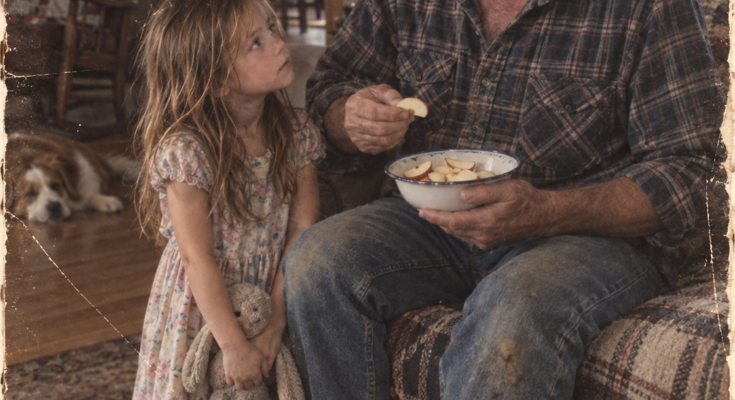
“Does your truck have a kitchen table?”
My dad laughed and reached for another cracker. “No, ma’am. Got a bed back there, though. Little refrigerator, too.”
My daughter, Willa, stood between his knees, thinking hard. “Well, where could we eat together?”
Dad’s hand stopped halfway to his mouth. Then he set the cracker on his paper plate and brushed salt off his jeans. It was the first time all afternoon he quit looking at the clock.
He’d arrived at two with a stuffed rabbit from a highway gift shop and a promise that he could stay forty-five minutes. His truck was parked at a travel stop outside town. He had a load to pick up before evening. There was always a load.
My father, Russell Keene, was sixty-one and had spent most of his adult life driving freight out of Oklahoma. Growing up, I knew the sound of his pickup turning into our driveway before I knew how to read. He came home smelling like cold air and coffee. He’d stand in the kitchen while Mom warmed his dinner, eating whatever she handed him before he even took off his jacket. Sometimes it was midnight. Sometimes my brother and I were supposed to be asleep. We came downstairs anyway.
After their thirty-year marriage ended, Dad moved into a small rental with brown carpet and windows that rattled in the wind. Mom moved closer to her sister. Nobody had done one terrible thing we could point to. They had just spent years getting further apart, until one day they stopped pretending they weren’t.
Dad bought four plates, two towels, and a secondhand kitchen table. Then he started volunteering for every holiday route. At first, I thought work helped. He’d always been a man who felt better with something useful to do. Then he missed Thanksgiving. Then Christmas. Then Willa’s sixth birthday, her seventh, and the afternoon she stood on a little school stage with a paper sun pinned to her shirt.
He sent money and pictures. Snow beside a highway in Wyoming. A sunrise somewhere in Nebraska. A sandwich so big he thought Willa would laugh. She did laugh. Then she asked when he was coming over. I got tired of making excuses for him. Eventually, I started saying, “I don’t know, sweetheart.”
That afternoon, after her question about the table, Dad pulled her onto his lap. “We’ll have supper one of these days,” he said. Willa leaned against his chest. “You always say days. Which day?” He looked at me over the top of her head. I wanted to rescue him. I also wanted him to answer. Instead, his phone buzzed. He checked it, closed his eyes for a second, and said he had to go.
I walked him outside while Willa stayed in the living room with her rabbit. “You could tell them no once in a while,” I said. He put his hands into his jacket pockets. “It isn’t always that simple.” “It’s getting pretty simple for her.” He looked back at the house, then down at the cracked concrete between us. “I know.” That answer took some of the anger out of me. I’d expected an excuse.
He opened his pickup door but didn’t climb in. “Your mother knew when I was coming,” he said. “Had things figured out. Supper, groceries, all of it.” “You don’t need somebody to make you supper, Dad.” “No.” He rubbed his jaw. “Guess I don’t know how to come home to somebody else’s house.”
I stood there after he drove away. For three years, I’d been inviting him to birthdays, holidays, school programs—things with starting times and people waiting to see whether he showed up. I hadn’t once called and said, Come over. Nothing’s happening. We’re just here.
What would you do if you realized the person you were waiting for didn’t know how to come home? The answer will change everything. Keep reading to find out what happens next. 👇
I know you’re curious to see what happens next, so please be patient and continue reading in the comments below. Thank you for understanding the inconvenience. Please leave a “YES” below and give us a Like to get the full story. 👇to part 2.
—
Part 2: The Breakfast
The next month, he sent a picture of rain on his windshield. I called him. “Are you coming through our way this week?” “Thursday morning. Why?” “Where do you stop?” He named a place near the interstate, about twenty minutes from our house. He had a scheduled break there around seven. “What do you usually eat?” There was a pause. “Depends.” “On what?” “What’s open.”
Thursday morning, I got up before six and scrambled eggs while Willa packed napkins into a grocery bag. We wrapped biscuits in a dish towel and borrowed two folding chairs from the garage. She wore her school clothes under her coat. There was still a little crease across her cheek from her pillow. “Is Grandpa coming to breakfast?” she asked. “We’re bringing breakfast to Grandpa.”
We found him standing beside his truck, looking confused. I’d told him we were stopping by. I hadn’t mentioned the chairs. “What’s all this?” “Eggs,” I said. “Try not to act disappointed.”
The travel stop had a narrow patch of grass beside its smaller parking lot, with a cottonwood tree and a battered picnic table. Dad helped carry everything over. The table was damp, so we wiped it with an old towel from his cab. Willa insisted on unfolding his chair herself.
We ate while trucks grumbled beyond the building and the sun climbed through the branches. The biscuits were a little squashed. I’d forgotten pepper. Dad said they tasted fine. For the first few minutes, we talked about weather and traffic. Then Willa told him a boy in her class had swallowed a loose tooth while eating an apple. Dad laughed so hard he had to put down his coffee.
She told him about her spelling test. He asked which word she’d missed. “Together,” she said. He helped her spell it on a napkin. When breakfast was over, I started gathering the wrappers. “We should let you get going.” Dad checked his watch. “I’ve got another twenty minutes.” So I sat back down.
He asked about my job. Not how work was, the way people ask while reaching for their keys. He asked about the woman I shared an office with, whose husband had been out of work. I hadn’t realized he remembered.
When we finally left, Willa hugged him around the middle. “Next time, you bring the orange juice.” “All right,” he said.
What would you do if a simple breakfast changed everything? The answer will warm your heart. Keep reading to find out what happens next. 👇
I know you’re curious to see what happens next, so please be patient and continue reading in the comments below. Thank you for understanding the inconvenience. Please leave a “YES” below and give us a Like to get the full story. 👇to part 3.
—
Part 3: The Reckoning
Two weeks later, he did. He brought orange juice. And a dozen eggs. And a new coffee mug for Willa because he remembered she had admired the one in his truck.
It didn’t fix everything at once. He missed another Sunday dinner when a delivery ran late, and I still had moments when I saw his name on my phone and braced for a cancellation. But he started calling before he chose his routes. “What time does her thing start Friday?” Or, “Would anybody be around if I came by Tuesday?”
One evening, he showed up while I was folding laundry. There was nothing cooked, the living room was a mess, and Willa was arguing with a math worksheet. Dad hung his jacket on a chair. “I can make grilled cheese.” He burned the first two sandwiches because Willa was telling him something and he forgot to turn them. We ate them anyway, scraping the black edges over the sink. Later, I found him at the kitchen table, listening while she read aloud. His phone was in his jacket pocket.
This past Christmas, his truck stayed parked. He arrived the night before with a duffel bag and a board game he’d bought at a truck stop. He slept on the couch. In the morning, he helped Willa make pancakes. He flipped one too high and it landed on the floor. Willa laughed so hard she had to sit down.
After breakfast, we sat around the kitchen table—the one I’d bought secondhand when I first moved out. Dad looked around the room. At the dishes in the sink. At the wrapping paper on the floor. At Willa, who was showing him how to fold a napkin into a swan. “This is nice,” he said. “What is?” “This. Just being here.”
I realized something in that moment. My father had spent years driving freight across the country, sleeping in his truck, eating whatever was open. He had done it because he didn’t know how to be still. He didn’t know how to sit at a table that wasn’t his. He didn’t know how to be present without being useful.
But he was learning. Slowly. Painfully. But surely.
That spring, he gave up long-haul routes. He took a local job driving for a building supply company. He was home every night. He bought a small house with a real kitchen table and four matching chairs. He started coming over for Sunday dinners. Not every Sunday. But most.
Willa turned ten last month. At her birthday party, she asked Grandpa to sit next to her. He did. He stayed for the whole party. He didn’t check his phone once.
When it was time for cake, Willa leaned over and whispered something in his ear. He laughed. Then he looked at me, and his eyes were wet. “What did she say?” I asked. He shook his head. “She asked if I was coming back next year.”
I walked over and sat beside him. “What did you tell her?” He smiled. “I told her I wouldn’t miss it for anything.”
That was the moment I knew. He had finally learned how to come home.
It wasn’t about the truck. It wasn’t about the routes. It wasn’t about the money or the miles or the excuses. It was about showing up. It was about being present. It was about sitting at a kitchen table and realizing that the most important thing you can give someone is your time.
My father spent thirty years driving away from the people he loved. It took a little girl asking about a kitchen table to remind him that he didn’t need to drive anywhere to find what he was looking for.
He just needed to stay.
The End. ❤️