Part 1: The Call
The metal folding chairs in the chapel were completely empty when the county transport van pulled up to the back door.
It was a drizzly Tuesday afternoon in southern Georgia, and I was sitting at my late father’s desk, trying to make sense of the bills. My brother had passed away just four months earlier. We used to run Gaines Family Funeral Home together, and without his laughter echoing down the hallway, the silence in the building felt heavier than usual. I was exhausted, grieving, and wondering how much longer I could keep our doors open.
Then the phone rang.
It was the county coroner’s office. They had the remains of a seventy-eight-year-old man named Thomas. He had passed away quietly in a small rented room on the edge of town. No surviving family. No money left behind. Just an old worn cardboard box containing a folded American flag, a bronze star medal, and a discharge paper from 1968.
The voice on the phone was polite but direct. “Loretta, we just need a simple, immediate burial. No service. No fuss. The county budget only covers the basics.”
They call them “unclaimed.” It’s a cold word for a human life.
I walked back to the preparation room and looked at the simple, plain wooden crate sitting on the gurney. I thought about my brother, who served two tours decades ago and always stood a little taller whenever he heard the national anthem. I thought about this man, Thomas, who had once walked into the unknown for people he would never meet, only to leave this world without a single person standing beside him.
I sat down at my desk, picked up the phone, and made three calls.
First, I called our local florist down on Main Street. I told her to send over a spray of fresh red, white, and blue flowers, and to put it on my personal account.
Second, I called the chaplain at the local veterans’ post. His voice was raspy, but when I told him what we had, he didn’t hesitate. “We’ll be there, Loretta.”
Third, I went into the back storage room and pulled out our finest solid wood casket—the kind reserved for families who could afford the very best. My assistant looked at me like I had lost my mind. We were already struggling to pay the monthly light bill.
“Loretta, we aren’t getting reimbursed for that,” he said quietly.
“Some things aren’t measured in dollars, Marcus,” I told him, smoothing down the lapel of my black dress jacket. “No man who wore the uniform of this country is leaving my chapel in a cardboard box.”
What happened next would bring an entire town together. Keep reading to find out what happens next. 👇
I know you’re curious to see what happens next, so please be patient and continue reading in the comments below. Thank you for understanding the inconvenience. Please leave a “YES” below and give us a Like to get the full story. 👇to part 2.
—
Part 2: The Service
The morning of the burial, the rain had stopped, leaving the Georgia air thick and sweet with the smell of pine.
When we opened the chapel doors, five elderly men in dark suits and military caps were standing in the lobby. They didn’t know Thomas. They had never met him. But they stood at attention as we wheeled him out to the hearse.
At the cemetery, the grass was damp. The county worker was waiting with the lowering equipment, ready to wrap things up quickly. But we didn’t rush.
The chaplain read a scripture. A young active-duty soldier came forward to play Taps, the notes clear and sharp in the crisp morning air. When they folded the flag and presented it, there was no family to receive it. So, the chaplain turned and handed the tight blue triangle of stars directly to me.
I held that flag against my chest and stayed right there by the graveside until the sun started to set, until the vault was sealed, and until the earth was turned. I stayed because I wanted Thomas to have at least one person stand watch over him until the very end.
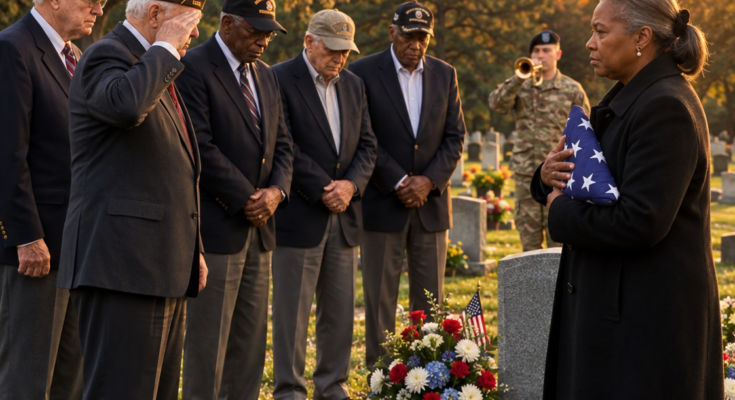
A photographer from the local weekly paper happened to be covering another event across the cemetery that day. He saw us standing there in the quiet field and snapped a picture from a distance—just a Black woman in a black coat holding an American flag beside six old veterans under a wide open sky.
By Thursday morning, that photograph was everywhere.
What happened next would change everything. Keep reading to find out what happens next. 👇
I know you’re curious to see what happens next, so please be patient and continue reading in the comments below. Thank you for understanding the inconvenience. Please leave a “YES” below and give us a Like to get the full story. 👇to part 3.
—
Part 3: The Reckoning
I was sitting at my desk adjusting the ledger when the front bell chimed. I walked out to the foyer and found a young man standing there in a grease-stained mechanic’s uniform. He looked nervous. He held out a folded twenty-dollar bill.
“Ma’am, I read about what you did for Mr. Thomas. I don’t have much, but I wanted to help cover the cost of those flowers.”
Before I could answer, the door opened again. An older woman walked in holding a warm peach cobbler wrapped in a dish towel. Then a retired teacher. Then two off-duty police officers.
By noon, the lobby of our small funeral home was filled with neighbors, strangers, farmers, and business owners. Some brought envelopes with small donations. Others just wanted to shake my hand or give me a hug.
A gentleman in a faded hat walked up to me with tears in his eyes. “Mrs. Gaines,” he said, his voice trembling slightly. “My father died alone in a hospital three states away. Seeing what you did for that veteran felt like somebody finally did right by my dad.”
I stood in the middle of our foyer, looking at all those different faces gathered under one roof, and for the first time since my brother died, the heavy knot in my chest began to loosen.
The donations didn’t stop that day. They kept coming. A local contractor offered to fix our leaking roof for free. A retired accountant volunteered to help me organize the books. A group of veterans started a fund to help cover burial costs for other unclaimed service members. And a young journalist wrote a feature story about Thomas—his life, his service, and the community that came together to honor him.
I learned that Thomas had been a quiet man. He had worked as a mechanic after the war, never married, never had children. He kept to himself. But he had served his country with honor. And he deserved to be remembered.
We placed a small headstone on his grave. It reads: *Thomas. Soldier. Neighbor. Not forgotten.*
Every year on Veterans Day, the town holds a small ceremony at his graveside. The veterans’ post sends a color guard. The chaplain says a prayer. And someone always places a spray of red, white, and blue flowers on the stone.
I still run the funeral home. It’s still small. It’s still struggling some months. But I never regret what I did. Because I learned something from Thomas. I learned that honor is not about money. It’s about showing up. It’s about standing watch. It’s about making sure that no one—no matter who they are or what they have—leaves this world alone.
We live in a world that moves too fast. We get so caught up in our own struggles, our bills, and our differences that we sometimes forget the quiet debts we owe to one another. We forget that behind every stranger walking down the street is a story, a struggle, and a soul that deserves to be remembered.
Thomas reminded me of that. And I will never forget him.
The End.