
Part One: The Greeting
The letter of termination sat on my kitchen table, printed on sterile school district letterhead.
Thirty-two years of driving Route 42, navigating snowy Ohio backroads and foggy mornings, ended because I refused to stop speaking to the children.
Since my wife Martha passed away three years ago from a long battle with illness, the silence in my house had become a heavy, suffocating thing. When you lose the person you’ve loved for forty years, the quiet doesn’t just sit in the room; it rings in your ears.
That yellow school bus was my lifeline. The roar of the diesel engine, the squeak of the vinyl seats, and the early morning chatter of the kids were the only things keeping me tethered to this earth.
Then came the new district mandate. They called it the “Silent Ride” protocol.
A regional manager in a sharp suit stood in the depot one morning and told us that to minimize liability and distractions, drivers were no longer permitted to converse with students. We were to drive. They were to sit in silence.
“No small talk. Keep your eyes on the road. We aren’t paying you to be their friends,” the manager said, looking at a clipboard instead of our faces.
I tried to follow the rules. I really did. But then there was Jaxon.
Jaxon was a fifteen-year-old kid who always boarded at the edge of the county line. He was practically a ghost. He wore a faded gray hoodie pulled up over his head, heavy headphones clamped over his ears, and his eyes never left his glowing phone screen.
I knew that look. It was the same hollow, lonely look I saw in the mirror every morning since Martha died.
I couldn’t just let him walk past me in silence. I couldn’t let him start his day feeling invisible.
One rainy Tuesday, as Jaxon climbed the steps, I broke the new rule.
“Morning, Jaxon,” I said warmly. “Looks like we need to build an ark out there.”
He didn’t look up. He just grunted and walked to the back of the bus, sinking into the seat.
But the next day, I did it again. “Morning, Jaxon. Hope you have a good one today, son.”
For three weeks, I greeted him. I asked about his classes. I asked if he caught the football game over the weekend. I spoke into the void, ignoring the security cameras watching me from the front of the bus.
On a freezing morning in November, Jaxon stopped at the top of the stairs.
He reached up and pulled one headphone off his ear. He looked at me, really looked at me, with tired eyes that belonged on an older man.
“Morning, Mr. Elias,” he mumbled. “I got a B on my history test.”
My heart swelled. I smiled so hard my wrinkled cheeks hurt. “I knew you could do it, son. I’m proud of you,” I told him.
After that, Jaxon stopped sitting in the back. He took the seat right behind mine. He didn’t always talk, but he always took his headphones off. Sometimes he’d ask me about my life, and I’d tell him stories about Martha, about the farm I grew up on, about the way this town used to be before everyone got so busy looking down at screens.
I found out his mother worked two nursing shifts to pay the rent, and his father hadn’t been in the picture for years. That boy was carrying the weight of the world in his backpack.
The district didn’t see a lonely old man and a struggling kid finding common ground. They saw a liability on the security footage.
They pulled me into the office on a Friday afternoon.
“You were warned, Elias,” the supervisor said, sliding the termination papers across the desk. “You’re constantly engaging in conversation. You’re distracted. We have to let you go.”
I didn’t argue. You can’t argue with a spreadsheet. I handed over my keys, walked out to my old truck, and cried for the first time since my wife’s funeral. I felt utterly useless. I was a relic belonging to a world that didn’t exist anymore.
Monday morning was agony. At 6:00 AM, the time I usually started my pre-trip bus inspection, I was sitting on my front porch in the cold, drinking black coffee and watching the sun come up over the empty fields.
Then, around 6:45 AM, I heard the unmistakable grinding of heavy air brakes at the end of my driveway. When I looked up, what I saw made me nearly drop my coffee.
—
Part Two: The Ride
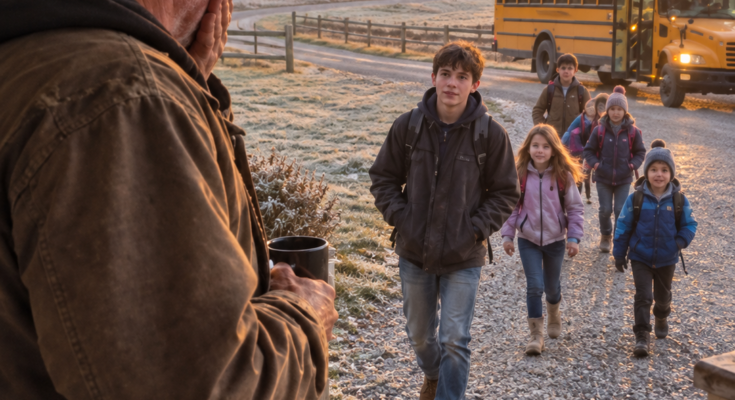
A yellow school bus was parked at the end of my driveway.
Not just any bus. My bus. Route 42.
The door hissed open, and Jaxon stepped out. He was wearing his gray hoodie, but his headphones were around his neck, not on his ears. Behind him, more kids filed out. Dozens of them. They stood in my yard, shivering in the cold, waiting.
Jaxon walked up to my porch.
“Mr. Elias,” he said. “We heard what happened.”
I couldn’t speak.
“We talked to our parents,” he continued. “We wrote letters. We signed a petition. The district said it didn’t matter. They said you broke the rules.”
He looked back at the kids standing in my yard.
“So we decided to break them too.”
I looked at the bus. The regular driver was sitting behind the wheel, looking uncomfortable. He shrugged when I caught his eye.
“They wouldn’t get on,” he called out. “Said they weren’t riding unless you were driving.”
Jaxon pulled a folded piece of paper from his pocket.
“We made a list,” he said. “Of all the things you said to us. All the mornings you asked how we were. All the times you remembered our names.”
He handed me the paper.
I unfolded it slowly.
*Thank you for asking about my mom’s surgery.*
*Thank you for remembering my birthday.*
*Thank you for telling me I could do it when nobody else did.*
*Thank you for making me feel like I mattered.*
The list went on. Page after page. Dozens of handwritten notes from kids I had driven for years.
I looked up at Jaxon.
“I was just doing my job,” I whispered.
“No,” he said. “You were doing more than that.”
—
Part Three: The Return
The school district didn’t know what to do.
Fifty students refused to board their buses. Parents called the superintendent’s office. The local news showed up. Someone posted a video of the kids standing in my yard, holding signs that said *”Let Mr. Elias Drive.”*
By Tuesday afternoon, the district had reversed its decision.
They called it a “review of policy implementation.” They said they had “determined that appropriate student-driver interaction is essential to a safe and supportive transportation environment.”
They offered me my job back.
I accepted.
The next morning, I climbed into the driver’s seat of Route 42. My hands shook a little as I adjusted the mirrors and checked the gauges. The diesel engine rumbled to life.
I pulled up to the first stop.
Jaxon was waiting. He climbed the steps, looked at me, and smiled.
“Morning, Mr. Elias.”
“Morning, Jaxon.”
He took his seat behind mine.
The other kids filed in, one by one. They said good morning. I said it back. The bus filled with chatter and laughter and the sound of life.
I drove slowly, carefully, the way I always had.
At the last stop, Jaxon stood up to leave. He paused at the front of the bus.
“Mr. Elias?”
“Yeah, son?”
“I’m glad you’re back.”
I nodded, blinking back tears.
“Me too, Jaxon. Me too.”
—
That was two years ago.
The “Silent Ride” protocol was permanently revoked. The district implemented a new training program for bus drivers, emphasizing the importance of connection and community.
I still drive Route 42. I still greet every kid by name. I still ask about their tests and their games and their families.
And every morning, Jaxon takes his seat behind mine. He’s a senior now. He’s applying to colleges. He wants to be a teacher.
“Like you,” he told me once.
I don’t know if I’ll drive much longer. My knees ache. My eyes aren’t what they used to be. But I’ll keep going as long as I can.
Because that bus isn’t just a job. It’s a lifeline.
For me. For Jaxon. For every kid who needs someone to say good morning.
Sometimes the smallest things matter most.
A greeting. A name. A moment of connection.
Sometimes that’s all it takes to change a life.
I learned that from a boy in a gray hoodie.
And I’ll never forget it.
—