PART 1 — THE SMELL OF WORK
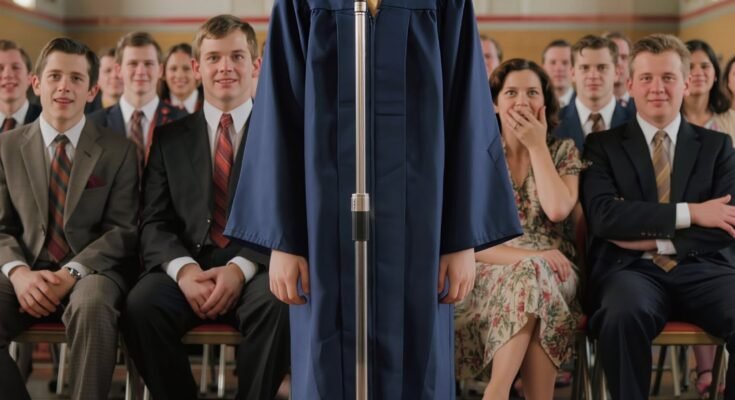
I was halfway to the graduation podium when someone in the front row whispered,
“This should be interesting.”
A few students laughed.
I knew that laugh.
I had heard it on the bus, in the cafeteria and outside the locker room whenever someone noticed the smell clinging to my clothes.
Bleach.
Laundry steam.
Cheap motel soap.
My mother, Denise, cleaned motel rooms every morning and washed bedding at a nursing home every night.
The smell followed her home.
Then it followed me to school.
Once, Mason Cole leaned away from me at lunch and announced,
“You smell like a mop closet.”
Everyone laughed.
I laughed too.
Sometimes pretending something is funny hurts less than admitting it broke you.
At home, Mom counted money into grocery envelopes.
Rent.
Electricity.
Truck insurance.
The pile marked later was always larger than the pile marked paid.
Then one night, I saw her struggling to open a jar.
Her fingers were swollen from years of scrubbing bathrooms and lifting wet sheets.
She winced, wrapped the lid in a towel and tried again.
She had delayed seeing a doctor because treatment cost money we did not have.
A week later, I found a pawn-shop receipt inside the kitchen drawer.
Mom’s wedding ring was listed at the top.
My college entrance-exam fee was listed beneath it.
“You sold Dad’s ring for me?”
She looked at her damaged hands.
“Your father gave it to me because he wanted us to have a future.”
Then she smiled.
“Now it’s buying yours.”
PART 2 — THE SPEECH
I studied everywhere.
At the laundromat.
Inside our truck.
At the diner after school while waiting for Mom to finish her second shift.
When my scholarship letter arrived, she laughed until she cried.
“Good,” she whispered. “Maybe your life won’t have to hurt this much.”
Four years later, I returned to my old high school as the graduating class valedictorian.
My gown was borrowed.
My boots came from a thrift store.
Mom sat in the third row wearing the same blue dress she had owned since I was fourteen.
When my name was announced, I heard the laughter.
I reached the microphone and unfolded the polished speech I had prepared.
Then I looked at Mom’s swollen hands.
I folded the pages and placed them aside.
“When I was fifteen,” I began, “I thought the worst thing in the world was smelling like my mother’s work.”
The gym became silent.
“I believed people could smell how poor we were. I washed my hands until my skin cracked because I wanted to remove every sign of where I came from.”
Mason stopped smiling.
“But my mother cleaned strangers’ rooms all morning and washed other people’s sheets all night. When her hands began failing, she still refused to spend money on herself.”
My voice cracked.
“She sold her wedding ring so I could take the exam that brought me here.”
I looked directly at her.
“This diploma carries my name, but it belongs to the woman who spent her body building my future.”
For one second, nobody moved.
Then my government teacher stood at the back of the gym and began clapping.
Slowly.
Deliberately.
Another teacher stood.
Then the students.
Then every person in the room.
My mother remained seated.
She covered her face with her swollen hands and cried.
For years, people had walked past her in motel hallways without remembering her name.
That afternoon, an entire gym stood because of what those hands had built.
PART 3 — THE SIGN
After graduation, I used part of my scholarship refund to retrieve Mom’s ring.
The pawn-shop owner had already sold it.
When he heard why I wanted it, he contacted the buyer.
Two weeks later, I placed the ring back into Mom’s hand.
She stared at it.
“You should have saved the money.”
“You already saved me.”
Years passed.
I finished college and returned to eastern Kentucky.
People asked why I came back when I could have found a better-paying job somewhere else.
Because leaving poverty behind is not the same as forgetting the people still living inside it.
I became a teacher at the same high school where students once laughed at my clothes.
Mom finally received treatment for her hands.
She could no longer work double shifts, but she attended every school event and sat proudly in the front row.
On the wall of my classroom, I placed a sign:
SOME HANDS LOOK BROKEN BECAUSE THEY BUILT SOMETHING.
Every year, students stop and read it.
Some arrive smelling like kitchens, farms, factories or cleaning chemicals.
Some hide worn shoes beneath their desks.
Some apologize when they cannot afford a field trip.
I never allow anyone to laugh.
The boy who mocked me at lunch barely remembered what he had said.
I remembered every word.
But I also remembered the sound that came years later.
Hundreds of people rising to their feet for a woman they had ignored.
I once believed my mother’s work was something I needed to wash away.
It took me years to understand:
That smell was never shame.
It was sacrifice.
THEY LAUGHED WHEN THE BOY IN SECONDHAND BOOTS WALKED TO THE MICROPHONE—THREE MINUTES LATER, THE WHOLE GYM STOOD FOR HIS MOTHER