Part One: The Shaking Hands
“Just point me toward the grinder and the welding leads,” the young farmer said.
Hank Dillard looked down at his hands.
They were trembling again.
Not violently. Just enough that a coffee cup rattled against a saucer. Enough that people noticed.
Enough that people had started deciding things about him before he ever opened his mouth.
Hank was 61, and for nearly forty years, the little welding shop at the edge of town had been his second home.
The place smelled like hot steel, old grease, and the coffee he reheated three times every morning.
Farmers had brought him cracked plows, bent gates, trailer hitches, hay equipment, and machinery that looked beyond saving.
For years, people used to say, “Take it to Hank. He’ll figure it out.”
Then Parkinson’s came.
At first, the tremor was small enough to hide.
Hank learned to hold his coffee with both hands. He kept one hand in his pocket when customers came in. He laughed when someone noticed.
“Too much caffeine,” he’d say.
But small towns notice things.
Before long, Hank noticed something too.
The complicated jobs stopped coming.
People still brought him little repairs. A broken hinge. A mower deck. A gate latch.
But the big jobs—the ones that required judgment, patience, and experience—started going somewhere else.
Nobody said why.
That almost made it worse.
Hank understood.
A welder whose hands shook didn’t inspire confidence.
But understanding something doesn’t mean it doesn’t hurt.
One October morning, a young farmer named Cody Mercer pulled into the gravel lot towing a damaged combine part on a flatbed.
Cody was 27 and had taken over much of his family’s farm after his father’s health began slowing him down.
He walked into Hank’s shop carrying himself like a man with too much work and not enough daylight.
“Morning,” Cody said. “Mind if I borrow your equipment for an hour? I’ll pay you.”
Hank glanced toward the trailer.
“You want me to look at it?”
Cody hesitated.
His eyes dropped briefly toward Hank’s hands.
That tiny glance said everything.
“I think I’ve got it,” Cody answered.
Hank nodded.
“Show me.”
Outside, a heavy steel bracket from the combine’s feeder assembly had split almost completely through.
Someone had repaired it before.
Cody pointed at the crack.
“I’ll grind that old weld out and run another bead over it.”
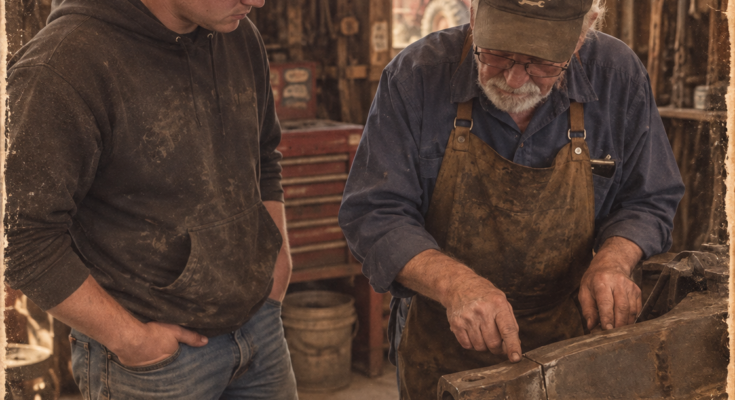
Hank crouched beside the bracket.
His knees complained more than they used to.
He stared at the metal for maybe thirty seconds.
Then he shook his head.
“If you weld that the same way, it’ll break again.”
Cody frowned.
“Why?”
Hank pointed.
“Look here.”
Cody leaned closer.
Hank traced the edge of the old weld with one trembling finger.
“This isn’t where the real problem started. See that little line?”
Cody squinted.
Hank continued.
“The bracket’s flexing from underneath. Whoever fixed it last time welded the crack, but they didn’t relieve the stress that caused it.”
He tapped another spot.
“You put another bead across there, you’ll make it look strong. Might even hold through harvest.”
He paused.
“But it’ll fail again.”
Cody’s expression changed.
“How would you fix it?”
Hank stood slowly.
“I’d stop chasing the crack.”
Then he smiled.
“I’d fix the reason it cracked.”
For the next twenty minutes, Hank explained how he would grind the failed weld, reshape the damaged edge, reinforce the bracket, and add support where the stress was concentrating.
He didn’t speak quickly.
He didn’t need to.
Forty years of broken machinery had taught him what textbooks never could.
Cody listened.
Then finally he said, “Would you mind staying while I do it?”
Hank looked at him.
“Thought you just wanted my tools.”
Cody lowered his eyes.
“Yeah.”
A long silence passed.
Then Cody said, “I was wrong.”
Hank didn’t embarrass him.
He simply handed him a face shield.
“That makes two of us this week.”
Cody laughed.
—
Part Two: The Partnership
They worked side by side most of the afternoon.
Cody did much of the physical welding.
Hank watched every angle.
“Slow down.”
“Clean that edge again.”
“Don’t build heat there.”
“Now reinforce the back.”
His hands shook.
His voice didn’t.
When Cody finished, Hank inspected the repair and nodded.
“That’ll hold.”
Two weeks later, Cody came back.
Not with broken equipment.
With his father.
Behind their truck sat an old tractor beneath a faded canvas tarp.
Cody’s father, Ray, climbed out slowly.
“We bought this tractor when Cody was a boy,” Ray said. “My dad owned one like it before me.”
The tractor was rusted, faded, and missing pieces.
Cody looked at Hank.
“We want to restore it.”
Hank rubbed his chin.
“That’ll take some work.”
“I know.”
Cody smiled.
“We want you to show us how.”
Hank looked at him for a long moment.
“Show you?”
“I’ll do the parts your hands don’t want to do anymore,” Cody said. “You tell me the parts my head doesn’t know yet.”
Hank looked away.
He pretended to inspect the tractor.
Truth was, he needed a second.
For months, Hank had been quietly grieving something he couldn’t explain to anybody.
It wasn’t just the shaking.
It was the feeling that the world had looked at what his body could no longer do and decided there was nothing useful left inside him.
—
Part Three: The Good Tired
That winter, Cody and Ray came by every Saturday.
Sometimes other farmers stopped in too.
Someone needed advice on a loader bucket.
Someone brought a bent hitch.
Someone else wanted Hank’s opinion on an old repair.
Before long, Hank’s shop became busy again.
Not the way it had been twenty years earlier.
Different.
Better, maybe.
Hank worked slower.
Some days he couldn’t weld at all.
On those days, he sat on an old wooden stool and talked younger men through jobs he once would have finished himself.
He taught them why metal failed.
How heat traveled.
When a repair needed reinforcement instead of another patch.
And when a farmer was better off replacing a piece completely instead of trying to save a few dollars.
By spring, the antique tractor was finished.
They rolled it outside beneath a bright Kansas sky.
Fresh paint.
Straight fenders.
Engine running smooth.
Ray stood beside it with tears in his eyes.
“My dad would’ve loved this.”
Cody looked at Hank.
“Couldn’t have done it without you.”
Hank shook his head.
“You did most of the work.”
Cody answered, “Work isn’t the same thing as knowing what to do.”
That sentence stayed with Hank.
So did something else.
People had been watching.
Word had spread around town that Hank Dillard might not have the steadiest hands anymore, but if you wanted to understand why something broke—and how to make sure it stayed fixed—there wasn’t anybody better.
One afternoon, Hank’s wife found him sitting outside the shop after everyone had gone home.
“You look tired,” she said.
“I am.”
“Good tired?”
Hank stared through the open shop door at the welding helmets, old tools, and scarred workbench he had used most of his adult life.
Then he looked at his hands.
They were shaking.
He didn’t hide them.
“Yeah,” he said quietly.
“Good tired.”
There comes a time in many lives when the things we were once known for become harder.
The carpenter’s knees give out.
The farmer can’t climb into the tractor as quickly.
The nurse retires.
The mechanic needs stronger glasses.
The teacher forgets a student’s name.
The hands slow down.
But that doesn’t mean the person inside those hands has become less valuable.
Sometimes what looks like weakness from across the room is simply a lifetime of experience arriving in a different form.
Never mistake slower hands for an empty mind. Some of the greatest things a person has left to give are the things only time could teach them.
—