PART 1 — THE CHARGE
My eight-year-old son had not truly smiled in two years.
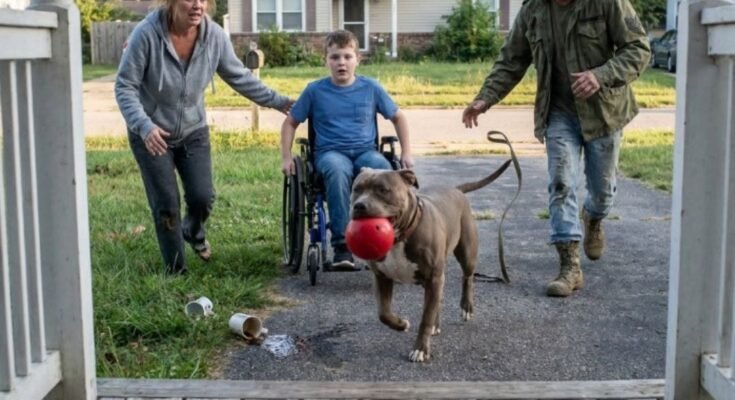
Then the enormous pit bull next door broke free from his leash and charged straight toward Leo’s wheelchair.
I dropped my coffee and ran.
“Leo!”
His red therapy ball had rolled across the property line.
The dog reached him before I did.
I braced for screaming.
Instead, I heard laughter.
Leo was laughing so hard he could barely breathe.
The dog sat beside his wheelchair and gently dropped the ball into his lap.
Then he rested his massive head on Leo’s knees.
Leo’s trembling fingers disappeared into the dog’s coat.
“Buster,” a deep voice said behind me.
Arthur, our scarred and reclusive neighbor, stood at the edge of the driveway.
Most people crossed the street when they saw him.
He wore combat boots, rarely spoke and always kept Buster close.
I grabbed Leo’s wheelchair.
“I’m sorry. The ball rolled—”
“Buster likes him,” Arthur said quietly.
Leo giggled when Buster licked his hand.
Arthur picked up the ball.
“Does he want to throw it again?”
Leo looked at me with pleading eyes.
“Again.”
Arthur supported Leo’s stiff arm and helped him toss the ball.
Buster brought it back.
They repeated it until sunset.
Before leaving, Arthur stared at the pavement.
“I walk him every Tuesday and Thursday.”
“We’ll be outside,” I said.
Those visits became the center of Leo’s week.
He worked harder during therapy because Arthur told him stronger shoulders meant longer throws.
Then one afternoon, a truck’s brakes screamed outside our house.
Leo panicked.
His body stiffened, and his breathing became fast and shallow.
Before I reached him, Buster climbed partly onto the wheelchair and pressed his chest across Leo’s lap.
Within seconds, Leo began breathing normally.
I stared at Arthur.
“How did he know?”
Arthur looked at the wheelchair.
“He remembered.”
“Remembered what?”
“My daughter.”
PART 2 — CLARA
Arthur showed me a photograph.
A smiling girl sat in a wheelchair with Buster stretched across her lap.
“Her name was Clara,” he said. “She trained him.”
Clara had a degenerative illness.
Buster retrieved anything she dropped and calmed her during breathing attacks.
She died three years earlier.
“Afterward, Buster waited beside her empty chair every day,” Arthur said.
“That’s why he ran toward Leo?”
“He saw the chair and the red ball.”
Arthur swallowed.
“I think he thought Clara had come back.”
From then on, I understood that Arthur was not frightening.
He was grieving.
The visits continued.
Buster picked up Leo’s dropped toys.
Arthur built a padded handle so Leo could grip the ball more easily.
Leo still could not walk.
His condition did not disappear.
But he began participating in life again.
Then Arthur and Buster suddenly stopped coming.
Leo waited by the window for two weeks.
Finally, I crossed the yard and knocked.
Arthur opened the door only a few inches.
“Buster is sick,” he said.
Cancer.
The veterinarian had given him only a short time.
Arthur did not want Leo to watch the dog weaken.
“He has already lost enough,” Arthur said.
“You don’t get to disappear and call it protection.”
“I buried my daughter.”
“And Leo spent two years believing everything good eventually leaves.”
That evening, I told Leo the truth.
He listened quietly, holding the red ball.
“I want to see him.”
“It may hurt.”
Leo looked toward Arthur’s house.
“It will hurt Buster more if he thinks I forgot him.”
PART 3 — ONE LAST THROW
The next morning, I wheeled Leo across the lawn.
Arthur opened the door.
“I said this wasn’t a good idea.”
Leo held up the ball.
“I came for Buster.”
The old dog slowly walked into the hallway.
The moment he saw Leo, his tail began striking the floor.
We spent the afternoon in Arthur’s backyard.
Leo could no longer throw far.
Buster could no longer run.
So Leo rolled the ball across the grass.
Buster walked after it, carried it back and placed it in Leo’s lap.
Again.
Again.
Again.
Finally, Buster lay beside the wheelchair and rested his head on Leo’s knees.
Leo stroked his fur.
“You were a good boy,” he whispered.
Buster died peacefully three days later.
For weeks, Leo barely spoke.
Then, on his ninth birthday, Arthur appeared at our door holding the red ball.
Beside him stood a young brown dog wearing a training harness.
Leo stared.
Arthur cleared his throat.
“Her name is Clara.”
He had contacted the organization that originally trained Buster.
He had applied for a mobility-assistance dog for Leo months before Buster became ill.
The young dog walked toward the wheelchair, picked up the red ball and placed it in Leo’s lap.
Leo looked at Arthur.
“Did Buster teach her?”
Arthur knelt beside him.
“No.”
He placed Leo’s hand gently on the dog’s head.
“You will.”
Leo smiled.
Buster never cured my son.
He gave him something medicine could not.
A reason to try.
And Leo gave Arthur something grief had taken away.
A reason to stay.
Everyone in the neighborhood had feared the scarred veteran and his enormous dog.
But the day Buster charged into our yard, he was not attacking.
He was answering a call only he could understand.
A lonely child needed him.
And so did the man holding the leash.
MY PARALYZED SON HADN’T SMILED IN TWO YEARS—THEN THE “DANGEROUS” DOG NEXT DOOR CHARGED AT HIM