Part One
“I’m not hungry today, Miss Maribel.”
Maribel Dunn froze with the serving spoon still in her hand.
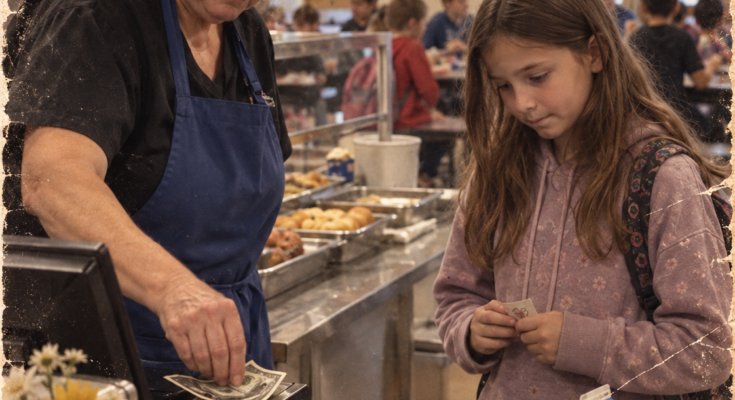
Across the cafeteria counter stood a fourth-grade girl named Ellie, staring at the floor and twisting the sleeve of her faded purple sweatshirt around her fingers.
Maribel had heard those exact words three times that week.
She had also watched Ellie stare at the mashed potatoes every single time she said them.
“You sure, honey?” Maribel asked gently.
Ellie nodded too quickly.
Then her stomach growled loud enough for both of them to hear.
Maribel pretended she hadn’t noticed.
After 24 years working in an elementary school cafeteria in a small West Virginia town, she had learned something important about children.
Hunger didn’t always look like hunger.
Sometimes it looked like embarrassment.
Sometimes it sounded like, “I forgot my lunch.”
Or, “I ate a big breakfast.”
Or, “I don’t like pizza.”
And sometimes it looked like a nine-year-old girl trying desperately not to cry in front of her classmates.
Maribel leaned closer.
“Tell you what,” she whispered. “We made too much today. You’d be doing me a favor.”
Ellie finally looked up.
“Really?”
“Really.”
Maribel filled the tray.
Chicken, mashed potatoes, green beans, an apple and milk.
Then she quietly reached below the register and pulled a few crumpled dollar bills from her apron pocket.
Nobody saw her place them beside the till.
At least, she thought nobody did.
Maribel was 63 years old and had been working in that cafeteria since her own daughter was in middle school.
She wasn’t wealthy.
Not even close.
Her little house needed a new roof. Her car made a strange rattling sound every winter. And most months she could tell you, within a few dollars, exactly how much money was left until payday.
She was also raising two grandchildren.
Her daughter had entered addiction treatment the year before, and Maribel had taken the children without hesitation.
One was seven.
The other was eleven.
She never complained about it.
But people who knew her well noticed certain things.
She stopped buying coffee on the way to work.
She packed peanut butter sandwiches instead of leftovers.
Sometimes she told the grandchildren she had “already eaten” and sat with them at the kitchen table while they finished dinner.
The truth was, there were nights when Maribel drank tea and ate crackers after they went to bed.
Still, every payday, she took a few dollars and placed them inside a white envelope.
She kept it behind the cafeteria register.
On the front, in blue ink, she had written only two words:
“Just in case.”
The envelope had started because of Ellie.
But Ellie wasn’t the last child.
There was a boy whose father had been laid off from the lumber mill.
Another whose mother had recently moved into a motel after leaving a bad situation.
A little girl being raised by her grandfather.
Two brothers who always asked whether they could take an extra apple home.
Maribel never asked children to explain.
She never wanted them to stand at the register while other kids listened.
She simply watched.
If a child hesitated when the cashier mentioned the account balance, Maribel found a reason to step in.
“Computer’s acting funny.”
“We’ve got it today.”
“Go ahead and eat, sweetheart.”
Then later, when the cafeteria emptied, she opened the envelope.
One dollar here.
Three dollars there.
Five dollars after payday.
Nobody made an announcement.
Nobody took a photograph.
Nobody thanked her because almost nobody knew.
That was exactly how Maribel wanted it.
—
Part Two
The envelope stayed thin. It was never meant to be a solution—just a cushion for the moments that fell through the cracks. But by October, Maribel was pulling from it almost every day. The lumber mill had cut another shift. Two more families in the district had lost their footing. Ellie had stopped saying she wasn’t hungry, but now she just stood at the register with empty hands and silent eyes.
Maribel started skipping lunch herself. She told the other workers she was watching her figure. They laughed and didn’t ask questions.
One Thursday, the cafeteria manager, Donna, called her into the back office. Maribel’s stomach dropped. She was certain someone had noticed the missing money from the register—money she always replaced, but sometimes a day late.
“Sit down,” Donna said.
Maribel sat.
Donna slid a folded piece of paper across the desk. It was a printout from the district office. A new policy was being introduced in January: universal free lunch for every student in the school. No applications. No account balances. No questions.
Maribel read it twice.
“I don’t understand,” she said. “How?”
“State funding finally came through. A few people have been pushing for it for years.” Donna paused. “One of them wrote your name on a form. Said you’d understand why.”
Maribel looked up.
“Who?”
Donna smiled. “A parent. She said you fed her daughter when she couldn’t. She never forgot.”
Maribel’s hands began to tremble.
For twenty-four years, she had been the only thing standing between hungry children and empty trays. She had given what she had, never expecting anything back. And now, without warning, the whole system had shifted. The envelope behind the register would no longer be needed.
She walked back into the cafeteria and looked at the lunch line. Ellie was there, laughing with a friend, holding a full tray.
—
Part Three
That afternoon, Maribel sat alone in the empty cafeteria. The last bell had rung. The tables were wiped clean. The lights hummed overhead.
She opened the register drawer and pulled out the white envelope. It was nearly empty now—just two wrinkled dollars and a receipt from the hardware store.
She held it for a long moment.
Then she heard footsteps.
Ellie stood in the doorway, clutching a folded piece of paper.
“Miss Maribel?”
“Hi, honey. You forget something?”
Ellie shook her head. She walked forward and placed the paper on the counter.
“I made you something. In art class.”
Maribel unfolded it. It was a drawing of two figures behind a lunch counter. One was tall with gray hair. The other was small with a purple sweatshirt. Above them, in careful letters, Ellie had written: *Thank you for not making me say it.*
Maribel’s eyes filled.
“You don’t have to thank me, sweetheart.”
“I know.” Ellie shrugged. “But I wanted to.”
She turned and ran back toward the buses.
Maribel sat there for a long time. Then she folded the drawing carefully and placed it inside the white envelope, beside the two dollars. She wrote something new on the front, beneath the words that were already there.
*Just in case* became *Just because.*
The policy changed everything. No child in that school would ever have to stand at the register and admit they couldn’t afford to eat. But Maribel kept the envelope anyway. Not for lunches. For the other things. A coat for a boy whose family couldn’t afford one. School supplies for a girl who never asked. A Christmas gift for a grandparent raising grandchildren alone.
She still skipped coffee. She still packed peanut butter sandwiches. She still told her grandchildren she’d already eaten.
But she never felt invisible again.
Because sometimes, the smallest kindnesses echo the loudest. And sometimes, the people who give the most are the ones who never wanted anyone to notice.
Maribel Dunn never expected a thank-you. But she got one anyway.
And it hung on her refrigerator for the rest of her life.
—