Part One
My neighbor poisoned my loyal senior dog because he hated his barking. He expected me to ruin my life with a hunting rifle, but my revenge saved dozens of others instead.
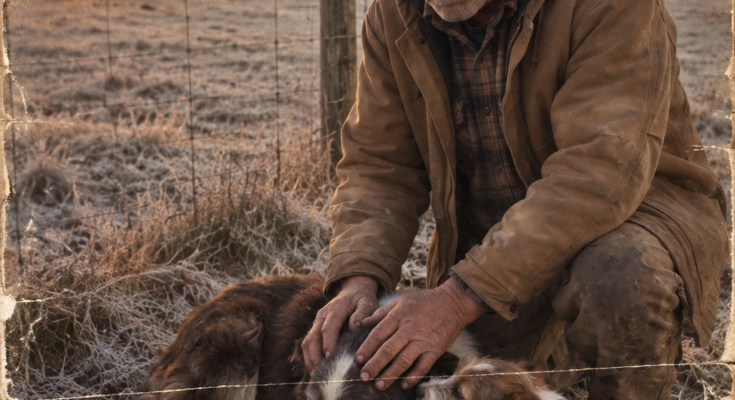
I found Buster right by the property line. My ten-year-old border collie was lying completely still in the morning frost, and right next to his nose was a chunk of raw hamburger meat tinted neon green.
Pip, the scruffy little terrier puppy I’d pulled out of a muddy ditch just three weeks prior, was frantically nudging Buster’s shoulder. The puppy was whining, pawing desperately at my old friend’s face, trying to wake him up.
But Buster wasn’t going to wake up.
I didn’t scream. I just felt a cold, heavy rock settle in the center of my chest. The neighbor, Judson, had stood right at that fence three days ago. He had looked me dead in the eye and swore he’d shut my dog up permanently if the barking at the coyotes didn’t stop.
I picked up Pip, tucked him inside my heavy canvas coat, and walked straight back to my farmhouse. I opened my steel gun safe.
I took out my hunting rifle and loaded it. I was seventy-two years old, widowed, and living alone. Buster had been my shadow for a decade. I fully intended to walk across the pasture, kick Judson’s front door off its hinges, and handle things the way men in my family always had.
I didn’t care about the consequences. I was going to destroy him.
I put my hand on the front doorknob. Then, I felt a tiny, sharp tug on the hem of my jeans.
I looked down to see Pip sitting heavily on my work boots. He was shaking violently. His scruffy ears were pinned flat against his head, and he let out the most pathetic little whimper. He looked up at me with terrified, wide brown eyes.
It hit me like a physical blow. If I walked out that door with my rifle, I’d be taken away in handcuffs by sunset.
And Pip? Animal control would take him. He’d end up in a cold concrete cage at the county pound, terrified and alone. Judson wouldn’t just be taking Buster. He’d be taking Pip, too.
I unloaded the rifle and locked it away. I sat on the kitchen floor, pulled Pip against my chest, and finally let myself break down. Then, I picked up the phone and called the local sheriff.
The young deputy who came out took one look at the tainted meat and shook his head. He said without hard proof, it was just my word against Judson’s. Dogs eat random things out in the country, he claimed.
I told him about the explicit threat, but the deputy just sighed. He couldn’t make an arrest on a threat alone. The law required physical evidence.
He drove away, leaving me feeling completely helpless. I sat on the wooden porch, watching Pip stare blankly at the exact spot by the fence where Buster died.
Then, my eyes drifted to the tree line at the edge of the property.
My trail cameras. I had set up three motion-activated cameras along the woods to track deer before hunting season. One of them was strapped to an old pine tree, facing the exact stretch of wire fence where Judson and I had argued.
I ran across the field faster than I had in twenty years. I unbuckled the camera, pulled the tiny memory card out, and hurried back to my laptop. My hands were shaking so badly I could barely plug it in.
I clicked through dozens of grainy videos of raccoons. Then I found a file timestamped at 2:14 AM—the exact hour everything had changed.
I clicked it, and what appeared on that screen changed the course of my life forever.
—
Part Two
There was Judson. The camera’s night vision turned him ghost-green. He wore rubber gloves and carried a plastic grocery bag. I watched him crouch at the fence, reach through the wire, and place the hamburger meat on my side. He looked toward my house. Not nervous. Not hurried. He looked like a man completing a chore. Then he stood and walked back toward the logging road.
But he didn’t go home. Another man waited there, leaning against a dark truck with no lights on. Judson handed him something. The man handed back a folded envelope. Money. Even in grainy footage, the exchange was unmistakable. Judson counted it with his thumb. The other man said something that made Judson laugh. Then the truck pulled away without headlights, and Judson disappeared into the trees.
I watched it four times. My hands had stopped shaking. In their place was something colder and steadier. Not rage. Not yet. Just clarity. Judson hadn’t killed Buster because of barking. He’d killed him because someone paid him to. Buster was old, loud, and easy to reach. A loose end. A nuisance. A job.
I copied the file onto two flash drives. One went into my late wife’s Bible. The other went into my coat pocket. Then I called the sheriff’s office again and asked for a different deputy. This time, I didn’t mention my dog. I said I had video evidence of a crime on my property and needed someone to see it before I did anything else.
The deputy who came was older, gray at the temples, with tired eyes. When I played the video, he went very still.
“Who’s the second man?” I asked.
He didn’t answer right away. He just stared at the frozen frame.
“That,” he finally said, “is someone we’ve been trying to find for two years.”
—
Part Three
The investigation that followed unraveled something far larger than one poisoned dog. The man on the logging road was part of a dogfighting operation that stretched across three counties. Judson wasn’t just a cruel neighbor—he was a scout. He watched properties, identified dogs left alone during the day, and either stole them outright or eliminated them if they were too old, too loud, or too difficult to take. The envelope contained his payment.
My trail cameras had captured evidence of at least six other transactions over the previous months. Six other dogs. Six other families who had lost their pets and never known why. Judson was arrested within a week. The second man was arrested three days later. The raid that followed rescued fourteen dogs from a property two towns over. Fourteen animals who would have been used as bait, bred against their will, or killed for entertainment.
When the prosecutor showed me the file, she said my video was the key that opened the entire case. Without it, they’d had nothing but suspicions and dead ends. I testified at the trial. I sat in that courtroom and described finding Buster in the frost. I described the green-tinted meat and the way Pip had tried to wake him. I didn’t look at Judson once. He got twelve years.
Pip is five now. He sleeps on Buster’s old bed, though he’s chewed the corner beyond repair. He still barks at the coyotes at night, and I let him. I don’t care what the neighbors think. Sometimes, when I walk the property line, I stop at the old pine tree where my camera still hangs. I think about the man I almost became that morning—the one who reached for a rifle instead of a phone. I think about how close I came to throwing away everything that mattered.
Buster is buried beneath that tree. I planted wildflowers there in the spring. They bloom every year, bright and stubborn, refusing to be poisoned by anything. Pip sits beside me when I visit. He doesn’t whine anymore. He just leans against my leg and watches the field, as if he knows that something good grew from something terrible. And I let him. Because he was right. He was right to pull me back. The law didn’t save Buster. But it saved the next fourteen. And some days, that’s enough to keep going.