PART 1 — THE FUNERAL
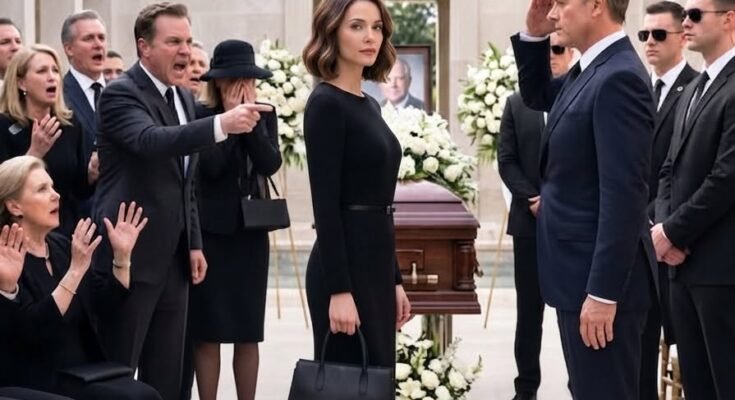
The first thing my father said at my grandfather’s funeral was,
“Still changing bandages for the Army?”
Richard Monroe made sure everyone heard.
Retired generals, defense contractors and senators filled the country-club reception room.
My grandfather, General Arthur Monroe, had been buried less than an hour earlier.
I stood in my dress uniform while my younger brother, Caleb, laughed into his whiskey.
“The family doctor finally came home,” Dad continued. “Should we line up for aspirin?”
Ten years earlier, he had disowned me for accepting an Army medical scholarship instead of joining the family’s defense business.
I had not returned since.
Before I could answer, the room suddenly quieted.
Thomas Whitmore, a senior Pentagon official, entered with three security agents.
My father straightened immediately.
Whitmore passed him without stopping.
He walked directly toward me.
“Colonel Monroe,” he said, standing at attention. “It is an honor to see you again.”
My father froze.
Whitmore shook my hand.
“The soldiers from Kandahar still speak about the surgeon who kept operating after the field hospital was hit.”
Caleb slowly lowered his glass.
Dad stared at my uniform as though he had finally realized the insignia meant something.
Later, Whitmore found me outside and placed my grandfather’s silver lighter in my palm.
“He wanted you to have this.”
A folded note was taped beneath it.
The first line read:
Do not let Richard touch the blue folder.
I looked through the window.
Dad and Caleb were already hurrying toward my grandfather’s private office.
I ran inside.
The office door was open.
Dad stood beside the desk holding a blue folder.
“Give it to me,” I said.
He smiled.
“This is family business.”
Then Whitmore entered behind me.
“No, Mr. Monroe,” he said. “It is now a federal matter.”
PART 2 — THE BLUE FOLDER
The folder contained contracts, internal emails and photographs of military medical equipment produced by my father’s company.
Equipment I recognized.
Five years earlier, a portable blood-warming system had failed during an attack in Kandahar.
Three soldiers died before we could stabilize them.
I had written the medical incident report myself.
The manufacturer listed on the device belonged to a shell company.
The blue folder proved that shell company was controlled by Richard and Caleb.
Grandfather had discovered they used cheaper components, falsified safety tests and pressured officials to approve the equipment.
“You knew it failed,” I said.
Dad closed the office door.
“It was one defective shipment.”
“Three men died.”
“War kills people, Evelyn.”
Whitmore’s expression hardened.
Caleb stepped forward.
“The company would have collapsed if we recalled everything.”
“So you buried the report?”
Dad looked at me coldly.
“You were supposed to become useful to this family. Instead, you put on a uniform and judged people who built something.”
“I saved the men your equipment injured.”
His face changed.
Grandfather had also recorded a conversation with Dad.
On the audio, Richard demanded that he destroy the evidence.
Grandfather refused.
Then Caleb said:
If Evelyn ever sees that folder, she will connect it to Kandahar.
That was why my father had tried to keep me away from the funeral.
Grandfather’s will required the folder to be delivered to me in Whitmore’s presence.
He had also transferred his controlling shares in the family company into an independent trust until the investigation ended.
Dad could not destroy the evidence.
He could not sell the company.
And he could not remove me from the process.
“You planned this with him,” Dad accused.
“No,” I said. “Grandfather finally told the truth without asking permission.”
Federal investigators entered the office.
Caleb immediately blamed Dad.
Dad called Caleb incompetent.
The two men who had mocked my medical career began turning on each other before the agents finished reading their rights.
As they escorted Dad out, he looked at me.
“You are destroying your own family.”
I held up the blue folder.
“No. I’m identifying what destroyed it.”
PART 3 — WHAT MY GRANDFATHER LEFT
The investigation lasted fourteen months.
My father admitted approving false safety reports.
Caleb admitted moving money through the shell company.
Both avoided lengthy trials by cooperating, paying restitution and surrendering control of the business.
The company survived under new leadership.
Its defective equipment was recalled.
The families of the soldiers who died received settlements and formal apologies.
My father never apologized to me.
He sent one letter.
Your grandfather chose you over his own son.
I wrote nothing back.
Grandfather had not chosen me over Dad.
He had chosen the truth after years of protecting the wrong person.
His will left me no mansion or executive position.
Instead, he created a scholarship for military doctors and medics.
The fund was financed by selling his shares in the company.
The first scholarship carried the names of the three soldiers who died in Kandahar.
At the ceremony, Whitmore handed me the silver lighter.
“You should keep it.”
I opened and closed the lid.
Click.
Pause.
Click.
My father once believed becoming an Army doctor meant I had wasted the Monroe name.
But when the family business needed someone willing to protect it, he protected the contracts.
Caleb protected the money.
My grandfather protected the secret until it nearly became too late.
I protected the patients.
Ten years after my family disowned me, I returned home expecting only to bury my grandfather.
Instead, he left me one final order:
Open the folder.
Tell the truth.
And do not let the family name matter more than the lives buried beneath it.
MY FATHER MOCKED ME FOR BECOMING AN ARMY DOCTOR—THEN A PENTAGON OFFICIAL CALLED ME “COLONEL”