Part 1: The Birthday
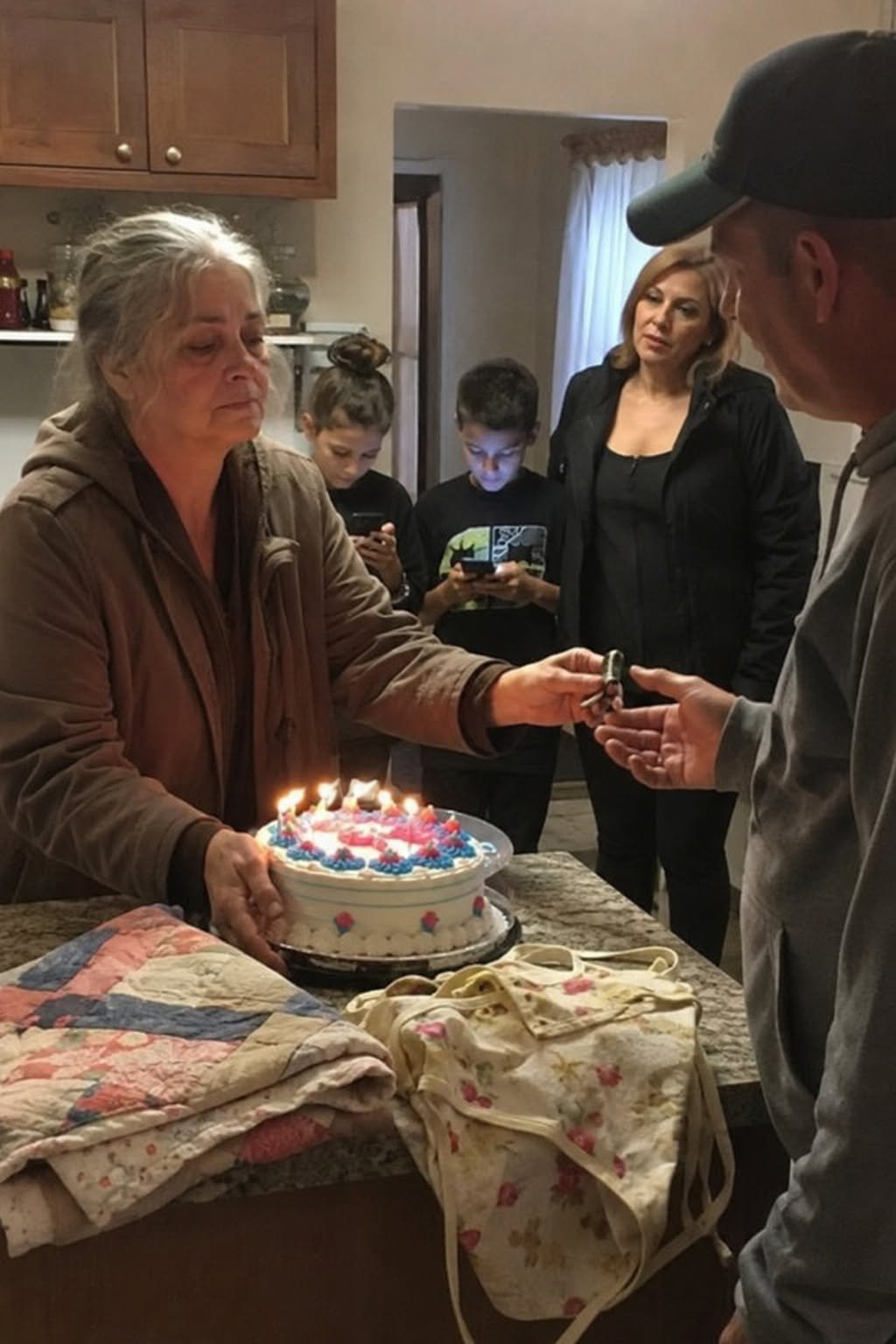
I placed the birthday cake on the kitchen counter, folded my apron beside it, and handed my son the spare key to his house.
“What’s this?” Caleb asked.
“The last thing you’ll need from me tonight,” I said.
The room went quiet, except for the electronic music coming from the two new phones my grandchildren were holding.
My name is Marlene Voss. I’m sixty-seven years old, and I’ve driven a school bus through the back roads of northern Missouri for nearly three decades. Every morning, I wake before sunrise, pull on my faded brown jacket, fill a thermos with coffee, and guide forty children through fog, rain, snow, and harvest traffic. But my real shift began after I parked the bus.
For the past five years, I had driven straight to my son Caleb’s house to help raise his two children, eleven-year-old Sadie and eight-year-old Owen. Caleb’s wife had left when Owen was three. Caleb worked long hours repairing farm equipment, and I knew he was doing his best. So I stepped in without being asked twice.
I packed lunches. I signed school forms. I washed soccer uniforms at midnight and sat beside Owen when thunderstorms frightened him. I taught Sadie how to sew on a button, make biscuits without burning the bottoms, and apologize when pride told her not to. I never considered it a sacrifice. That was simply what family did.
At least, that was how I had been raised. My own mother never had much money, but she could stretch a chicken into three meals and make a child feel rich with a jar of fireflies on a summer night. She used to tell me, “People will admire what shines, Marlene. Pay attention to what stays.”
I thought I understood her. I didn’t understand until Sadie’s eleventh birthday.
For weeks, I had been making her a quilt from old pieces of our family’s life. A square from the yellow dress she wore on her first day of kindergarten. A strip from Caleb’s high school work shirt. A piece of the blue curtain that once hung in my mother’s kitchen. In the center, I stitched a small red school bus. It wasn’t perfect. My fingers have grown stiff, and a few seams leaned crooked. But every piece carried a memory.
The party began Saturday afternoon. I arrived before breakfast to clean the house, frost the cake, hang paper decorations, and prepare enough food for fifteen children.
At three o’clock, Caleb’s younger sister, Brielle, pulled into the driveway in a polished white SUV. Brielle lived in Kansas City and visited only a few times a year. She wore expensive sunglasses, talked about restaurants none of us had heard of, and always arrived carrying shopping bags. The children adored her.
Part 2: The Quilt
“Aunt Brielle!” Sadie screamed. Brielle smiled and held up two sleek boxes. “I didn’t know what kids your age want,” she said, “so I asked the salesman for the newest thing.”
Inside were two expensive phones. Not one for the birthday girl. Two. Owen received one simply because Brielle didn’t want him to feel left out. The children shouted so loudly the dog hid beneath the table.
Caleb stared at the boxes. “Brielle, these must have cost a fortune.” She waved him off. “That’s what a fun aunt is for.”
Then she looked at me standing beside the kitchen island with my quilt folded over my arms. “What did you bring, Mom?” she asked. Before I could answer, Sadie glanced up from her glowing screen. “Probably something homemade.” She didn’t say it cruelly. That somehow hurt more.
I carried the quilt over anyway. “I made this from pieces of our family,” I explained. “This yellow square was from your kindergarten dress, and this blue one came from Great-Grandma’s kitchen—” Brielle laughed softly. “Oh, Mom. You and your old scraps.”
Sadie ran her fingers over the fabric for half a second. “Thanks, Grandma,” she said, already looking back at the phone. “Can I put it upstairs?”
Caleb poured himself a drink and gave me an apologetic smile. “You know kids,” he said. “They want modern things. Don’t take it personally.”
I looked around the room. At the decorations I had hung. At the dishes I would be expected to wash. At Owen eating the cupcakes I had baked while watching a game on a phone his aunt had purchased in ten minutes.
Then Sadie’s friend asked who drove them to school every morning. Sadie shrugged. “My grandma. She’s basically our driver.”
That one sentence hit harder than the laughter about the quilt. And what I did next made the entire room go silent.
Part 3: The Silence
I didn’t yell. I didn’t cry. I just set the quilt on the kitchen counter, walked to the sink, and began washing the dishes I had used to prepare the meal. When I finished, I dried my hands, folded my apron beside the cake, and walked toward the front door.
“Mom, where are you going?” Caleb asked.
I didn’t answer. I just opened the door and stepped outside. I heard Brielle laugh. “She’ll be back,” she said. “She always comes back.”
But I kept walking to my car, got in, and drove away.
For five years, I had given everything—my mornings, my evenings, my weekends. I had raised two children who no longer remembered who had taught them how to read. I had fed a family that didn’t know who had paid for the groceries. I had been a grandmother, a cook, a driver, a cleaner, a teacher, a seamstress, and a safety net. I had made a quilt from their history, and they had called it old scraps.
That night, I went home to my quiet house. I didn’t cry. I just sat on my porch, watched the stars come out, and thought about my mother’s words: “People will admire what shines, Marlene. Pay attention to what stays.”
I had stayed. And no one had noticed.
The next morning, I did not wake up at 5:00. I did not pack lunches or sign permission slips. I drove my bus route, but when the last child climbed off, I parked my car at my house and went inside. I didn’t go to Caleb’s house. I didn’t answer his calls. I didn’t respond to Brielle’s texts. For the first time in five years, I let them stand on their own.
By Wednesday, Caleb showed up at my door. He looked exhausted. “Mom, the kids need you. I need you. I can’t do this alone.”
I looked at him and said, “You’ve been doing it alone for five years, Caleb. I’ve just been making sure you didn’t notice.”
He opened his mouth to argue, but I held up my hand. “I love you. I love my grandchildren. But I am not invisible. I am not just a driver. I am not old scraps. If you want me to be part of this family, you need to see me. Not just what I do. Me.”
He stood there for a long moment, and I watched his face change. Not anger. Understanding.
“I’m sorry,” he said. “I didn’t realize.”
“You didn’t want to,” I said. “That’s different.”
He nodded, turned, and walked back to his car. I thought that was the end of it. But that weekend, Sadie and Owen showed up at my door, alone. They had walked half a mile, and Sadie was holding the quilt. It was folded neatly, and she was crying.
“I’m sorry, Grandma,” she said. “I didn’t mean to hurt your feelings. My friends said I was being mean. They said I was lucky to have you. I didn’t even notice.”
I knelt down and hugged her, and for the first time in days, I let myself cry.
Over the next few months, things shifted. They started coming to my house. They started helping me in the garden. They started asking about the pictures on my wall and the stories behind the quilt. Caleb started showing up on Saturdays without asking for anything.
I still drive my bus. I still wake up early. But now, I don’t go straight to someone else’s house. I go to my own. And I finally understand my mother’s words. “People will admire what shines, Marlene. Pay attention to what stays.”
I was never the one who shined. But I was the one who stayed. And staying, I finally learned, was never about being invisible. It was about being the foundation.
Sometimes the people who carry everyone else are the last to be seen. And sometimes, the only way they learn their worth is when they finally stop carrying.
I still have the quilt. Sadie asked me to teach her how to sew. Owen asked me to tell him about Great-Grandma’s blue curtain. And I realized that the things we make with our hands are never just things. They are memories. They are love. They are proof that we were here.
And I am still here. Still sewing. Still staying.
That’s what family really is. Not the shiny things. Not the phones. The people who show up. Every day. In the quiet. In the ordinary. In the love we stitch together, one square at a time. ❤️