
Part 1: The Gate
“You don’t belong here, sir.”
The young gate guard said it with the kind of clipped confidence that comes from a fresh uniform, polished boots, and a rulebook still warm in your hands. He didn’t say it cruelly. But he didn’t say it kindly, either. He said it like the matter was already settled. Like a broom in an old man’s hand was all the proof anyone needed.
Aaron Mitchell looked up from the strip of sidewalk he had been sweeping just outside the east gate of Fort Lincoln. Fog still sat low over the road. The sun had not fully climbed yet. Everything felt pale and cold and unfinished. Aaron lowered his eyes. He adjusted his grip on the broom, stepped back behind the painted line near the curb, and said nothing.
That was what made some people uncomfortable about him. He almost never defended himself. He never snapped back. Never demanded respect. Never reminded anybody how old he was, or how many mornings he had stood there while others were still sleeping. He simply gave a small nod, as if the boy in uniform had every right in the world to correct him, then went back to sweeping damp leaves away from the gate.
A few soldiers nearby glanced over and smirked. One of them muttered something under his breath. Another gave a short laugh. To them, Aaron Mitchell was just part of the scenery. The old civilian with the broom. The one who showed up before sunrise. The one who cleaned the stretch of pavement outside the base better than the maintenance crew cleaned the inside. The one who never asked for anything. Never crossed the yellow security line. Never made a scene. Never explained himself.
He was seventy-two years old, though most people guessed older. Time had worked on him hard. So had silence. His beard had gone fully gray years ago, and not the handsome silver people liked to romanticize, but a rough, weather-beaten gray that made him look like he had been standing out in the wind longer than other men had been alive. He wore the same canvas jacket most mornings. Same worn boots. Same old watch with a cracked leather band.
At 5:45 sharp, he arrived. Not 5:44. Not 5:46. At 5:45, every single morning, he came walking down the road from the direction of the town, carrying a broom in one hand and a small satchel over his shoulder. He would stop near the east gate. Stand still for one quiet moment. Look past the fence. Then begin. Left to right. Curb to gate. Bench to gutter. Paper scraps. Leaves. Dust. Sand. Bottle caps. Bits of windblown trash other people had trained themselves not to see. He swept with patience. With rhythm. With precision. Not like a man killing time. Like a man honoring something.
Part 2: The General
Some of the younger soldiers thought it was funny. Some found it sad. A few called him the ghost janitor. One private once joked that if the base ever got inspected, the old guy outside would probably pass faster than half the people inside. Most of them never bothered to learn his name.
Private First Class Jason Miller did. Jason had grown up in a military family in a little town outside Tulsa. His father had worn a uniform. His grandfather had too. He had been raised to notice posture, tone, and the things people carried without speaking about them.
The first morning he paid real attention to Aaron Mitchell, it was because of the flag. The bugle had just sounded. A handful of soldiers near the gate straightened automatically. A couple did it lazily. One was still half-looking at his phone. Aaron, standing outside the line with his broom resting against his shoulder, did not move quickly. He did not jerk into position. He became still in one clean motion, like stillness itself had once been drilled into his bones so deeply it no longer required thought. Chin level. Shoulders set. Eyes forward. Not theatrical. Not showy. Just exact.
And when Jason finally saw the faded name stitched inside Aaron’s jacket, he realized the old man might be hiding a past no one on that base was ready for.
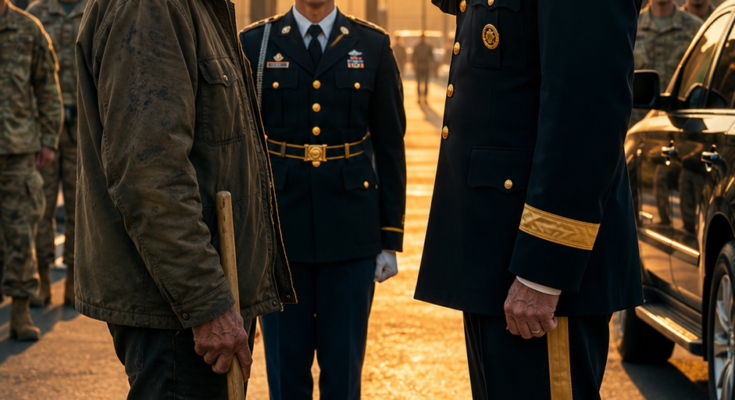
Ten minutes after the young guard dismissed him, a black SUV pulled up to the gate. The driver stepped out, then opened the rear door. A decorated general emerged—medals covering his chest, stars on his shoulders, the kind of presence that made everyone around him stand a little straighter. He walked past the young guard without a word, past the saluting soldiers, and headed straight for the old janitor.
General Matthew Harrison stopped in front of Aaron Mitchell. He removed his cap. And then, in front of everyone, he saluted.
“Colonel Mitchell,” the general said, his voice carrying across the silent yard. “It’s been forty years.”
Part 3: The Truth
Aaron Mitchell looked up slowly. His eyes met the general’s. For a long moment, neither man spoke. Then Aaron nodded once, a small, almost imperceptible motion. “General Harrison,” he said quietly. “You’re looking well.”
The young guard’s jaw dropped. The soldiers nearby stared in disbelief. The old janitor—the ghost janitor—had just been addressed as a colonel by a four-star general.
“I was told you were here,” General Harrison continued. “I had to see for myself. Forty years, Colonel. Forty years since you disappeared.”
Aaron’s hand tightened on his broom. “I didn’t disappear, General. I just… stopped.”
“Stopped?”
“Stopped being who I was. Stopped pretending I could be that man anymore.”
The general studied him for a moment, then gestured toward the gate. “Walk with me.”
Aaron set his broom against the fence and followed the general inside the base. For the first time in four decades, he crossed the yellow line. The young guard watched him go, his face pale, his hands trembling.
They walked in silence until they reached a small memorial garden near the center of the base. General Harrison stopped in front of a stone wall covered with names.
“Do you know what this is?” he asked.
Aaron looked at the wall. His eyes moved across the names, stopping on one near the middle. “I know what it is.”
“That’s your name, Colonel. You’re listed as missing in action. Presumed dead. For forty years, your country believed you had given your life for it. Your family believed it. Your men believed it.” The general turned to face him. “And you’ve been sweeping sidewalks outside the base for the last decade. Why?”
Aaron was quiet for a long moment. Then he spoke, his voice low and rough. “Because I couldn’t go back. After what happened in Vietnam, after what I saw, what I did… I couldn’t be the man they wanted me to be. So I walked away. I changed my name. I found a quiet corner of the world and I just… swept. Every morning. 5:45 sharp. It’s the only thing that made sense.”
“You saved lives out there,” the general said. “You led men through hell. You earned every medal on that wall.”
“Medals don’t bring back the dead,” Aaron said quietly. “Medals don’t fix the memories.”
The general placed a hand on his shoulder. “No, they don’t. But honoring those who served does. And you, Colonel, have been serving this country your entire life. Even when you thought you had stopped. Even when you were sweeping sidewalks and no one knew your name. You were still serving. You were still honoring.”
Aaron’s eyes glistened. For the first time in forty years, he let himself feel something other than silence.
“Come with me,” the general said. “Let me take you back to Washington. Let me correct the record. Let me tell the world that Aaron Mitchell is alive—and that he deserves to be honored, not forgotten.”
Aaron shook his head slowly. “I don’t need honors, General. I just need… peace.”
“Then let me give you that. Let me find you a place where you can rest. Where you can be remembered. Where your grandchildren can know who you really were.”
Aaron looked at the wall again. At the name he had left behind. At the life he had run from.
“I don’t have grandchildren,” he said.
“Yes, you do,” the general said softly. “Two. A boy and a girl. Your daughter never stopped looking for you. She never believed you were dead.”
Aaron’s face crumbled. “My daughter—”
“She’s a captain now. Serving in Germany. She’s been searching for you for twenty years.”
A sound escaped Aaron’s throat, something between a sob and a laugh. He covered his eyes with one hand, his shoulders shaking. The general stood beside him, waiting, patient.
“She deserves to know the truth,” the general said. “She deserves to meet her father.”
It took Aaron a long time to answer. But when he did, his voice was steady. “Take me to her.”
The general smiled. “I’ll make the arrangements.”
That afternoon, the young guard who had dismissed Aaron watched from the gate as Aaron got into the black SUV with the general. He stood there, frozen, as the vehicle drove away. He had told a decorated war hero to get lost. He had treated a colonel like trash.
One of the other guards walked over to him. “How were you supposed to know?” he asked.
The young guard shook his head. “I wasn’t supposed to know. That’s the point. I was supposed to treat everyone with respect, regardless of who they are. And I didn’t.”
He never forgot that lesson.
Months later, Aaron Mitchell returned to Fort Lincoln. But this time, he wasn’t sweeping sidewalks. He was standing at the center of the base, wearing his dress uniform, medals gleaming on his chest. His daughter stood beside him, tears streaming down her face. His grandchildren held his hands. And the entire base—soldiers, officers, and civilians—stood in formation to honor him.
General Harrison stepped to the podium. “Today, we correct a forty-year-old wrong. Today, we welcome home a man who gave everything to this country, even when no one knew his name. Colonel Aaron Mitchell—welcome home.”
The applause was deafening. Aaron looked out at the crowd, at the young soldiers who had once dismissed him, at the veterans who had fought beside him, at the daughter he had never stopped loving.
“Thank you,” he said, his voice breaking. “I don’t deserve this.”
His daughter wrapped her arms around him. “Yes, you do, Dad. You always did.”
Aaron Mitchell died peacefully five years later, surrounded by family. His daughter became a general. His grandchildren joined the military. And his story became legend at Fort Lincoln—the story of the janitor who was never just a janitor, the soldier who never stopped serving, the man who found his way home.
Sometimes, the greatest heroes are the ones who do the work no one sees. The ones who show up every day, no matter what, and do their job with dignity. The ones who don’t need medals or titles or praise. The ones who just… sweep.
Because even when no one is watching, the work still matters. And the people who do it matter too.
Aaron Mitchell taught us that. And his legacy lives on in every soldier who salutes, every veteran who remembers, and every janitor who sweeps the sidewalk like it’s the most important job in the world.
Because sometimes, it is. ❤️