Jamaica is an island of fewer than three million residents, yet Jamaican culture has an influence far beyond the Caribbean.
Reggae is heard around the world.
Jamaican athletes are international stars.
Foods such as jerk chicken and patties have traveled with migrants.
Words and expressions from Jamaican Patois appear in music and youth culture thousands of kilometers from Kingston.
Behind that cultural reach is an enormous story of migration.
Over generations, Jamaicans have established major communities in:
the United States, Canada and the United Kingdom, alongside smaller but important populations in countries from Australia to Japan.
The map above highlights five destinations where official statistics provide identifiable Jamaican population counts.
But the numbers also reveal how surprisingly difficult it is to answer a seemingly simple question:
How many Jamaicans live abroad?
The answer depends on what we mean by “Jamaican.”
Do we count only people born in Jamaica?
Jamaican citizens?
People with Jamaican parents?
People with Jamaican grandparents?
Anyone who reports Jamaican ancestry?
Different countries answer those questions differently.
And that makes the Jamaican diaspora even more interesting.
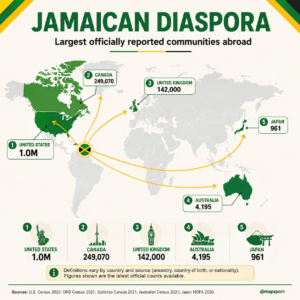
1. United States — Around 1 Million
The United States contains the largest Jamaican-origin community shown on the map.
The U.S. Census Bureau’s detailed 2020 Census data identified roughly 1 million people in the Jamaican detailed population group. Jamaicans and Haitians were the two largest detailed Caribbean-origin populations in the country.
That makes the United States one of the most important centers of Jamaican life outside Jamaica itself.
Why Did So Many Jamaicans Move to the United States?
Jamaican migration to the United States stretches back generations, but it accelerated strongly during the 20th century.
Economic opportunity was a major attraction.
Migrants found work in:
- Healthcare
- Transportation
- Education
- Construction
- Hospitality
- Professional services
- Small business
Family migration then reinforced the pattern.
Once relatives had established themselves in American cities, later migrants often had somewhere to stay, employment connections and an existing community.
Migration therefore became self-reinforcing.
New York Became a Major Jamaican Center
The strongest Jamaican cultural presence in the United States is associated particularly with the New York metropolitan area.
Neighborhoods in Brooklyn and the Bronx became important Caribbean centers.
Jamaican restaurants, churches, grocery stores, music venues and community organizations helped create cultural spaces where later generations could retain strong connections to the island.
Florida also developed an important Jamaican population, helped partly by its geographical proximity to the Caribbean.
Other communities emerged throughout states such as:
- New Jersey
- Georgia
- Connecticut
- Massachusetts
- Maryland
The diaspora therefore became increasingly national rather than concentrated in only one American city.
Jamaican Influence on American Music
Migration did more than move people.
It moved culture.
One of the most famous examples involves DJ Kool Herc, a Jamaican-born DJ who grew up in Kingston before moving to New York.
His Bronx parties during the 1970s became part of the early development of hip-hop culture.
Jamaican sound-system traditions—including DJs speaking rhythmically over instrumental music—formed one of several influences that helped shape the emerging genre.
This is an extraordinary example of diaspora influence:
A musical culture developed on a Caribbean island became part of the environment from which one of America’s most important modern cultural movements emerged.
2. Canada — 249,070 People Reporting Jamaican Origin
Canada provides perhaps the cleanest number on the infographic.
According to the 2021 Canadian Census, exactly:
249,070 people reported Jamaican ethnic or cultural origin.
That represented about 0.7% of Canada’s population in private households.
But one detail makes the Canadian statistics particularly fascinating.
Most are not necessarily recent Jamaican immigrants.
Statistics Canada reported that among those identifying Jamaican ancestry:
101,965 were first generation
104,730 were second generation
and
42,380 were third generation.
That tells us something important:
The Jamaican community in Canada has become deeply established.
It is no longer simply a migrant population.
It includes large numbers of Canadian-born children and grandchildren of Jamaican immigrants.
Toronto Is the Heart of Jamaican Canada
Most Jamaicans who migrated to Canada settled in and around Toronto.
Statistics Canada notes that the Greater Toronto Area has been the principal destination for Jamaican immigrants over the past several decades.
That concentration transformed Toronto culturally.
Jamaican influence can be seen in:
- Food
- Music
- Language
- Radio
- Festivals
- Churches
- Sports
- Local politics
Toronto’s Caribbean culture cannot be understood without Jamaica.
The Jamaican patty, for example, became such a familiar Toronto food that it crossed from immigrant cuisine into mainstream Canadian urban life.
Jamaica Is Canada’s Largest Caribbean Source Community
Statistics Canada also reports that Jamaica is Canada’s largest Caribbean source country for immigrants, ahead of Haiti and Trinidad and Tobago.
More than one in eight Black Canadians had Jamaican roots according to Statistics Canada’s summary of the 2021 Census.
That is an extraordinary level of cultural influence for an island thousands of kilometers away.
3. United Kingdom — At Least 142,000 Jamaica-Born Residents in England and Wales
This number needs the biggest clarification.
The infographic gives:
United Kingdom — 142,000
But that is not the size of Britain’s full Jamaican-descended population.
It is the 2021 Census count of people living in England and Wales who were born in Jamaica.
ONS reported that the Jamaica-born population in England and Wales declined from approximately 160,000 in 2011 to 142,000 in 2021. (Office for National Statistics)
The total population with Jamaican family roots is substantially larger because it includes:
children,
grandchildren,
and later descendants
who were born in Britain.
So the map should say:
England & Wales — 142,000 Jamaica-born residents
rather than simply:
United Kingdom — 142,000 Jamaicans.
The Windrush Connection
Britain’s Jamaican story is inseparable from the Windrush generation.
After World War II, Britain faced labor shortages.
People from Jamaica and other Caribbean territories migrated to Britain, particularly from the late 1940s onward.
The arrival of the ship Empire Windrush in 1948 became the symbolic beginning of this major postwar Caribbean migration era.
Thousands of Jamaicans eventually settled permanently.
They worked in:
- Public transport
- Hospitals
- Manufacturing
- Construction
- Public services
and numerous other parts of Britain’s rebuilding economy.
Their children and grandchildren became part of modern British society.
London Became a Jamaican Cultural Capital
London developed Britain’s largest concentration of Jamaican and broader Caribbean communities.
Areas such as:
- Brixton
- Hackney
- Lambeth
- Lewisham
became closely associated with Caribbean migration.
The influence on British culture was enormous.
Reggae.
Dub.
Ska.
Sound-system culture.
Caribbean food.
Carnival traditions.
And eventually British musical movements including jungle, garage, grime and other genres all developed within a cultural landscape heavily influenced by Caribbean communities.
Jamaican vocabulary also entered British urban speech.
So even though Jamaica is nearly 7,500 kilometers away, its cultural influence can be heard in everyday Britain.
Why the UK Number Is Falling Even Though the Community Hasn’t Disappeared
ONS reports that the Jamaica-born population of England and Wales decreased from 160,000 to 142,000 between 2011 and 2021. (Office for National Statistics)
That does not mean Jamaican heritage is disappearing from Britain.
It partly reflects an ageing migration history.
Many people from the large postwar migration waves have lived in Britain for decades.
ONS found that 40.2% of Jamaica-born residents in England and Wales were aged 65 or older in the 2021 Census. (Office for National Statistics)
Meanwhile their British-born descendants are not counted as Jamaica-born.
Imagine a Jamaican woman who migrated to London in 1965.
Her daughter was born in Britain in 1970.
Her grandchildren were born there in the 1990s.
Only the grandmother appears in the “Jamaica-born” statistic.
Yet all three generations may identify strongly with Jamaican heritage.
This illustrates why country of birth and diaspora size are not the same thing.
4. Australia — 4,195 People of Jamaican Descent
Australia’s Jamaican community is much smaller.
The 2021 Australian Census recorded:
4,195 Australian residents of Jamaican descent.
Of those, only:
1,148 were actually born in Jamaica. (DFAT)
This is another perfect demonstration of why definitions matter.
If we used:
country of birth
Australia’s Jamaican number would be 1,148.
If we use:
ancestry
it becomes 4,195.
Neither is necessarily wrong.
They measure different things.
Why Is Australia’s Community Smaller?
Distance matters.
Historically, Jamaican migration networks developed most strongly toward:
the United States,
Canada,
and Britain.
Those countries offered earlier migration connections, family networks and historical relationships.
Australia is much farther away and had fewer established Jamaican migration chains.
Still, the presence of more than four thousand Jamaican-descended Australians shows how widely the diaspora has spread.
5. Japan — 961 Jamaican Nationals
Japan is the smallest destination shown.
Japan’s Ministry of Foreign Affairs reported:
961 Jamaican nationals living in Japan as of December 2020. (Ministry of Foreign Affairs of Japan)
But once again, this is a different measurement.
It counts:
Jamaican citizens
rather than:
people reporting Jamaican ancestry.
So it cannot be directly compared with Canada’s 249,070 ancestry count.
A Japanese citizen with a Jamaican parent might not appear in the 961.
Likewise, a Jamaican national temporarily residing in Japan could.
Still, the figure illustrates something interesting:
Jamaican migration extends even into East Asia.
Jamaica and Japan Have an Unexpected Cultural Connection
Japan has developed a surprisingly enthusiastic following for Jamaican music.
Reggae and dancehall gained dedicated Japanese audiences.
Japanese sound systems have even participated internationally in Jamaican-style sound clashes.
The connection demonstrates how diaspora and cultural influence do not always move together.
A country can have a relatively small Jamaican population yet maintain strong interest in Jamaican culture.
The Diaspora Is Bigger Than These Five Countries
The infographic should not be interpreted as a complete map of every Jamaican community abroad.
Jamaicans and their descendants also live throughout:
- Cayman Islands
- Bahamas
- Trinidad and Tobago
- other Caribbean territories
- Germany
- Netherlands
- other European states
And different governments collect ancestry data differently—or do not collect it at all.
This makes a definitive worldwide ranking surprisingly difficult.
Why Jamaican Emigration Became So Significant
Several factors pushed and pulled Jamaicans abroad over generations.
Economic opportunity
Higher wages and larger labor markets abroad attracted workers.
Colonial connections
As part of the British Empire until independence in 1962, Jamaica had strong institutional and migration links with Britain.
Geography
The United States and Canada were relatively accessible destinations in the Western Hemisphere.
Family networks
Once communities developed overseas, relatives followed.
This is known as chain migration or network migration.
A migration path can become self-sustaining.
One person moves.
Then a sibling.
Then a cousin.
Then a spouse.
Then children join.
Within decades an overseas community can contain multiple generations.
Migration Didn’t Weaken Jamaican Culture—It Globalized It
One particularly interesting aspect of Jamaica’s diaspora is how strongly cultural identity survived.
Diaspora communities brought:
Reggae
Artists such as Bob Marley helped turn Jamaican music into a truly global cultural phenomenon.
Dancehall
The genre became influential internationally, especially in Britain, North America and Caribbean communities.
Food
Jerk chicken, curry goat, patties, rice and peas and other Jamaican foods became widely available in diaspora cities.
Language
Jamaican Patois influenced slang and music far beyond the island.
Religion
Church communities often became important social institutions for migrants.
Sport
Jamaica’s extraordinary international track-and-field reputation became a source of diaspora identity and pride.
Migration therefore did not simply move Jamaicans abroad.
It helped export Jamaica itself.
Remittances Connect the Diaspora Back to Jamaica
Diaspora communities also maintain strong economic relationships with Jamaica.
Migrants frequently send money home to relatives.
These transfers—known as remittances—can help families pay for:
- Food
- Housing
- Education
- Healthcare
- Business investment
For many migrant-sending countries, remittances become an important component of household income and the national economy.
So Jamaicans living overseas remain connected economically as well as culturally.
One Island, Several Generations Abroad
The Canadian data provide perhaps the clearest evidence of how mature the diaspora has become.
Among 249,070 Canadians reporting Jamaican ancestry, fewer than half were first generation. Large numbers were second- and third-generation Canadians. (Statistics Canada)
The same basic phenomenon exists in Britain and the United States.
That raises an interesting question:
When does someone stop being part of a diaspora?
A person born in Toronto whose parents were born in Jamaica?
Clearly connected.
What about someone whose Jamaican grandparents migrated in the 1960s?
What about a great-grandchild?
There is no universal statistical answer.
Identity cannot always be reduced to birthplace.
Why Diaspora Maps Are So Difficult to Make
Imagine comparing five countries.
Canada asks:
What is your ethnic or cultural origin?
Australia asks about:
ancestry.
Britain publishes detailed:
country-of-birth data.
Japan reports:
foreign nationality.
The United States uses detailed:
race and ethnicity responses.
The resulting numbers look similar enough to put into a table.
But they are measuring different populations. (Census.gov)
That is why a disclaimer is essential.
Otherwise readers might conclude, for example, that Canada has nearly twice as many Jamaicans as Britain.
What we can actually say is:
Canada counted 249,070 people reporting Jamaican ancestry.
England and Wales counted 142,000 Jamaica-born residents.
Those are not directly comparable categories.
A Better Way to Present the Five Numbers
For maximum accuracy, I would label the infographic like this:
United States — ~1.0M
2020 Census, Jamaican detailed population group
Canada — 249,070
2021 Census, Jamaican ethnic/cultural origin
England & Wales — 142,000
2021 Census, born in Jamaica
Australia — 4,195
2021 Census, Jamaican ancestry/descent
Japan — 961
2020, Jamaican nationals residing in Japan
That tells readers exactly what each number means.
The Bigger Story
Jamaica provides a remarkable example of how national influence can extend far beyond national territory.
Large communities formed in North America and Britain.
Their children built lives abroad.
Their grandchildren inherited parts of Jamaican identity.
Meanwhile music, food, language and style traveled even farther than the migrants themselves.
That is why Jamaican influence feels disproportionately large compared with the island’s population.
The diaspora helped turn a relatively small Caribbean country into a cultural power with a global footprint.
Look at New York.
Toronto.
London.
Even Sydney and Tokyo.
The numbers are different.
The migration histories are different.
But all remain connected in some way to the same island.
Jamaica’s population lives mostly in Jamaica. Jamaican culture does not.
Source & Accuracy Note
Three figures on the infographic are strongly supported exactly as shown: Canada’s 249,070 is the 2021 Census count reporting Jamaican ethnic or cultural origin; Australia’s 4,195 represents residents reporting Jamaican descent in the 2021 Census; and Japan’s 961 is the number of Jamaican nationals recorded as residing in Japan in December 2020. (Statistics Canada)
The U.S. Census Bureau reports roughly 1 million people in the Jamaican detailed population group in 2020. The 142,000 figure, however, applies specifically to Jamaica-born residents of England and Wales, not the full United Kingdom or everyone of Jamaican ancestry. ONS says that number declined from roughly 160,000 in 2011 to 142,000 in 2021. (Census.gov)