
South Korea has a population of roughly 50 million people, but Korean communities extend far beyond the Korean Peninsula.
From Los Angeles and Toronto to Tokyo, Beijing, Almaty and Tashkent, millions of people with Korean nationality or ancestry live across the world.
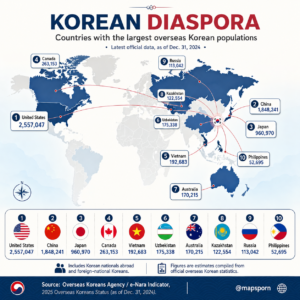
According to South Korea’s latest official overseas-population statistics, approximately 7.01 million overseas Koreans were living in 181 countries as of December 31, 2024.
And their distribution tells a fascinating story.
The United States alone has more than 2.55 million.
China has around 1.85 million.
Japan has almost 961,000.
Meanwhile, unexpectedly large historic Korean communities remain in countries such as Uzbekistan, Kazakhstan and Russia—living evidence of migrations and forced relocations stretching back more than a century.
What Does “Overseas Korean” Mean?
Before examining the map, it is important to understand what South Korea’s government is counting.
The 7,006,703 total contains two broad groups:
Korean nationals living overseas — 2,402,026
and
foreign nationals of Korean descent — 4,604,677. (Oka)
That means someone does not have to hold a South Korean passport to appear in these statistics.
A Korean American born in California, an ethnic Korean citizen of China, or a Koryo-saram family in Kazakhstan may all be included depending on how the relevant statistics are compiled.
This makes the map more accurately a map of the global Korean diaspora, rather than merely South Korean emigrants.
1. United States — 2,557,047
The United States has the world’s largest overseas Korean community:
2,557,047 people. (Oka)
Korean immigration to the United States occurred in several major waves.
The first significant group arrived in Hawaii during the early 20th century, often working on sugar plantations.
Migration expanded dramatically following changes to U.S. immigration law during the 1960s.
Large Korean communities subsequently developed in places including:
- Los Angeles
- New York
- New Jersey
- Washington metropolitan area
- Atlanta
- Chicago
- Seattle
- Dallas
Los Angeles and Koreatown
Los Angeles became perhaps the best-known Korean cultural center outside Korea.
Its famous Koreatown contains Korean restaurants, supermarkets, churches, businesses, entertainment venues and media.
But Korean Americans today are far more geographically dispersed than the name “Koreatown” suggests.
Second-, third- and later-generation Korean Americans live throughout the country.
The community also includes students, temporary workers, permanent residents, naturalized Americans and American-born descendants.
Interestingly, the official 2025 report shows the U.S. estimate falling from 2,615,419 in the previous survey to 2,557,047, a decline of about 2.2%. South Korean authorities say part of this change reflects an update to the methodology used with U.S. Census data rather than simply hundreds of thousands of people physically leaving. (Oka)
That is an important reminder:
Diaspora statistics can change because of measurement methods as well as migration.
2. China — 1,848,241
China has the second-largest Korean population outside Korea:
1,848,241.
Unlike many Korean communities in Western countries, China’s Korean population has deep historical roots concentrated near the Korean Peninsula.
A particularly important community consists of Joseonjok, or ethnic Koreans who are citizens of China.
Large populations historically lived in northeastern China, especially around the Yanbian Korean Autonomous Prefecture in Jilin Province.
Korean language, food and cultural traditions have remained important there for generations.
But China’s Korean Population Is Shrinking
China experienced one of the largest changes in the latest report.
The official estimate dropped from:
2,109,727
to:
1,848,241.
That’s a decline of 12.39% in two years. (Oka)
The Overseas Koreans Agency attributes the decline partly to economic factors encouraging people to move back to Korea or migrate onward to other countries. (지표누리)
This is significant.
For decades, China was one of the dominant centers of the Korean diaspora.
It remains enormous—but its share is declining.
3. Japan — 960,970
Japan ranks third with:
960,970 overseas Koreans.
The Korean community in Japan has one of the most complicated histories on this list.
Many Koreans moved—or were brought—to Japan during the period when Korea was under Japanese colonial rule from 1910 to 1945.
Their descendants became commonly known as Zainichi Koreans, literally Koreans residing in Japan.
Some eventually became Japanese citizens.
Others retained Korean nationality or special permanent-resident status.
More recent decades added South Korean:
- Students
- Professionals
- Business owners
- Spouses
- Temporary residents
So Japan’s Korean population contains very different generations and migration histories.
Why Did Japan’s Number Suddenly Rise?
This is one of the most interesting changes in the new dataset.
Japan’s official overseas-Korean estimate jumped from:
802,118
to:
960,970
—a remarkable 19.8% increase. (Oka)
But this does not mean nearly 160,000 Koreans suddenly migrated to Japan.
The Overseas Koreans Agency explains that this survey newly incorporated more children born through international marriages into the Japanese estimate. (지표누리)
Again, methodology matters enormously.
4. Canada — 263,153
Canada contains the fourth-largest community:
263,153 overseas Koreans.
Major concentrations exist around:
Toronto
and
Vancouver.
Both cities developed extensive Korean commercial districts, churches, restaurants and community institutions.
Canadian immigration programs have attracted Korean:
- Professionals
- Entrepreneurs
- Students
- Families
for decades.
Unlike the declines recorded in the United States and China, Canada’s official Korean population estimate increased from 247,362 to 263,153, approximately 6.4%. (Oka)
5. Vietnam — 192,683
Vietnam may be one of the more surprising countries on the list.
It now contains an estimated:
192,683 overseas Koreans.
This population is much more recent than the historic Korean communities of China, Japan or Central Asia.
Its growth is strongly connected with expanding economic relations between South Korea and Vietnam.
South Korean companies have invested heavily in Vietnam in industries including:
- Electronics
- Manufacturing
- Construction
- Retail
- Finance
- Hospitality
This brought Korean executives, engineers, workers, business owners and families.
Major communities developed particularly around:
Ho Chi Minh City
and
Hanoi.
Vietnam therefore represents a newer kind of Korean diaspora destination—one shaped less by historic displacement and more by globalization and investment.
6. Uzbekistan — 175,338
Uzbekistan’s 175,338 Koreans reveal one of the most dramatic chapters in diaspora history.
These communities are closely associated with the Koryo-saram, ethnic Koreans of the former Soviet Union.
Their story begins in the Russian Far East.
Koreans migrated there during the late 19th and early 20th centuries.
Then, in 1937, Joseph Stalin’s Soviet government forcibly deported tens of thousands of ethnic Koreans from the Soviet Far East to Central Asia.
Many were transported to:
Uzbekistan
and
Kazakhstan.
Families had to rebuild their lives thousands of kilometers away from Korea.
Generations later, large Korean-descended communities remain there.
7. Australia — 170,215
Australia’s overseas Korean population has grown to:
170,215.
Most are concentrated in large urban centers such as:
- Sydney
- Melbourne
- Brisbane
Australia became especially attractive for Korean students and skilled migrants.
Tourism, education and business connections between Australia and South Korea further strengthened the community.
The broader South Asia-Pacific region was one of the strongest-growing areas in the latest Overseas Koreans Agency report, rising 12.5% from the previous survey. (Oka)
That suggests the geographic center of the Korean diaspora is slowly becoming more diverse.
8. Kazakhstan — 122,554
Kazakhstan has:
122,554 overseas Koreans.
Like Uzbekistan, its Korean population is heavily connected to the Soviet-era deportations of 1937.
Koryo-saram communities became integrated into Central Asian society while retaining elements of Korean cultural identity.
Over generations, Russian often became the principal language for many families, while traditional Korean customs evolved separately from those developing on the Korean Peninsula.
This created a distinctive diaspora culture.
Koryo-saram identity today is neither simply Korean nor simply Russian or Central Asian.
It reflects generations of migration and adaptation.
9. Russia — 113,042
Russia has approximately:
113,042 overseas Koreans according to the latest official estimate.
Russia is historically important because the Russian Far East was one of the earliest major destinations for Korean migration during the late 19th century.
Although Stalin’s 1937 deportations removed much of that community to Central Asia, Korean populations later reappeared across parts of Russia.
The latest Korean government statistics indicate that the broader Russia/CIS region declined about 2.45% from the previous survey, with officials citing effects associated with the Russia-Ukraine war among the factors affecting the population. (지표누리)
10. Philippines — 52,695
The Philippines rounds out the top 10 with:
52,695 overseas Koreans.
The community has been influenced especially by:
- Education
- Tourism
- Business
- Retirement
- English-language study
For years, Korean students traveled to the Philippines for relatively affordable English education.
Cebu and Metro Manila became particularly recognizable Korean destinations.
Tourism also developed strongly in both directions.
Although the community is considerably smaller than Vietnam’s, it demonstrates how South Korea’s economic and cultural links with Southeast Asia have generated new migration networks.
More Than 7 Million Koreans Live Abroad
The worldwide estimate stands at:
7,006,703 people across 181 countries.
That total has actually fallen slightly.
The previous survey, based on the end of 2022, estimated:
7,081,510.
The latest figure represents a decline of:
74,807 people, or 1.06%.
But the regional pattern is much more interesting than the global decline.
Northeast Asia
−3.52%
North America
−1.49%
Russia & CIS
−2.45%
South Asia-Pacific
+12.50%
Europe
+7.60%
Latin America
+3.50% (Oka)
In other words:
Older major Korean diaspora centers are shrinking or stabilizing, while some newer destinations are expanding.
The Overseas Koreans Agency itself describes the trend as traditional large settlement areas shrinking while emerging regions grow. (Oka)
Nearly Two-Thirds Are Foreign Citizens of Korean Descent
Another fascinating statistic is the citizenship breakdown.
Of the roughly 7.01 million overseas Koreans:
2,402,026 are Korean nationals living abroad
while
4,604,677 are people of Korean descent holding foreign nationality. (Oka)
That means the majority of the diaspora does not consist simply of South Koreans temporarily living overseas.
Much of it represents communities that have permanently settled abroad.
Some families left Korea decades—or even more than a century—ago.
Their descendants may speak:
English,
Chinese,
Japanese,
Russian,
Kazakh,
Uzbek,
or other languages
as their first language.
Yet they remain part of the much wider story of Korean migration.
Why Did Koreans Spread Around the World?
There wasn’t one Korean migration.
There were many.
Economic migration
People moved to the United States, Canada and Australia seeking jobs, education and business opportunities.
Colonial history
Korea’s period under Japanese rule helped create the long-established Korean population in Japan.
Political upheaval
The division of the Korean Peninsula and the Korean War displaced millions.
Forced migration
Stalin’s 1937 deportation created the major Koryo-saram populations of Uzbekistan and Kazakhstan.
Modern globalization
South Korean companies and professionals helped produce newer communities in Vietnam and elsewhere in Southeast Asia.
Each diaspora destination therefore has a different origin.
The map connects communities that sometimes share very little migration history beyond their distant Korean ancestry.
The Korean Diaspora Is Also Changing Korea
Migration doesn’t operate in only one direction.
People return.
Families move between countries.
Foreign-born descendants study or work in South Korea.
Koryo-saram communities have increasingly migrated from Central Asia to South Korea.
Korean Americans and Korean Canadians establish businesses and professional links.
And younger generations interact through Korean popular culture.
The enormous global success of:
K-pop
K-dramas
Korean cinema
Korean food
has also created a new connection between diaspora populations and contemporary South Korea.
A descendant of Koreans who left generations ago can now access Korean language and culture online instantly.
Diaspora identity is therefore continually changing.
Why These Figures Are Estimates
The Korean government does not conduct a worldwide census itself.
Instead, Korean diplomatic missions compile estimates using sources such as:
- Host-country censuses
- Immigration data
- Government statistics
- Overseas Korean registration records
- Consular administrative records
- Local Korean community organizations
The Overseas Koreans Agency says these different sources are combined because data availability and reference dates vary by country.
That means:
2,557,047 in the United States should not be understood as a literal headcount accurate to one individual.
It is an official estimate.
That distinction is worth keeping on the infographic.
The Bigger Story Behind the Map
The top 10 countries tell several completely different histories.
The United States and Canada represent modern immigration.
China represents a centuries-old neighboring population.
Japan reflects colonial history and modern migration.
Uzbekistan and Kazakhstan preserve the legacy of Soviet forced deportation.
Vietnam and the Philippines show the growth of modern economic networks.
Australia reflects education and skilled migration.
And Russia connects the story back to some of the earliest large Korean migrations beyond the peninsula.
Put them together and the Korean diaspora is not one community.
It is a collection of populations formed in different centuries, under different political systems and for completely different reasons.
Yet today roughly seven million people across 181 countries fall within South Korea’s official definition of overseas Koreans.
For a country the size of South Korea, that is an extraordinary global footprint.
Source & Accuracy Note
This infographic’s top-10 figures match the 2025 Status of Overseas Koreans released by South Korea’s Overseas Koreans Agency: United States 2,557,047, China 1,848,241, Japan 960,970, Canada 263,153, Vietnam 192,683, Uzbekistan 175,338, Australia 170,215, Kazakhstan 122,554, Russia 113,042, and Philippines 52,695. The reference date is December 31, 2024, although the report itself was released on December 31, 2025.
I would keep the infographic’s note explaining that the figures include both Korean nationals abroad and foreign-national Koreans, and I would describe them as official estimates, not exact census counts.