Part 1: The Thief
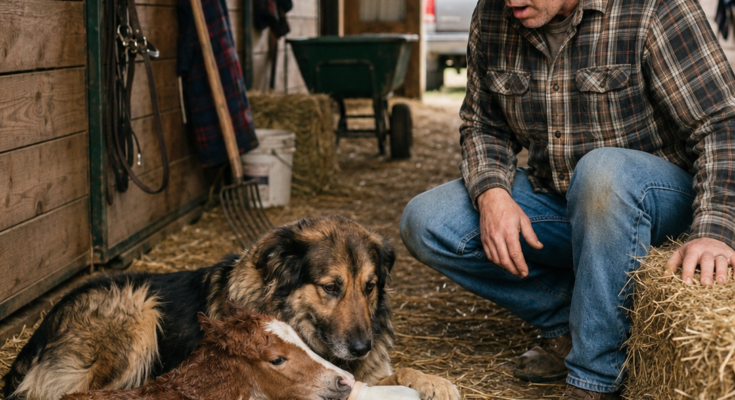
For a few seconds, I just crouched there with one hand on the hay bale, trying to understand what I was seeing. The foal was tucked into a hollow the dog had made in the straw. Its legs were folded awkwardly under its tiny body, and dried milk clung to the soft hair around its mouth. Our dog lay beside it with her front paws pressed against the bottle, keeping it from rolling away while the foal worked at the nipple.
Then she looked at me. Not guilty. Not scared. Protective.
I reached for the bottle, and she put one paw across it and gave a low whine. She wasn’t threatening me. She was watching the foal’s face, then mine, as if she needed me to understand that breakfast wasn’t finished yet.
That was when my embarrassment hit. For three mornings, I’d complained about missing milk. I’d checked the porch, the utility room, even blamed one of us for forgetting where we’d put the bottles. Meanwhile, this dog had apparently decided there was something in the barn more important than getting caught.
I waited until the foal stopped drinking, then carefully picked up the bottle. The rubber nipple was marked with tiny tooth dents. Suddenly I knew exactly how she’d done it. We kept prepared bottles on a low shelf near the barn entrance during morning chores. She hadn’t learned to fill one. She’d learned which bottle smelled like milk, how to lift it without spilling much, and where to carry it.
I looked around the little nest again. There was more straw piled against the foal’s back than anywhere else. A feed sack had been dragged across the dirt and bunched near its legs. None of that had fallen there naturally. The dog had been building around it.
I slipped my arms under the foal and tried to help it stand. Its knees shook immediately, and after one weak attempt, it sank back into the straw. Our dog jumped up. I expected her to stay with the foal. Instead, she grabbed the empty bottle, ran toward the barn door, stopped, and looked back at me. When I didn’t follow, she dropped it and barked once.
Then she ran outside.
Part 2: The Trail
I followed her past the side of the barn, and that’s when I realized the milk wasn’t the only mystery she had solved before the rest of us. She stopped at one particular spot and began pawing furiously at the ground.
Under the loose dirt, I found a small leather collar. It was old, worn, and had a nameplate engraved with letters that had nearly faded away. I wiped the mud off and squinted at the name. Daisy. The name of a horse we had lost two years earlier. Daisy had been the foal’s mother.
I sat back on my heels, trying to piece it together. Daisy had died during a difficult birth. The foal had been so weak that the vet didn’t think it would survive. We had focused on saving the foal’s life in those first few days, but when it seemed stable, we moved on. We never thought about the bond it had already formed with our dog.
But the dog had remembered. She had watched over the foal from the beginning. She had seen its mother die, and she had decided that this tiny creature needed someone. So she became that someone.
I looked at the dog, who was now sitting patiently beside me. She wasn’t a young dog anymore. Her muzzle was gray, and her movements were slower than they used to be. But there was a quiet dignity about her that I had never fully appreciated until that moment.
“You’ve been doing this for two years,” I whispered. “You’ve been taking care of it all along.”
I thought about all the times I had seen her carry a bottle into the barn. I had assumed she was being mischievous. I had scolded her. I had even considered tying her up to stop her. And all along, she was just being a mother.
She nudged my hand with her nose. I reached down and scratched behind her ears. “I’m sorry,” I said. “I didn’t understand.”
Part 3: The Legacy
I went back inside and told my family what I had found. They were stunned. My husband shook his head in disbelief. “That dog has been feeding that foal for two years, and we never noticed?”
“We weren’t paying attention,” I said. “We were too busy assuming the worst.”
The foal—whom we named Hope—continued to grow, but she was never quite like the other horses. She was gentler, quieter. She would follow the dog everywhere. The dog would lie in the pasture while Hope grazed nearby, always keeping an eye on her. They were an unlikely pair, but they were inseparable.
Over time, we learned the full story. The dog had been pregnant once, years ago, but her puppies had been stillborn. She never forgot that loss. When Daisy died and left her foal behind, the dog saw a chance to mother again. She took it. She didn’t just feed the foal. She protected her. She loved her. She raised her.
I thought about all the times I had been impatient with the dog. All the times I had dismissed her as just another farm animal. She had shown me that love doesn’t require language. It doesn’t require approval. It just requires showing up, again and again, even when nobody understands.
Years passed. Hope grew into a beautiful horse. The dog grew older and slower. Eventually, the dog couldn’t keep up with Hope anymore. She would lie in the sun, watching Hope run, her tail wagging slowly. Hope would come to her, nuzzle her, and lie down beside her. It was their ritual. Their way of saying goodbye.
The dog passed away peacefully in her sleep, surrounded by hay and sunshine, with Hope curled up beside her. We buried her on the hill overlooking the pasture. I put a small stone at the head of her grave with her name on it. And every year on the anniversary of her death, Hope comes to the hill and lies down beside the stone for a few minutes. Then she gets up and runs back to the herd.
I never forgot what that dog taught me. She taught me that love is fierce. That it doesn’t ask for permission. That it shows up, even when it’s not wanted, even when it’s misunderstood, even when it costs something.
She also taught me to pay attention. To look closer. To assume the best instead of the worst. Because sometimes, the things that look like theft are really acts of care. The things that look like mischief are really devotion. The things that seem broken are really just waiting to be understood.
I still keep a bottle of milk on the low shelf near the barn entrance. Not because any animal needs it anymore. But because it reminds me of the dog who taught me that love is always worth the risk.
Sometimes, the greatest heroes come in the most unlikely packages. Sometimes, they have four legs, gray muzzles, and a nose for trouble. Sometimes, they’re just a farm dog who decided that a motherless foal deserved to be loved.
I’ll always be grateful for that dog. And I’ll always remember what she taught me: that the best kind of love doesn’t need words. It just needs to show up. ❤️