Part 1: The Pancake
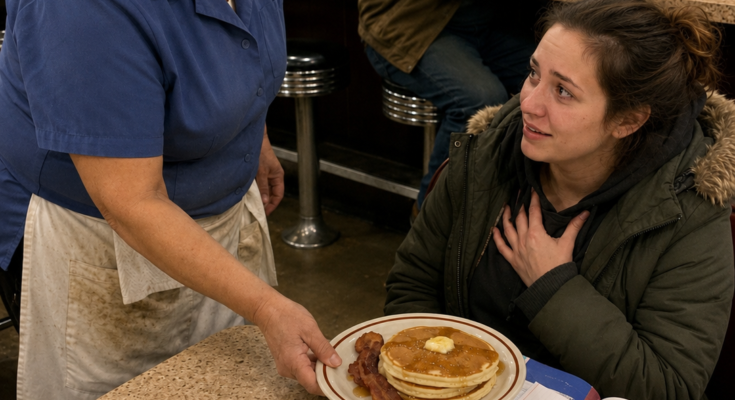
“Miss, I think you have the wrong table. I only ordered the tap water and a black coffee,” the young girl whispered. Her hands were shaking so hard the ice clinked against the cheap plastic cup.
I wiped my apron and didn’t make eye contact. “Cook messed up the ticket,” I lied, sliding the steaming plate of buttermilk pancakes and bacon across the sticky Formica table. “Boss says if I throw it out, it comes out of my paycheck. Just eat it, honey.”
She looked at the food like it was a mirage. Then she looked at me, her eyes welling up, before practically inhaling the meal.
My name is Maria. I’m sixty-two, and I’ve worked the graveyard shift at a highway diner in rural Ohio for fourteen years. At 2:00 AM, the world is divided into two types of people: those who are running away from something, and those who are working too hard to get somewhere. The girl in Booth Four was definitely the latter.
Her name was Chloe. She was a nursing student. I knew this because her side of the booth was always completely buried under thick medical textbooks, highlighters, and flashcards. She came in every Tuesday night. She always wore the same thin, faded winter coat that had no business being worn in a brutal Midwestern December. She never asked for food. Just the coffee, which she nursed for four hours while she studied under the flickering neon light.
I know what it looks like to be running on empty. Thirty years ago, I was a single mom stretching a dollar of ground beef over three days. I know the hollow look of someone who is calculating the exact cost of their next breath. So, the “accidental” pancakes became our weekly tradition. Sometimes the cook “burned” a grilled cheese just right. Sometimes a bowl of chicken noodle soup “accidentally” got ladled twice. Chloe eventually stopped arguing and started saying thank you with a quiet, tearful grace.
But diner life is a fishbowl. You can’t keep a secret at 3:00 AM when the only sound is the hum of the refrigerator.
Part 2: The Spark
Hank, a massive, bearded long-haul trucker who smelled like diesel oil and strong coffee, sat a few stools down at the counter. He was a regular who usually complained about the state highways and left exactly a 15% tip in quarters. One Tuesday, Hank watched me slide a “mistake” slice of cherry pie onto Chloe’s table.
When Hank got up to pay his bill, he didn’t hand me his usual exact change. He slapped a crumpled fifty-dollar bill on the register. “Keep the change, Maria,” he grumbled, pulling his grease-stained cap down low over his eyes. “And put it toward the kid in Booth Four. Nobody should have to learn how to save lives on an empty stomach.”
I stood there, stunned, holding the fifty. That was the spark. That was all it took.
The next week, it wasn’t just Hank. An older couple who suffered from insomnia and came in for decaf left a sealed envelope under their ketchup bottle. Inside was a twenty-dollar bill and a sticky note that just said: “For Booth Four.” A local mechanic named Dave started coming in on his night off. He would order a full steak dinner, eat half of it, and loudly declare he was “completely stuffed.” He’d then ask me to box up the rest and give it to “the student over there so it doesn’t go to waste.”
Chloe didn’t know how to handle it. She was used to fighting her battles completely alone. One night, she broke down crying right over her anatomy textbook. She pulled me aside and tried to hand me a handful of crumpled dollar bills she’d somehow saved up.
“Maria, I can’t keep taking charity,” she sobbed quietly. “I’m going to pay everyone back. I promise. As soon as I get my degree.”
I gently pushed her hand away. “Honey, this isn’t a loan,” I told her softly. “This is an investment. They’re investing in you.”
By February, the brutal cold outside was relentless, but Booth Four was the warmest place in the county. It wasn’t just food anymore. One night, Chloe found a brand-new pair of thick, wool socks sitting on her side of the booth. Another night, someone left a pre-paid gas card tucked inside her textbook when she went to the restroom. I never saw who left the gas card. In a diner full of rough-around-the-edges night owls, everyone suddenly had a soft spot they were desperately trying to hide.
Part 3: The Legacy
Spring finally arrived. The snow melted, and the diner windows were propped open. On a Tuesday in May, Chloe walked in. But this time, she didn’t have her heavy textbooks. She wasn’t wearing her thin winter coat. She was wearing crisp, blue hospital scrubs.
She walked straight up to the counter. The entire diner went completely silent. Hank stopped mid-bite of his burger. Dave lowered his coffee mug.
“I passed,” Chloe said, her voice shaking but carrying across the quiet room. “I’m officially a registered nurse. And I got the job at the county hospital.”
The cheer that erupted in that diner could have woken the dead. Hank slammed his massive hand on the counter, hooting loudly. The insomnia couple clapped until their hands were red. I just leaned over the counter and hugged her, tears streaming down my face.
Chloe didn’t sit in Booth Four that night. She sat at the counter with all of us, and she bought everyone a round of coffee with her very first signing bonus.
That was three years ago. Chloe is an incredible nurse now. She visits when her shifts align, and she never lets me pay for my own coffee when we meet up. But the legacy of Booth Four didn’t leave when she did. Word got around. Our little late-night community created an unspoken rule.
If you come into our diner between midnight and 6 AM, and you sit in Booth Four, you don’t get a bill. Sometimes it’s a young mother escaping a bad situation. Sometimes it’s a teenager who got kicked out of their house. Sometimes it’s just someone who has hit absolute rock bottom and needs a hot meal to remember they are still human.
There is a glass mason jar under the cash register now. Customers constantly drop their spare change, their extra fives, their unexpected bonuses into it. That jar pays for Booth Four. It’s never empty.
The world can seem incredibly dark, especially when you’re scrolling on your phone or watching the late-night news. It feels like everyone is angry, everyone is shouting, and no one is listening. But I get a front-row seat to the best part of humanity every single night. I get to watch calloused, tired people give their hard-earned money to strangers they will never even speak to. I get to watch a cracked vinyl booth become a sanctuary.
You don’t need a million dollars to change a life. You don’t need a grand platform or an official charity. Sometimes, all you need is a plate of hot pancakes, a little unexpected kindness, and the willingness to look out for the person sitting in the next booth over.
Chloe still comes back to the diner. She sits in Booth Four sometimes, but now she’s the one buying meals for the next student who’s studying too hard and eating too little. She told me once that she’ll never forget what it felt like to be seen when she was invisible.
“You saved me, Maria,” she said. “You showed me that I wasn’t alone.”
I shook my head. “I didn’t save you, honey. I just gave you a pancake. You saved yourself. We just reminded you that you were worth saving.”
She hugged me, and I cried again. Some people come into your life and leave footprints on your heart. Chloe left a map.
And that map led a whole community to a place called kindness. ❤️