Part 1: The Milk
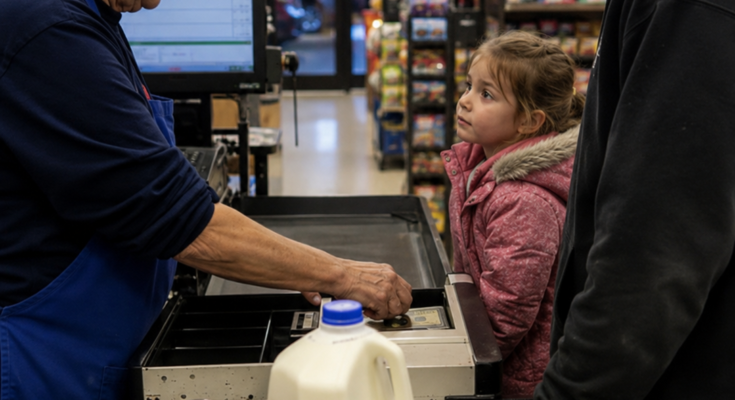
“I’m sorry,” the young father whispered, pulling a gallon of milk from the counter. “Put this one back.”
Sharon Fields looked at the little girl standing beside him. She couldn’t have been more than five. Her pink winter coat was too small at the wrists, and she was staring at that gallon of milk like it was something precious. The register said they were $7.13 short.
Sharon reached into the pocket of her blue work apron, pulled out a crumpled ten-dollar bill, and slid it into the drawer. “You’re good,” she said.
The father shook his head immediately. “No, ma’am. I can’t let you do that.”
Sharon handed him his receipt. “Yes, you can.” Then she leaned toward the little girl and smiled. “Besides, somebody has to make sure Santa gets his milk.”
The child grinned. Her father didn’t. His eyes filled. That was the part Sharon remembered. Not the seven dollars. Not the milk. Not the store policy she had just technically broken. It was the look on that man’s face when somebody helped him without making him explain why he needed help.
Sharon was 63 and had worked the evening shift at the only grocery store in their little eastern Kentucky town for nearly eleven years. Everybody knew her. She knew which old men bought coffee every morning before sunrise. She knew which widows came in on Tuesdays because their checks arrived on Mondays. She knew which parents quietly removed items from their carts during the last week of the month.
And Sharon knew something else. She knew exactly what an empty refrigerator looked like. Her two grandchildren, Mason and Ellie, lived with her in a small house with a sagging porch three streets from the store. Their mother—Sharon’s only daughter—had been fighting addiction for years. Sometimes she called. Sometimes she disappeared. Sharon had learned not to make promises to the children about when their mother might come home.
She simply packed lunches, washed school clothes, signed permission slips, worked nights, and stretched every dollar until it squeaked. There had been winters when Sharon stood in her own kitchen with twelve dollars until payday and wondered how to turn it into four dinners.
So when customers came through her checkout line short by fifty cents, two dollars, or seven dollars, Sharon noticed. Most people think poverty looks dramatic. Often it doesn’t. Sometimes it looks like a man staring at the register and saying, “Take off the cereal.” Sometimes it looks like an elderly woman counting nickels beside a loaf of bread. Sometimes it looks like a mother telling her son, “We’ve already got enough at home,” while quietly putting the eggs back.
Part 2: The Firing
Sharon rarely said much. She would reach into her apron. “Don’t worry about it.” Over eleven years, she had probably done it hundreds of times. A dollar here. Three dollars there. Once, nearly twenty dollars for an elderly man whose electricity bill had eaten most of his grocery money. Sharon never wrote it down. She never told anyone. She certainly never expected it to matter.
Then, twelve days before Christmas, the store manager asked her to come into the back office. There were two chairs. A computer monitor. A printed sheet of paper. And an uncomfortable silence.
The manager looked genuinely miserable. “Sharon, we reviewed some register footage.” She folded her hands in her lap.
He explained that cameras had recorded her repeatedly using her own money to cover shortages for customers. The company considered it an improper register practice. Even though Sharon wasn’t stealing anything, management said employees weren’t supposed to alter transactions that way without approval. There had apparently been warnings in the handbook. Sharon had signed the handbook years earlier. She didn’t argue.
“Am I being fired?”
The manager looked down. “Yes.”
Sharon nodded. For a moment, she didn’t trust herself to speak. Not because she was angry. Because Christmas was twelve days away. There were gifts hidden beneath blankets in her bedroom closet. A heating bill was due. Mason needed new boots. Ellie had been talking for three months about a little art set she wanted.
Sharon stood, removed her name badge, and placed it on the desk. Before leaving, she said quietly, “I understand rules are rules.” Then she walked through the grocery store she had worked in for eleven years. Customers waved. Sharon waved back. Nobody knew she had just lost her job.
That evening, she sat at her kitchen table with a cup of coffee that went cold. Mason found her there. He was fourteen and old enough to understand when adults were pretending everything was fine.
“You got fired?”
Sharon nodded.
“For helping people?”
“It’s more complicated than that.”
He frowned. “Doesn’t sound complicated.”
Sharon almost smiled.
The next morning, somebody in town posted about what had happened. Nobody ever figured out exactly who. By noon, nearly everyone seemed to know. And something strange started happening. People began telling their Sharon stories.
Part 3: The Jar
A retired miner wrote that she had once covered his groceries when his pension deposit came a day late. A mother said Sharon had quietly paid for diapers after her debit card was declined. A teacher remembered seeing Sharon buy lunch meat for one of her former students. A widower said Sharon had covered his bill after he accidentally left his wallet at home.
Then someone wrote: “She never gave away the store’s money. She gave away her own.”
That sentence traveled quickly.
Saturday morning, Sharon was making pancakes for her grandchildren when her phone rang. It was an old coworker. “Sharon,” she said, “you might want to come down here.”
“Why?”
There was a pause. “You just need to see this.”
Sharon drove toward the grocery store expecting maybe a few friends. Instead, cars were lined along the road. The parking lot was packed. Dozens of people stood near the entrance in winter coats, holding grocery receipts. Not protest signs. Receipts.
Sharon stepped out of her car. A woman she vaguely recognized walked toward her. “You paid $4.62 for me three years ago when I was choosing between groceries and gas,” she said.
An elderly man held up another faded receipt. “You covered eleven dollars when my wife was sick.”
A father raised his hand. “You bought my son’s formula.”
Then Sharon saw the young man with the gallon of milk. His little girl stood beside him in the same pink coat. He held up his receipt. Seven dollars and thirteen cents. “I wanted them to know,” he said, “that you didn’t give me their money.” He pointed toward Sharon. “You gave me yours.”
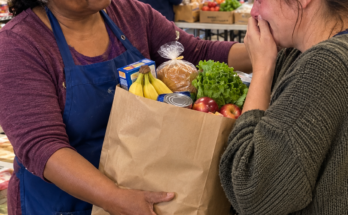
Sharon covered her mouth. She cried right there in the parking lot.
By Monday morning, the store owner had driven in personally. He met Sharon inside the office. This time, the conversation was different. “We handled this wrong,” he told her. “I’d like to offer you your job back.”
Sharon sat quietly. The mortgage wasn’t going to pay itself. The heating bill was still due. She needed that job. But something had changed. “I’ll come back,” she said. The owner nodded quickly. “Thank you.”
Sharon held up one finger. “But I want something first.”
He hesitated. “What?”
“A jar.”
“A jar?”
“A fund. Whatever you want to call it.”
She explained. Employees and customers could contribute voluntarily. If somebody came through a register short on milk, bread, diapers, eggs, or another basic grocery item, there would be a small community fund available. No embarrassment. No interrogation. No putting food back while strangers watched.
The owner stared at her for a moment. Then he smiled. “We can do that.”
The jar was placed near the registers before Christmas Eve. Someone taped a handwritten card to the front. It simply said: “FOR WHEN SOMEONE COMES UP SHORT.” By closing time, it was nearly full. People dropped in ones, fives, tens, and loose change. A retired teacher left fifty dollars. A coal miner dropped in his change after every shift. Kids added quarters.
Sharon returned to work the following week. Nothing about her looked different. Same comfortable shoes. Same blue apron. Same tired smile near the end of a long shift. But there was one difference. Whenever somebody came through her line counting pennies with that familiar worried look, Sharon no longer had to reach into her own pocket. The whole town was standing there with her.
Years later, Mason would say that the most important thing his grandmother ever taught him wasn’t about money. It was about dignity. She taught him that helping somebody isn’t supposed to make them feel smaller. She taught him that rules matter, but so does remembering why communities exist in the first place.
And she taught him something many of us forget until life humbles us: Almost everyone will come up short someday. Maybe not at a grocery register. Maybe it will be strength. Time. Hope. Patience. Money. Or simply the ability to keep going.
And when that day comes, what we remember most is usually not who noticed our struggle. It is who quietly helped us carry it.
Good communities are not built by people who never come up short. They are built by people who refuse to let each other stay there.
Sharon’s jar is still there. The town still adds to it. And every Christmas, someone tells the story of the woman who gave away her own money and asked for nothing in return—except a way to keep helping. ❤️