I was planning to take him back to the shelter on Monday. It hurts to admit that, but I had reached my limit.
His name was Sarge, a 110-pound Great Pyrenees mix who had spent three weeks wearing down every ounce of patience I had. He wasn’t destructive. He didn’t bark all night. He had never attacked anyone. He just kept escaping.
My six-foot backyard fence barely slowed him down. He dug underneath it. When I fixed that, he somehow figured out the locked gate. Almost every day while I was at work, Sarge vanished. Animal control would eventually bring him home exhausted and filthy, dirt packed into his white coat, sometimes favoring one leg after whatever miles he’d covered. The fines kept coming. So did the stress.
I tried everything I could think of. I reinforced the fence. I bought heavier locks. I tried longer walks, more toys, more attention. But the one thing that mattered never changed: Sarge kept leaving.
Finally, I told my sister what I’d been thinking for days. “He doesn’t want to be here,” I said. “He just keeps running.”
Once I heard myself say it, the decision felt final. Monday, I would take him back to the shelter.
I adopted Sarge from that same shelter three weeks earlier. He had been surrendered by his previous owner, an elderly man who had passed away. The shelter staff told me Sarge was a sweet dog, a loyal companion. They said he just needed a loving home. I believed them.
But from the moment I brought him home, something felt off. He was anxious. Restless. He spent hours staring at the door. He whined at the fence. He paced the yard like a prisoner waiting for release. I tried to be patient. I tried to give him time. But the escapes kept happening, and my patience was wearing thin.
Then Saturday happened.
Around ten that morning, Sarge started pacing between the living room and the door. Back and forth. Then came the whining, followed by the scratching. Normally, I would’ve blocked the door or distracted him. But something about him felt different this time. He wasn’t bouncing around like a dog desperate to get outside. His whole body was focused, his nose lifting toward the door before dropping again.
So I opened it.
And when Sarge stepped outside, I followed him. I needed to know where he kept going.
Part 2: The Journey
Sarge didn’t head for a park. He didn’t chase another animal. He didn’t wander from yard to yard looking for trouble. He lowered his nose to the ground and walked with purpose. Like he wasn’t lost. Like he’d made this trip before.
I stayed behind him as he led me farther than I expected. We crossed a highway, then pushed through thick brush that snagged my clothes and scraped against my arms. More than once, I considered turning around. Sarge never did. He kept the same steady pace, occasionally dropping his nose before moving forward again.
And the story I’d been telling myself for three weeks suddenly stopped making sense. A dog trying to escape doesn’t usually travel like this. Sarge wasn’t searching for somewhere to go. He already knew where he was going.
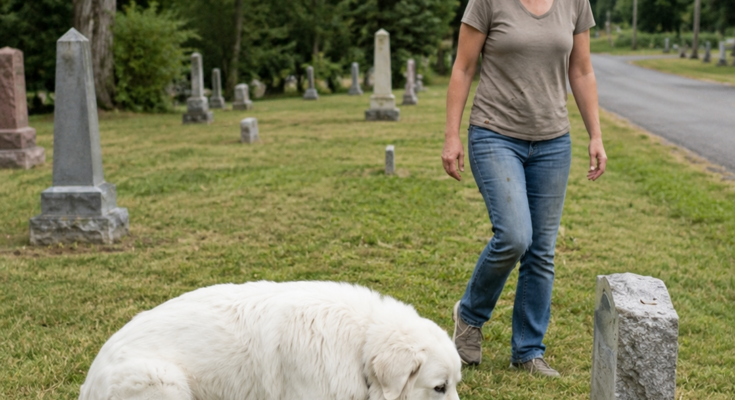
Eventually, the brush thinned and fencing appeared ahead. A cemetery. Sarge didn’t hesitate. He followed the edge until he reached a broken section, squeezed through, and continued on. I climbed over after him.
He passed the newer graves and the maintained paths, heading toward the farthest corner, where the stones were older and the grass looked less traveled. His whining had stopped completely. So had the restless energy I’d lived with for three weeks.
Near a small, weathered headstone, Sarge slowed. I stopped several steps behind him. For three weeks, I’d been convinced this dog was doing everything he could to get away from me. Now I was standing miles from home, watching him approach one specific grave as though nothing else in that cemetery existed.
Sarge took the final few steps toward the stone. Then he lowered his enormous body onto the ground beside it. He lay there, his head resting on his paws, his whole body still. Peaceful. He wasn’t running away from me. He was running to someone he had lost.
Part 3: The Truth
I walked closer to the headstone. The name carved into the stone was James Whitfield. A date of birth, a date of death. He had passed away just four months earlier. This was the man who had surrendered Sarge to the shelter—before he died. This was his owner. His friend. His family.
Sarge had been trying to come home all along. He wasn’t running away from me. He was running back to the man who had loved him first.
I sat down on the grass beside him, my heart breaking. For three weeks, I had been angry. Frustrated. Ready to give up. And all this time, Sarge was grieving. He was trying to find his way back to the only person who had ever been his.
“I’m so sorry,” I whispered. “I didn’t understand.”
Sarge looked up at me, his eyes soft and tired. He rested his head on my knee. He wasn’t asking for anything. He was just letting me be there. Letting me see.
We stayed there for a long time. I ran my hand over his white coat, feeling the tension that had been coiled in his muscles for weeks finally release. He was exhausted. Heartbroken. But he was no longer alone.
That evening, I called the shelter and asked about James Whitfield. They told me he had been a widower, a retired veteran who had lived alone. Sarge had been his constant companion for nearly a decade. They said James had been ill for a long time before he passed, and that Sarge had stayed by his side until the very end.
They also told me that Sarge had been brought to the shelter after James’s death. He had been confused, anxious, refusing to eat. They thought a new home would help him move on. They didn’t realize he was still trying to go back.
I understood then what Sarge needed. It wasn’t a new home. It wasn’t a new family. He needed closure. He needed to say goodbye. He needed to visit the place where his person rested and know that he was still loved.
The next day, I drove Sarge to the cemetery. I walked him to the grave and sat with him. I told him about James. I told him it was okay to be sad. I told him that he was safe with me now.
Sarge lay beside the headstone and let out a long, slow sigh. For the first time in weeks, his body relaxed completely. He had been carrying his grief alone. Now he was sharing it with me.
We started a new routine. Every Saturday, I would drive Sarge to the cemetery. He would walk to James’s grave, lie down beside it, and rest. Sometimes he would whine softly. Sometimes he would just close his eyes. But he always seemed a little lighter when we left.
Over time, Sarge stopped trying to escape. He still visited the cemetery with me, but he no longer needed to run. He had finally found a way to honor his past while embracing his present. And I had found a way to love him fully—not as a replacement for James, but as someone who could hold his grief and still give him hope.
Months passed. Sarge became the dog I had hoped he would be—loyal, calm, and deeply loving. He followed me around the house. He slept at the foot of my bed. He leaned into my hand whenever I reached out to him. We had become a team.
One afternoon, we visited James’s grave together. I brought flowers this time. I placed them on the headstone and said a quiet prayer. Sarge sat beside me, his head resting on my shoulder.
“Thank you,” I whispered to James. “Thank you for trusting me with your best friend.”
Sarge nudged my hand. I smiled and scratched behind his ears.
That night, as we sat on the porch watching the sunset, I realized something: I hadn’t just given Sarge a home. He had given me one too. He had shown me that love doesn’t end when someone dies. It just changes. It becomes something quieter, deeper, and more patient.
Now, Sarge and I visit James’s grave every month. We talk about him. We remember him. And we remind each other that grief is not a burden to carry alone. It’s a bridge between the past and the future—a way to honor someone you lost while still finding the courage to move forward.
Sarge is no longer the dog who kept running. He’s the dog who taught me that sometimes, the thing you think is running away is actually running home.
I never took him back to the shelter. I couldn’t. He wasn’t broken. He was mourning. And all he needed was someone to walk beside him while he learned to let go.
Sometimes, love isn’t about fixing something. It’s about being present. It’s about showing up, even when you don’t understand. It’s about staying, even when leaving seems easier.
Sarge stayed. And so did I.
We found our way home together. ❤️