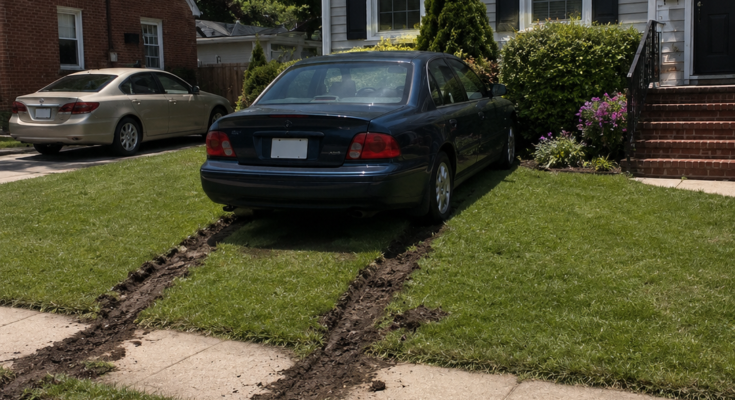
My neighbor parked his SUV directly in the middle of my front lawn. The tires carved deep tracks through the grass I had spent months watering and carefully maintaining.
When I confronted him, he laughed. “Relax,” he said. “I promise I won’t do it again.” His tone made it clear he wasn’t sorry. He was enjoying every second of watching me get angry.
I could have called the police. I could have shouted at him. But none of those choices would have taught him anything.
So I simply smiled. “Have a nice day,” I said.
Then I waited until nightfall. When the street went silent and all the lights turned off, I quietly opened my garage. I carried everything I needed outside and began putting my plan into action.
By the time I finished, his SUV had not been scratched. It had not been damaged. And I had not broken a single law.
But when he looked through his window the next morning, he would immediately understand that parking on my lawn had been a very expensive mistake.
Have you ever dealt with a neighbor who thought boundaries didn’t apply to them?
Then you need to read my story.
Part 1: The Invasion
I woke up Saturday morning expecting nothing more than a quiet cup of coffee on my porch. Instead, I looked through the front window and nearly dropped my mug. My neighbor’s SUV was parked directly in the middle of my front lawn. Its tires had carved deep tracks through the grass I had spent months watering, trimming, and carefully maintaining.
There was plenty of available space along the street. He had no reason to park on my property except to prove that he believed he could do whatever he wanted. It was not the first time he had ignored my boundaries. But it was easily the most disrespectful thing he had done.
I walked straight across the yard, approached his house, and rang the doorbell. He opened the door already smiling, as though he had been waiting for me to complain. I told him to move his vehicle immediately. Instead of apologizing, he laughed, shrugged his shoulders, and said I was making too much of “a little grass.” Then he leaned against the doorway and gave me the most sarcastic grin imaginable.
“Relax,” he said. “I promise I won’t do it again.”
His tone made it obvious that he was not sorry. He was enjoying every second of watching me become angry. I could have continued arguing. I could have threatened to call the police. I could have started shouting at him in the middle of the driveway. But none of those choices would have taught him anything.
So I simply smiled. “Have a nice day,” I said. Then I turned around and walked back into my house.
He probably believed he had won. He probably assumed I had finally accepted that he could treat my property however he pleased. But the truth was that I had already decided he was going to learn the lesson another way. If I had awakened to an unexpected surprise sitting on my lawn, it seemed only fair that he should wake up to a surprise of his own. Except mine would be far more difficult to ignore.
Part 2: The Plan
I waited until nightfall. One by one, the lights inside the neighboring houses disappeared. The street became silent. My neighbor’s SUV remained exactly where he had left it, sitting proudly in the center of my damaged lawn.
Shortly after midnight, I quietly opened my garage. Then I carried everything I needed outside and began putting my plan into action.
The first thing I did was to carefully mark a boundary around his SUV. I took bright orange spray paint and outlined the entire vehicle on my grass—tracing its exact shape so that the damage to my lawn would be clearly visible. Then I added a few choice words beneath the outline: “NEXT TIME, USE THE STREET.”
But that wasn’t all.
I had purchased several bags of grass seed and a large roll of orange construction fencing. I spread the seed over the damaged areas, watered them lightly, and then erected the fencing around the entire section. On the fencing, I hung a sign I had made earlier that afternoon:
**”Private Property – Lawn Restoration in Progress – Trespassers Will Be Prosecuted.”**
Then I attached a small, bright yellow boot to the driver’s side front tire—not a real wheel clamp, but a convincingly realistic replica that anyone would mistake for the real thing. It was secured with a simple padlock that I could easily remove.
The final touch was the most memorable. I placed a small lawn chair in the middle of my restored patch, right next to his SUV, and sat down with a cup of coffee I had poured from my thermos. I didn’t stay long—just long enough to send a message.
By the time I finished, the SUV had not been scratched. It had not been damaged. And I had not broken a single law. But when my neighbor looked through his window the following morning, he would immediately understand that parking on my lawn had been a very expensive mistake.
Part 3: The Morning After
I didn’t sleep much that night. Not because I was worried, but because I was too excited to see how my neighbor would react. At 6:15 a.m., I heard his front door open. I watched from my window as he stepped outside in his bathrobe, coffee in hand, and froze.
His SUV was still there. The orange outline was unmistakable. The construction fencing was impossible to miss. And the replica wheel boot looked terrifyingly real. But what really made him pause were the words I had spray-painted on the grass.
He stared at the outline. He stared at the fencing. He stared at the boot. Then he slowly walked around his vehicle, checking for damage, checking for scratches, checking for anything that would give him a reason to call the police. He found nothing. Because I hadn’t damaged his car. I had only damaged his pride.
He turned toward my house, and I could see the confusion and anger warring on his face. He walked over to the fencing and read the sign. Then he saw me standing at my window, smiling, holding my own coffee cup. He opened his mouth to say something, but I beat him to it.
I stepped outside and called out cheerfully, “Good morning! Having some trouble with your car?”
“This is ridiculous,” he sputtered. “You can’t just—”
“Oh, but I can,” I interrupted. “You parked on my lawn. You destroyed my grass. You laughed at me when I asked you to move. And you told me you wouldn’t do it again. But you didn’t say anything about what I would do if you did.”
“I didn’t damage anything!”
“Exactly,” I said. “Neither did I. Your car is fine. Your lawn is fine. But now, every time you look at your driveway, you’ll remember exactly what happens when you take advantage of other people.”
He tried to argue. He threatened to call the police. I handed him my phone and said, “Go ahead. The officer will see the orange outline. He’ll see the fencing. He’ll see that your car is undamaged. And he’ll ask you one simple question: ‘What were you doing parked on his lawn?'”
He didn’t call. He couldn’t. Because everything I had done was legal. I hadn’t vandalized his car. I hadn’t trespassed on his property. I had simply documented the damage he had caused and taken steps to protect my lawn from future abuse.
It took him three hours to remove the “boot” and the fencing. I had used a padlock that was easy to cut, but he didn’t have bolt cutters. He had to call a locksmith, which cost him over a hundred dollars. Then he had to water the grass seed I had planted, because the sign I had posted made it clear that he was responsible for restoring my lawn. He spent the rest of the day trying to repair the damage he had caused.
Later that week, I saw him out on his driveway, talking to another neighbor. He was complaining about me, telling them what I had done. But the other neighbor just laughed and said, “Sounds like you got what you deserved. Who parks on someone’s lawn and then laughs about it?”
He didn’t have an answer for that.
Over the following weeks, my neighbor and I found a new balance. He no longer ignored my property line. He no longer laughed at my boundaries. He had learned that disrespect has consequences, even when the consequences are legal and non-damaging.
I also learned something important. Sometimes, the best way to teach a lesson is not to escalate a conflict, but to respond with cleverness. A fight would have made me the villain. But my quiet, creative response made me the victor—and it made him think twice before ever trying something like that again.
The grass eventually grew back. I filled in the tire tracks and reseeded the damaged areas. By the middle of summer, my lawn looked as beautiful as ever. And every time I looked at it, I smiled—not because of the grass, but because I had found a way to protect what was mine without losing my dignity.
My neighbor and I never became friends. But we developed a mutual respect that hadn’t existed before. He waved hello. I waved back. He stayed off my lawn. And I never had to spray paint his outline again.
Sometimes, the best revenge is simply making someone face the consequences of their actions. And sometimes, the best way to keep the peace is to show people exactly what happens when they break it. ❤️