
Part 1: The Key
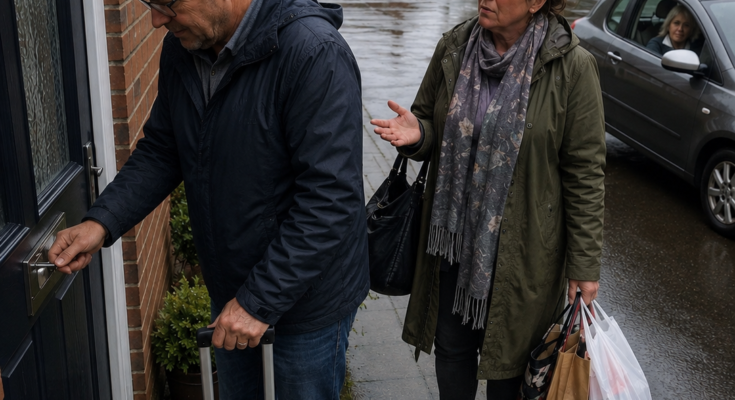
The key wouldn’t turn. Daniel stood on the porch in his airport clothes, one hand gripping a hard-shell suitcase, the other twisting that silver key over and over like the lock had made some kind of mistake. Melissa stood beside him in oversized sunglasses, shopping bags hanging from her wrist, still smiling—until it didn’t open. Then Daniel tried again. Harder. The smile faded. He pulled the key out, stared at it, then at the door. Like the house had betrayed him.
It hadn’t. I had.
Three weeks earlier, my home was still filled with framed photos, Frank’s old chair by the window, and the pencil marks on the laundry room wall where we measured Daniel as he grew. Cedar Grove was the kind of town where people waved from their porches and trimmed hedges on Saturdays. Frank and I built our life in that house. And in a way, we lost our son in it too.
After my husband passed, Daniel and Melissa started visiting more often. Everyone said I was lucky. My son brought groceries. My daughter-in-law brought soup in neat containers and spoke in that soft, careful tone that made selfishness sound like kindness. Then the comments began. “This house is a lot for one person.” “Stairs can be risky.” “You should start thinking ahead.”
Daniel talked about taxes. About planning. Melissa sent me photos of tidy little retirement communities. They acted like they were helping. They were circling.
I learned the truth by accident. The day before their Europe trip, Daniel called while I was upstairs folding laundry. I missed it. A minute later, I saw he had left a voicemail. I pressed play. I expected something ordinary. Instead, I heard a car door slam, Melissa’s real laugh—the sharp one—and then my son’s voice. “She’s a burden, Mel. She just doesn’t see it. We’ve held our lives back long enough.”
The towels slipped from my hands. Then Melissa said, “Once the house is sorted out, everything gets easier.”
That was the moment something shifted. Not the greed. Not even the words. It was how calm they sounded. I wasn’t a mother in that moment. I was an obstacle. A delay. Something standing between them and what they had already decided was theirs.
Part 2: The Plan
I cried that night. I walked through every room in the dark, touching the banister, the piano, Daniel’s old door, the kitchen counter where Frank used to stand drying dishes. I kept hearing “burden” until it stopped sounding like a word and started feeling like a sentence.
By morning, the tears were gone. I opened Frank’s old files. Then Daniel’s storage box. What I found made everything colder. Emails. Notes. Discussions about power of attorney. Words like “confusion,” “safety,” “transition.” They weren’t just waiting for me to slow down. They were building a story around me.
So I made my own plan. I called a real estate agent who knew how to work quietly. I called Frank’s lawyer. I called my bank. I moved everything Daniel thought he would one day control. The house went into a private sale. No sign. No discussion. No warning.
While they were posting photos under European lights, smiling with glasses of wine, movers packed my dishes, wrapped my photos, and carried my entire life out through the front door. The buyer closed quickly. I rented a small place by the lake.
And I left one thing behind. A note.
So when Daniel and Melissa came home—tan, relaxed, and carrying expensive souvenirs—they didn’t return to my house. They returned to an empty shell.
From inside a parked truck across the street, I watched Daniel finally force the door open. I watched Melissa step in behind him. And I watched both of them freeze when they saw the bare walls, the stripped rooms, the silence. Then Daniel spotted the white envelope sitting alone on the kitchen counter.
Part 3: The Note
Daniel’s hands trembled as he reached for the envelope. I could see it from across the street—the way his fingers hesitated, the way Melissa stepped closer, the way they both seemed to know, even before they opened it, that something had irrevocably changed.
He tore it open and pulled out a single sheet of paper.
I had written it carefully, sitting at the lake house I had rented, looking out at the water. I had rewritten it three times. The first draft was angry. The second was heartbroken. The final version was simple. It was the truth.
*”Daniel,*
*By the time you read this, I will be gone from the house your father and I built. I heard your voicemail. I heard you call me a burden. I heard Melissa say that once the house was ‘sorted out,’ everything would get easier.*
*I spent 32 years paying off that house. I raised you in it. I loved you in it. And I was willing to give it to you one day—not because you deserved it, but because I loved you.*
*But love isn’t a transaction. And I refuse to be a problem someone is trying to solve.*
*I sold the house. The money is in an account that you cannot access. I have made arrangements for my own care. I have found my own home. I will not be placed in a facility, and I will not be talked about like I’m already gone.*
*This is not revenge. This is survival.*
*I hope one day you understand. I hope one day you remember that I was your mother before I was a burden. But I won’t wait for that day. I’ve waited long enough.*
*Goodbye, Daniel.*
*—Mom”*
I watched him read it. I watched his face change—confusion, then disbelief, then something that looked like grief. Melissa grabbed the letter and read it over his shoulder. Her face went white. She looked around the empty house, at the bare walls, at the missing furniture, at the silence that had replaced a lifetime of memories.
Daniel dropped the letter. He walked slowly through the living room, touching the walls, opening empty closets, standing in the middle of rooms that no longer held anything familiar. I could see his shoulders shaking.
Melissa said something. Her voice was sharp, accusatory. I couldn’t hear the words, but I could see the anger in her posture. Daniel didn’t respond. He just stood there, staring at the floor where his father’s chair used to sit.
Then he looked at the note again. He read it once more. And I saw something I had never seen in my son’s face before. Regret. Real, honest regret.
I didn’t get out of the truck. I didn’t go to him. I had made my choice, and I was at peace with it.
That night, I drove back to my lake house. I made myself a cup of tea and sat on the porch, watching the moonlight ripple across the water. The house I had sold was gone from my life. The house where I had raised my son, where I had loved my husband, where I had built a lifetime of memories. It was gone. But I was still here. And I was still whole.
Daniel called me the next morning. I let it go to voicemail. His voice was raw, broken. “Mom, I’m so sorry. I didn’t mean what I said. I was wrong. Please call me. Please, let me explain.”
I didn’t call back.
He called again that afternoon. I listened to his voicemail, then deleted it. He sent texts—long paragraphs of apologies, promises, pleas. I read them, then deleted those too.
Melissa tried to reach me through a mutual friend. I told the friend I was not interested. My daughter-in-law had laughed at my expense. She had circled my home like a vulture. She had no place in my new life.
Weeks passed. Daniel called less often. His messages became shorter. I could feel his desperation fading, replaced by a quiet resignation. He had lost something he never truly valued until it was gone.
I didn’t feel angry anymore. I didn’t feel sad. I felt… free.
A year later, I received a letter. It was from Daniel, handwritten, several pages long. He told me he had started therapy. He told me he had finally understood what he had done—how he had treated me like a problem, how he had prioritized money over love, how he had let Melissa’s greed poison his relationship with me.
He didn’t ask for forgiveness. He didn’t ask for the house. He just asked for a chance to be my son again.
I thought about it for a long time. I thought about the little boy who used to run into my room after nightmares, who used to hold my hand in the grocery store, who used to tell me he loved me without any conditions attached. I missed that boy. I missed the son I had raised.
So I wrote back. A short letter. Simple. “I’m not ready yet. But I’m not saying never.”
It was the truth. I wasn’t ready to let him back in completely. But I wasn’t ready to close the door forever either.
I still live by the lake. I have a garden now. I have neighbors who wave from their porches and friends who come over for tea. I have built a new life—one that doesn’t depend on anyone else’s approval.
And Daniel? He’s still trying. He calls on my birthday. He sends Christmas cards. He’s learning, slowly, what it means to love without expectation.
Maybe one day, I’ll let him back in. Maybe I’ll even invite him to visit my little house by the lake. But it will be on my terms, not his.
Because I am not a burden. I never was. I am a woman who survived loss, betrayal, and heartbreak—and came out stronger on the other side.
And that, I think, is worth more than any house. ❤️