Part 3: What the Sign Meant
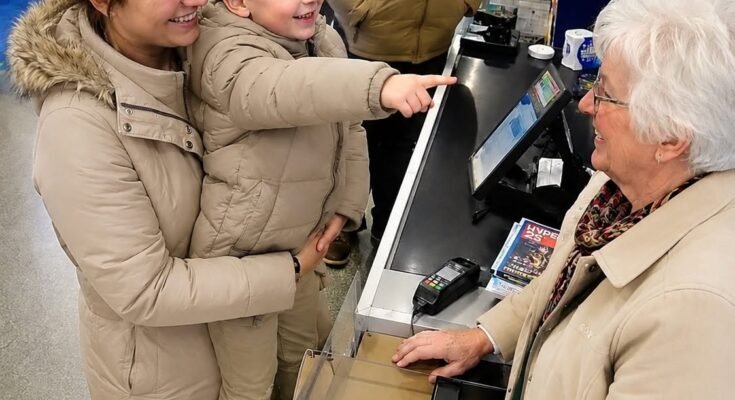
Her name was Eleanor, I learned, once I could speak again without my voice wobbling. She’d been a regular at that store for eleven years, ever since she and her husband moved into the apartments two blocks over, and in all that time, she told me, she’d never once had anyone step in for her at a register. She’d had people sigh at her. She’d had people mutter. She’d never had a stranger simply say I’ve got it and mean it.
“It wasn’t about the money,” she said, pressing the carnations into my free hand while Eli reached up to pat one of the balloon ribbons like it might do a trick. “Eleven dollars and forty cents wouldn’t have broken me. It was that nobody looked at me. You looked at me.”
The manager, whose name tag I finally read as PRIYA, explained the rest while Eleanor caught her breath. Eleanor had come in Thursday afternoon, once her account was unfrozen, specifically to pay off the difference she owed. When Priya waved it off as unnecessary, Eleanor had asked, instead, if there was some way to properly thank the young mother who’d stepped in. Priya, it turned out, had pulled the transaction records, matched the timestamp, and recognized me from the loyalty account tied to my card. The balloons had been Priya’s idea. The sign was Eleanor’s, hand-lettered at her kitchen table the night before, because she said typed things never felt like they meant it.
“I also did this,” Eleanor said, a little sheepishly now, and gestured toward the register, where a cart sat already loaded, bread, milk, a rotisserie chicken, a carton of strawberries, and a small stuffed elephant with a price tag still dangling from its ear. “For you and this one,” she added, nodding at Eli, who had already spotted the elephant and was vibrating with the particular joy of a three-year-old who senses something is about to be his.
“Eleanor, you don’t have to—”
“I know I don’t have to,” she said, cutting me off gently but firmly, the same way I imagined she’d once cut off plenty of things in a long life. “That’s rather the point. You didn’t have to, either, on Tuesday. I’ve thought about that all week. About how easy it would have been for you to just look at your phone instead of looking at me.”
I let her, in the end, because I understood something in that moment I hadn’t fully understood two nights earlier at the register. Refusing her gift wouldn’t have been humility. It would have taken away the one thing she’d clearly needed just as much as I’d needed to help her in the first place: the chance to close the circle.
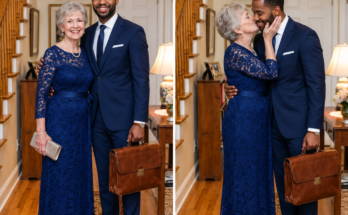
We stayed almost an hour that afternoon, long after the groceries were bagged and Priya had gone back to her register with a smile she kept trying and failing to hide. Eleanor told me about her husband, gone six years now, and how she still bought a single apple pie every week because it had been his favorite and buying it felt like keeping a small promise nobody else remembered but her. Eli sat on the floor by the registers running his new elephant along the tile like it was crossing some vast stuffed-animal savanna, occasionally shouting updates on its progress that nobody had asked for.
Eleanor and I exchanged numbers before we left. She’s watched Eli twice now on afternoons when daycare closed early and my meetings wouldn’t budge, and refuses payment every time, though I’ve started leaving a pie on her porch instead, because apparently that’s a currency we’ve both agreed to accept.
Eli still waves at her every time we see her, in the store or otherwise. “Bye-bye, Grandma,” he says, and these days, it isn’t a phrase he picked up by accident. It’s one he means.