Part 1: The Apron in the Corner
The night my sister got engaged, my mother handed me a dish towel instead of a seat at the table.
I stood in the marble foyer of the rented Hamptons estate, holding a bottle of wine I’d chosen carefully, wearing the simplest black dress I owned. White orchids climbed the staircase behind my mother’s head. A jazz quartet drifted through the terrace doors. For one hopeful second, walking up that gravel drive, I let myself believe tonight might just be a party. Nothing more, nothing less.
My mother’s eyes went straight to the bottle.
“You brought that?” she said, already handing it off to a passing server. Then she looked at me, and her voice dropped into the tone she saved just for me. Pleasant enough for anyone listening. Sharp enough that I always understood. “Well. Make yourself useful, Caroline.”
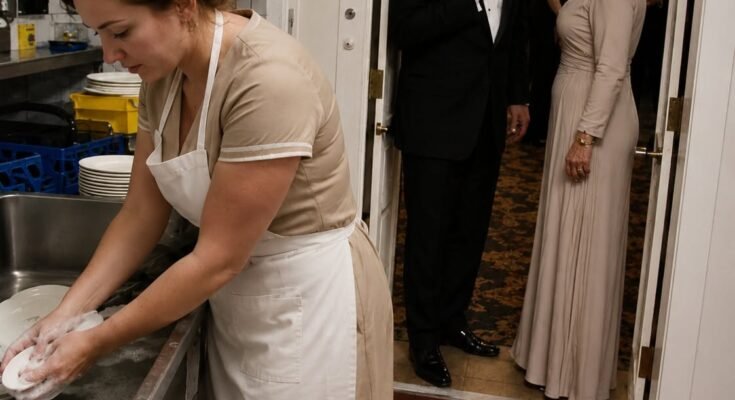
Before I could answer, she’d steered me down a side hallway and through a swinging door into the noise and steam of the catering kitchen. Two servers moved around stacked china. A commercial dishwasher hummed against the wall. My mother pressed a white apron into my hands like she was doing me a kindness.
“Staff’s short tonight,” she said. “Clear plates, wash what needs it. And Caroline, please don’t wander into the dining room trying to explain yourself to anyone.”
I looked down at the apron. Through the wall, I could hear my sister Brittany’s laugh, bright and easy, rising above the music.
“I was invited as family,” I said quietly.
“Tonight is about your sister,” my mother said. “The Jeffersons are important people. I won’t have anyone confused about who’s who.”
That was the whole shape of my childhood, really, folded into one sentence. Brittany was the celebration. I was the thing to be managed, tucked out of sight before the important guests arrived. My parents had never once asked what I actually did for a living. They had decided, years ago, that public service meant I’d settled for less, and they’d stopped being curious the day they stopped being able to brag about it.
So I tied the apron strings behind my back, turned on the faucet, and started clearing plates while my sister’s engagement party glittered on the other side of the door. Steam fogged the little round window. Somewhere past it, silver trays kept circling, and I kept telling myself it didn’t matter. I had gotten good at telling myself that.
Part 2: A Familiar Face
I’d been at the sink maybe twenty minutes when Brittany pushed through the door in her shimmering gown, her ring catching the light every time she moved her hand.
“Mom said she put you back here,” she said, sliding a stack of rental china onto the counter beside me. “I thought she was joking.” She leaned in, lowering her voice just for me. “Keep it smooth tonight, okay? I don’t need your serious little courtroom energy anywhere near my perfect evening.”
I didn’t answer. I’d learned a long time ago that my family mistook my silence for surrender, and I’d stopped trying to correct them for it.
A few minutes later, through the round window in the kitchen door, I watched the groom’s family arrive, his father Warren Jefferson first, the kind of man whose presence quietly rearranged a room. My mother’s smile went bright and brittle. Then her gaze drifted toward the kitchen window, found me, and dropped.
She pulled the door nearly shut. “Stay in here. Please don’t make this complicated.”
I picked up another plate, strangely calm.
Then the door opened again. Not my mother this time.
Warren Jefferson stood in the doorway, and the moment his eyes found me, something shifted in his face. Recognition. He pressed one hand flat against his chest.
“Ma’am,” he said, his voice carrying into the sudden quiet, “I sat in your courtroom two years ago.”
The plate in my hands went weightless.
Part 3: What the Room Learned
Warren didn’t wait for an explanation. He held out his arm, formal and certain. “Come on out here with me,” he said. “I’ve been telling my son about the judge who helped my family, and it’s about time he got to thank you himself.”
Behind him, my mother’s mouth opened and closed with nothing in it. Brittany stood frozen in the doorway, her champagne going flat and forgotten in her hand.
I laid the apron over the back of a chair, wiped my hands on a dish towel, and walked out into the party on Warren Jefferson’s arm. Not because I needed rescuing, but because for the first time all evening, someone had simply asked me to come in.
Two years earlier, Warren had stood in my courtroom holding his six-year-old granddaughter’s hand, both of them exhausted, after his son’s sudden hospitalization left no clear plan for who would care for her. Emergency guardianship cases move fast and cold most days, paperwork, a gavel, a next case waiting. But I remembered how frightened that little girl looked, swinging her feet off the edge of a chair too tall for her. I’d stayed late that afternoon, walked Warren through every form myself instead of leaving it to a clerk, and found him the name of a family counselor who didn’t charge more than he could pay. It wasn’t extraordinary. It was just the job, done the way I believed it should be done, for a man who had nothing to offer me but relief that someone had finally treated his family like it mattered.
I hadn’t remembered his face at a party. I had simply done what I did for everyone who stood in front of my bench.
“She never once made me feel small,” Warren told the room now, one hand resting warm on my shoulder. “Not when I had nothing, not when I didn’t know the right words to use. I sat across from powerful lawyers in that courthouse, and the only person who looked me in the eye like a human being was her.” He turned to my mother. “So you’ll understand why it troubles me to find her back here with a dish towel.”
Nobody laughed. Nobody offered a smooth recovery.
My mother’s face had gone the color of the tablecloth. For the first time in my life, I watched her search for words and find none.
I could have let the silence stretch. Some small, tired part of me even wanted to. Instead, I reached for my mother’s hand.
“Mom,” I said quietly, just for her, “I didn’t need you to announce anything tonight. I just needed you to let me come to my sister’s party as your daughter.”
Her eyes filled before she could stop them. “I didn’t know,” she whispered. “I didn’t know that was you. I didn’t know any of it.”
“I know,” I said, and I meant it kindly. Because the truth was, she’d never asked, not because she didn’t love me, but because somewhere along the way she’d decided love and pride had to look a certain shiny way, and anything quieter didn’t count. Watching her hold my hand in front of people she’d spent months trying to impress, I think she finally understood what that had cost us both.
Brittany found me by the terrace later, still in her gown, minus the sharp edges from earlier. “I didn’t know either,” she said. “About any of it. I’m sorry, Caro.” It wasn’t a perfect apology. It didn’t erase the kitchen, or the years before it. But it was a start, offered without an audience this time, and I let myself believe it.
The party went on past midnight, music, toasts, my sister’s ring catching candlelight. Somewhere around eleven, my mother pulled a chair up beside her own at the head table and set it for me herself.
I sat down without the apron. Nobody in that room needed to know what I did for a living to know I belonged there. But it turned out, for my family at least, that was exactly what it took to finally see me.
Weeks later, at an ordinary Sunday dinner, I noticed my mother had already set a place for me before I’d even rung the bell. No apron waiting by the door. Just a chair, pulled out, like it had always belonged to me. Some changes arrive with fireworks. That one arrived quietly, the way most real ones do, and I found I liked it better that way.