Part One: Two Miles, Carrying Everything
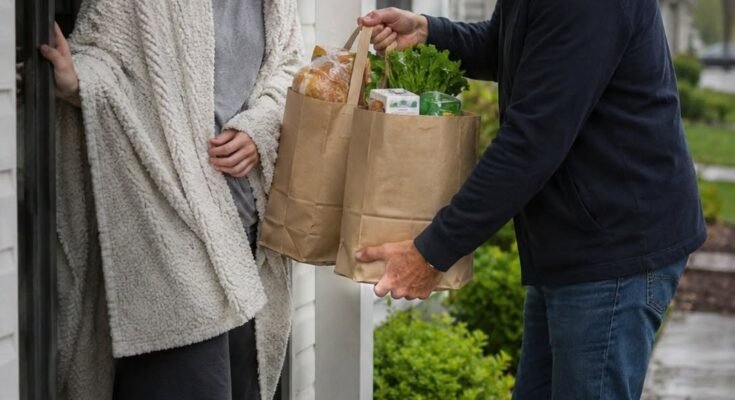
My ankle had swollen so badly that every step sent pain shooting up my leg. Caleb rested against my shoulder, warm and heavy, while the grocery bags dug deeper into my fingers. I kept shifting my weight, trying not to limp too obviously, as if there were anyone around to perform for.
I still had almost two miles left to walk.
Then the SUV slowed beside the curb.
The driver’s window rolled down.
“Elena?”
I froze.
“Dad…”
Robert Hayes was out of the SUV almost immediately. He wore jeans and a plain polo shirt, nothing that would tell a stranger he had spent decades commanding soldiers. But I knew that look on his face.
His eyes moved to my swollen ankle. Then to Caleb. Then to the grocery bags cutting into my hands.
“What happened?”
“I’m fine,” I said.
He did not even pretend to believe me.
“Where’s your car?”
I hesitated.
“My mother-in-law took it.”
His expression tightened.
“The SUV you bought after Caleb was born?”
I nodded.
“It’s registered under Aaron’s name,” I said. “She says since we’re living in her house, she decides who gets to use it.”
Dad looked at me for a long second.
“You bought it?”
“Yes.”
“You’re making the payments?”
“Yes.”
“And you’re walking home injured, carrying my grandson and groceries, while someone else is driving it?”
Hearing him say it plainly made the whole thing sound worse than every excuse I had made for it.
I looked down at the sidewalk.
“Aaron lost his job six months ago,” I said quietly. “We couldn’t afford the apartment anymore. His parents offered to let us stay until we got back on our feet.”
Dad’s voice lowered.
“And this is how they treat you?”
I could not answer.
I did not need to.
He looked at Caleb again, then at the ankle I was trying not to put weight on.
Something in his face changed—not exactly anger. Decision.
Dad reached over, took both grocery bags from my hands, and shifted them into his own.
“Get in the car, Elena.”
I got in.
The drive to Diane’s house took eleven minutes. Dad didn’t fill them with questions. He’d spent thirty years learning that people tell you the truth when they’re ready, not when you push them to, and something told me he already suspected there was more to this story than a borrowed car. He just drove, one hand loose on the wheel, the other resting on the console like he was waiting for an order he hadn’t given yet.
When we pulled into the driveway, my SUV was parked right where I’d last seen it, gleaming and untouched, as if it existed purely to remind me it wasn’t mine to use. Diane was on the porch in her gardening gloves, and Aaron’s father, Walter, was folding a lawn chair a few feet away. Neither of them looked up right away.
Dad parked, got out, and opened my door before I could reach for the handle myself. He lifted Caleb from his car seat like he’d done it a thousand times — he had — and settled him against his shoulder, and then he helped me out, one hand under my elbow, steady as a rail.
Diane’s gloves stopped moving.
“Elena,” she called out, her voice bright and brittle in the way it always got when she wanted witnesses. “Who’s this?”
“My father,” I said.
“Well,” she said, recovering fast, “it’s lovely to finally meet you. I’m sure Elena’s told you all about us.”
Dad’s eyes moved over her — the porch, the untouched SUV, the two miles of sidewalk still visible in the set of my shoulders — and he smiled, the kind of smile that had made majors nervous for twenty years.
“Not nearly enough,” he said. “But I’m about to learn a great deal more.”
Part Two: What the Uniform Never Told Them
What none of them knew — what I had never once mentioned, because it had simply never come up, and because Aaron himself had only met my father twice, both times briefly, both times in civilian clothes — was that Robert Hayes was a four-star general. Thirty-one years of service. Two combat commands. A man who had spent his entire career reading rooms for the lie hiding under the calm surface, because in his line of work, the lie hiding under the calm surface was usually the one that got people killed.
He didn’t announce it. He never did. He simply asked to come inside, set the groceries on the counter, and asked if he could get me some ice for my ankle, and somewhere in the next twenty minutes, without raising his voice once, he took the entire household apart.
“I’d like to understand something,” he said, once Caleb was settled in his high chair and I was sitting with my foot propped on a stool Walter had reluctantly fetched. “Elena tells me the SUV is registered to Aaron. But she made the down payment and she’s covered every note since. Is that your understanding as well?”
Diane’s smile flickered. “Family finances are complicated when everyone’s under one roof.”
“They can be,” Dad agreed. “Though I’ve found they’re usually only complicated for the person with the least power in the house. Everyone else tends to have a very clear understanding of who owns what.” He turned to Aaron, who had come down the stairs somewhere in the last five minutes and was hovering in the doorway like he wasn’t sure whether he was allowed in his own kitchen conversation. “Aaron. Did you know your wife walked two miles home today, on a sprained ankle, carrying our grandson and the groceries?”
Aaron’s face went through several things at once. “I — Mom said she’d drive her—”
“I offered,” Diane cut in smoothly, “and Elena said she preferred the walk. Some fresh air.”
“With a swollen ankle,” Dad said, “and a one-year-old, and forty pounds of groceries.” He let that sit in the room for a moment. “I’ve debriefed soldiers who lied better than that.”
Walter cleared his throat. “Now, hold on. This is a family matter—”
“It is,” Dad said. “Which is exactly why I’m here. I am, in fact, family.” He said it without any edge, which somehow made it land harder than if he’d shouted. “I’d like to know why my daughter is living somewhere she isn’t safe walking home from the grocery store.”
That was when Aaron said the thing that changed the entire shape of the afternoon.
“Dad, just tell them,” he said, quietly, to Walter. “Tell them what you told me.”
I looked between them. “Tell us what?”
Walter’s jaw worked for a moment before anything came out. “The severance,” he said finally. “From Aaron’s old job. It wasn’t nothing. It was enough to cover eight months of rent on your old apartment, easy. I told him to bring it here instead. Told him we’d invest it in the house, fix the roof, and he could stay ’til he found something better.” He wouldn’t look at me. “I didn’t think it’d go on this long.”
The room went very still.
“You had eight months of rent,” I said slowly, “and you moved us in here instead.”
“I thought it’d be a few weeks,” Aaron said, and for the first time all year, he actually sounded like he meant it. “Dad said it made more sense. I should’ve told you. I should’ve told you a long time ago.”
Dad hadn’t said a word through any of this. He didn’t need to. He simply watched Aaron come apart under the weight of his own silence, the way he’d watched a hundred younger officers do the same thing over the years, and he waited, because he knew — better than any of us — that the person telling the truth needed room to finish, not an audience rushing them along.
Part Three: What We Rebuilt
We didn’t stay another night in that house.
Dad didn’t order it, and he didn’t have to. I packed Caleb’s things myself while Aaron sat at the kitchen table with his head in his hands, finally saying out loud everything he should have said eight months earlier — that he’d been ashamed of losing the job, ashamed of needing his parents, and that somewhere in trying to fix it quietly on his own, he’d let his silence cost me more than the job loss ever had. Diane didn’t apologize. Walter, to his credit, did, in his own clipped way, and offered to sign the SUV’s title back over to me before we’d even reached the driveway.
Dad put us up in a hotel for two weeks while Aaron and I figured out what came next — not because we needed rescuing, but because for the first time in eight months, I had room to actually think instead of just endure. Those two weeks were hard in a different way than the last eight months had been. Aaron and I talked more honestly than we had in years. He got a new job three weeks later, smaller than his old one but enough, and we found a small apartment across town, one with our names on the lease and nobody else’s opinion on the rent.
Dad came by most Sundays after that, always in the same jeans and polo shirt, always just “Grandpa” to Caleb, who had no idea the man building block towers on our living room floor had once commanded thousands of soldiers and never once needed to raise his voice to be obeyed. Diane sent a birthday card for Caleb’s next birthday, stiff and formal, and I let it be a start rather than deciding it wasn’t enough.
I think about that walk sometimes — the two miles, the swollen ankle, the exact moment I’d told myself I was fine because it was easier than admitting I wasn’t. What I remember most, though, isn’t the pain. It’s the sound of that window rolling down, and the fact that after eight months of quietly shrinking myself to fit inside someone else’s house, it took exactly one person who refused to look away to remind me I never should have had to.