Part One: The Quiet
I had been retired for barely two days when my daughter-in-law called my newly bought lake cabin “the perfect solution” for her parents’ summer plans. She told me to get the rooms ready, then casually said I could always put the place on the market if I had a problem with it—as if four decades of hard work, every dollar I had saved, every quiet morning I had dreamed of, and the fact that my name alone was on the deed meant nothing once she decided my home could serve her family.
But before I tell you about that phone call, I should tell you why the quiet mattered so much.
I retired at sixty-four and bought that cabin for one reason. I wanted silence. Not luxury. Not some fancy vacation property. Just wood floors beneath my feet, lake air drifting through the screen door, coffee in my hand, and mornings peaceful enough to soften the ringing in my ears after forty-one years at the steel mill.
For most of my life, noise had been my constant companion. Furnaces roaring. Forklifts beeping. Steel grinding against steel. Men shouting over machines because softness never moved metal, fixed equipment, or finished a shift.
Even after I clocked out for the last time, I still woke up in my city apartment thinking I heard the plant whistle. But there was no whistle. Only the refrigerator humming and the upstairs neighbor dragging something across the floor after midnight.
So when I found the small timber cabin with three bedrooms, a green metal roof, a stone fireplace, and a dock that needed sanding, I didn’t think about it for long. It smelled like cedar, lake water, and honest work. The siding needed staining. The boathouse door stuck. The porch steps groaned when I walked across them.
I liked that. A place that needs care does not pretend to be anything else.
My son, Elliot, understood what that cabin meant to me better than anyone. I raised him alone after his mother left when he was thirteen. I never made him choose sides. I packed his lunches before sunrise, sat through cold school games in my work boots, taught him how to change oil in an old truck, and showed up to parent-teacher meetings still carrying the faint smell of the mill because overtime and fatherhood did not leave much room for pride.
We built something in those years that never needed explaining out loud. It just was — the two of us, steady, showing up for each other without keeping score.
When he married Sienna seven years ago, I made an effort. I ignored the little remarks. My apartment was “industrial vintage, but not on purpose.” My restored maple table was “very rustic.” My job was “charming,” said in the voice people use when they mean useful, but not impressive.
Silence was the courtesy I kept giving her.
But some people mistake silence for permission.
Thirty-six hours after I moved into the cabin, Sienna called me at 6:17 on a Thursday evening while I was sitting on the dock.
“Your son and I have decided my parents will stay in your cabin for the summer,” she said. “If that doesn’t work for you, sell it and move somewhere you can actually be useful.”
The lake lapped softly against the rocks. Somewhere beyond the reeds, a loon called. The coffee in my hand had gone cold.
I asked only one thing.
“Did Elliot agree to this?”
“My husband understands that family sometimes has to make sacrifices,” she replied. “Unlike some people.”
Then she started giving instructions. Her parents would arrive Friday. I could pick them up if necessary. Beverly had back problems, so she needed the main bedroom. Gordon required space for his files. I should empty the closets and not make things uncomfortable.
She didn’t ask.
She ordered.
That difference matters. People who ask still recognize you as a person. People who order have already decided you are part of the furniture.
Part Two: The Folder
I didn’t argue. A simple no works with reasonable people. With entitled people, no only begins the fight.
So I chose clarity instead.
At 7:04 p.m., I called the county clerk’s office and confirmed the recorded deed. At 7:41, I printed the closing disclosure, the property tax receipt, and the page showing the only owner: me. I also printed Sienna’s message from 8:12 p.m., the one that said, “Don’t embarrass everyone over empty rooms.”
Then I wrote one sentence across the top of a legal pad in black ink:
My home is not available for reassignment.
By Friday afternoon, no guest beds had been made. No closets had been cleared. The main bedroom door stayed shut. On the kitchen table sat a slim blue folder, arranged neatly: deed, tax bill, insurance page, printed messages, and one blank rental agreement with market-rate terms I knew they would never accept.
I wasn’t shaking. That surprised me.
For one ugly moment, I wanted to yell. I wanted Sienna to hear every hour I had spent beside the furnace, every weekend I missed, every dinner I ate standing at the sink because I was too exhausted to sit down. I wanted to tell her that a man does not spend forty-one years on concrete just so someone else’s parents can treat his peace like spare storage.
But anger costs too much when you have already paid for peace.
So I put on my old denim jacket, placed the folder under my hand, and walked out to the porch.
The driveway still held the warmth of the afternoon sun. A small American flag by the mailbox snapped once in the breeze. Behind me, the screen door creaked on its spring.
At 4:26 p.m., the SUV turned off the road.
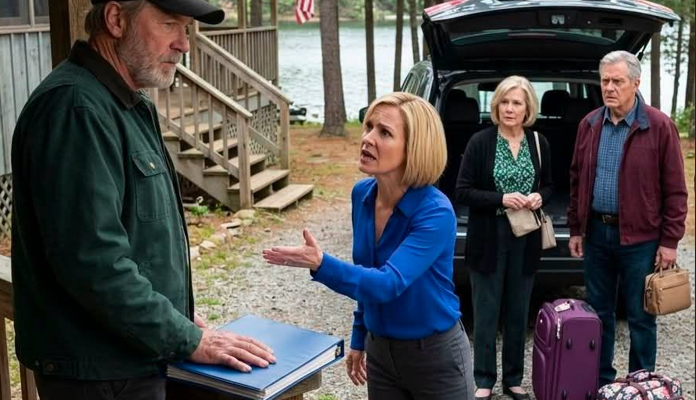
Sienna sat in the passenger seat, wearing sunglasses and smiling before the tires even stopped. Beverly was in the back with a travel pillow around her neck. Gordon held a banker’s box on his lap—the kind people carry when they believe someone has already cleared space for them.
The trunk opened. Two suitcases appeared.
Sienna stepped out, looked past me at the cabin, and said, “Good. You’re ready.”
I opened the blue folder on the porch railing.
And for the first time since I had known her, Sienna’s smile disappeared before she even knew what I was about to say.
“I want to be clear before anyone unpacks,” I said. “This cabin is mine. Deed, mortgage, insurance, taxes — every page here has my name on it and no one else’s. I’m not renting it out this summer. Not to family, not to strangers, and not as a favor.”
Sienna’s sunglasses came off slowly, the way people do when they think a hard look will fix a situation words already lost.
“We had an arrangement,” she said.
“You had an announcement,” I said. “There’s a difference, and I think you know it, because you never once asked me how I felt about spending my first summer of retirement hosting your parents in the home I bought to get away from noise.”
Gordon shifted the banker’s box in his lap, looking between his daughter and me with the expression of a man who suspected, correctly, that he’d been given incomplete information.
“Sienna told us you’d offered,” Beverly said carefully from the back seat. “She said you were excited to have the company.”
I looked at Sienna. She didn’t deny it.
“I didn’t offer anything,” I said, keeping my voice level. “I found out about this plan the same way you did — from a phone call telling me what was already decided.”
I slid the folder toward her across the railing. She didn’t reach for it.
“There’s a rental agreement in there too,” I said, “in case anyone still wants to stay. Market rate, thirty-day minimum, standard deposit. I’m happy to be a landlord to people who ask nicely. I’m not going to be furniture for people who don’t.”
“Elliot will hear about this,” Sienna said, her voice tightening.
“Good,” I said. “He should. Call him now, if you’d like. I’ll wait.”
She didn’t call him. Not then. She got back in the SUV, and Gordon and Beverly followed, Gordon giving me an apologetic nod through the window that told me more about who’d actually been misled than anything Sienna had said out loud.
The SUV backed down the driveway the same way it had come in — except slower, less certain, no longer moving like it owned the road.
Part Three: The Dock
Elliot called that night, an hour after the dust had settled and the loon had gone quiet on the lake.
“Dad, I had no idea,” he said. “Sienna told me you two had already worked it out. I would never have let this happen if I’d known she called you like that.”
I believed him. Forty years of raising that boy alone had taught me the sound of his real voice from his careful one, and this was the real one — tired, a little ashamed, entirely sincere.
“I know,” I told him. “That’s why I’m not angry at you. But you two need to have a longer conversation than the one you had with me tonight.”
He was quiet for a moment. “I will.”
I don’t know everything that happened in their house after that call. What I do know is that Beverly and Gordon never mentioned the cabin again, and that three weeks later, an envelope arrived from Sienna — no note, just a short, stiff apology that read more like a legal formality than an olive branch. It was something. I didn’t need more than that to move forward.
Elliot came up alone the following weekend, no warning, just his truck in the driveway on a Saturday morning and a six-pack of the same beer his mother used to buy for cookouts before she left. We sat on the dock until the sun went down, not talking about Sienna at all, just fishing badly and laughing about it the way we used to when he was thirteen and it was only the two of us against everything.
That became the real gift of that whole mess — not the apology, not even being right about the deed, but Elliot showing up like that, on his own, with no agenda but the two of us. He came back most weekends after that, sometimes with Sienna once things settled between them, more often just him, a cooler, and whatever bad joke he’d been saving up all week.
We fixed the boathouse door together that August, the two of us on our knees on the dock, him holding the flashlight while I worked the hinge loose the slow way, the way a man does when nobody’s timing him anymore. I restained the siding that fall, and Elliot came up two weekends running to help, even though I told him he didn’t have to.
“I want to,” he said, brush in hand, cedar dust on his forearms. “This is the first thing you’ve ever let me help you build instead of watching you build it.”
I hadn’t thought of it that way before. Forty-one years at the mill teaches a man to carry things alone because that’s simply what needed doing. It took retiring, and nearly losing a summer to somebody else’s plans, to learn that letting your son hand you a paintbrush is its own kind of peace — maybe the best kind, better even than the quiet I’d bought the place for in the first place.
Some mornings I still wake up expecting a whistle that isn’t coming. But most mornings now, it’s just the lake, the coffee, the sound of Elliot’s truck tires on gravel some Saturdays, and the quiet I paid forty-one years to earn — mine to keep, mine to share with the people who actually ask, and no longer anyone’s to assign.