The Property Line
“Take one step past that fence and I’ll have you arrested for trespassing.”
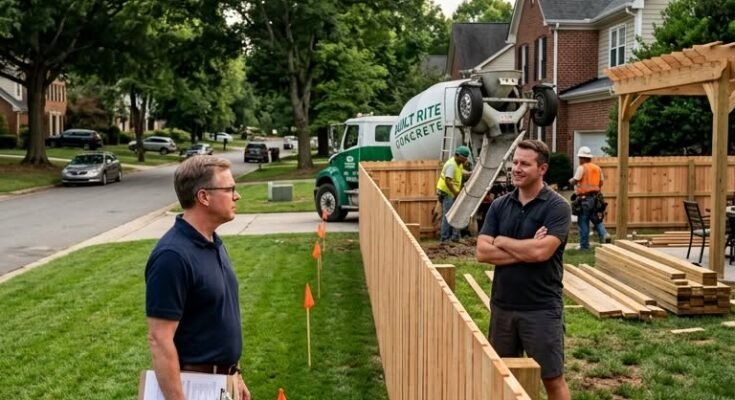
Tyler Bennett said it from his new backyard with one hand resting on the top rail of the fence he had built eight feet inside my property.
I looked at him.
Then at the orange survey flag sticking out of the grass three feet from his shoe.
“That’s my land.”
He smiled.
“Not anymore.”
I wish I could say I laughed.
I didn’t.
Because by then, I understood Tyler wasn’t confused.
He knew exactly what he was doing.
My name is Jason Miller. I’m forty-three, a commercial electrician, and I had lived in my little brick house outside Raleigh, North Carolina, for eleven years.
I bought it after my divorce because it had two things I could afford to love without worrying they would leave me: an old oak tree and a backyard.
Nothing extravagant.
Just enough grass for a grill, a shed, and the wooden swing my daughter Emma had used since she was six.
I knew every inch of that yard.
I had mowed it every Saturday for eleven summers.
Which was why I noticed immediately when eight feet disappeared.
I came outside one Thursday morning expecting to finish cutting the narrow strip along my eastern boundary.
My mower was still where I had left it.
The grass was not.
A brand-new cedar privacy fence stretched from the rear corner of Tyler’s house all the way to the drainage ditch.
The straight mowing line I had followed for years now vanished behind his boards.
Eight feet of my lawn had become part of his backyard overnight.
I walked the fence twice.
Then I called a surveyor.
His name was Carl Jennings.
Two days later, Carl found the original pins, checked the recorded plat, measured from the street monuments, and drove bright orange flags along the true boundary.
Every flag landed well beyond Tyler’s fence.
“You’re not imagining this,” Carl said.
“How far?”
He checked his tablet.
“Between seven feet eight inches and eight feet four inches, depending on the section.”
I stared at the fence.
“That’s almost four hundred square feet.”
“Closer to five hundred by the time you reach the rear.”
I photographed everything.
Then I emailed Tyler.
Professional. Calm. No threats.
*Tyler, I had the property line surveyed. It appears your new fence was installed approximately eight feet inside my parcel. I’ve attached the certified survey and measurements. Please let me know when you’d like to discuss having the fence relocated. — Jason*
Three days passed. Nothing. Then four.
After a week, I knocked on his door.
Ashley answered. She had been friendly enough since they moved in eight months earlier, but her smile disappeared the moment she saw me.
“Tyler?”
He stepped onto the porch.
“You get my email?”
“Oh, yeah.”
That was all.
“So what are we doing about the fence?”
He rubbed the back of his neck.
“Honestly? Moving it would cost a fortune. Posts are already set. Landscaping’s done.”
I waited.
Then he actually shrugged.
“You’ve still got plenty of yard.”
I thought I had misunderstood.
“You’re asking me to give you eight feet of my property because fixing your mistake is expensive?”
“Fences end up a little off all the time.”
“Eight feet isn’t a little off.”
He smiled. “We’re pretty busy right now.” Then he closed the door.
That afternoon, I walked the entire boundary. Behind Tyler’s fence sat fresh sod, ornamental stone, two Japanese maples, and a concrete pad for a hot tub. All of it looked expensive. All of it had been designed around land he did not own.
That night, I pulled the county parcel map. The fence changed nothing. The title still showed the strip as mine.
The next morning, I sent Tyler a certified letter giving him thirty days to correct the encroachment.
His response arrived by text.
*Stop harassing us. The fence stays.*
So I called an attorney.
Rachel Monroe specialized in real-estate disputes. She looked at Carl’s survey, my deed, Tyler’s fence permit, and the county GIS map. Then she frowned.
“His fence permit?”
“What about it?”
“He applied using a site drawing.” She turned the paper toward me.
The drawing showed the correct boundary. Not Tyler’s fence. The real line.
“He knew?”
Rachel tapped the permit. “He certified this placement when he applied.”
For the first time, my anger became something colder. The fence had not accidentally wandered eight feet. Someone had moved it after approval.
Rachel sent a formal demand. Tyler responded by putting a padlock on his gate.
Two days later, I found him spreading mulch over my strip. I walked toward the orange survey flags. He rushed across the yard.
“Don’t cross that fence.”
“I’m standing on my property.”
“Take another step and I’ll call the cops.”
I pointed at the flag beside him.
“That marks my boundary.”
He kicked it over. “Your surveyor can stick flags wherever he wants.”
Then he leaned closer. “I built the fence. It’s my yard now.”
Behind him, contractors were assembling the frame for a pergola. One corner sat directly on my property.
Rachel had told me not to touch the fence. Not yet. So I didn’t. Instead, I went home and opened the county permit portal again.
The pergola permit was not there. Neither was the hot tub electrical permit.
But something else was.
Tyler had applied for a pool. A large one. The approved setback required ten clear feet from the property line. According to the real survey, his proposed pool sat less than three.
I called Rachel. She was quiet for several seconds.
“Jason, don’t touch a single board.”
“Why?”
“Because if he pours that pool where the approved plan shows it…” She paused. “…he’s about to build roughly sixty thousand dollars’ worth of concrete around a property line he falsified.”
—
We waited.
That was the hardest part — not the letters, not the padlock, not watching a man landscape my own grass in front of me. It was sitting on my hands for three weeks while Tyler’s pool contractor staked out the excavation and the county quietly approved the permit based on a drawing that no longer matched the ground.
“You want him to dig,” Rachel explained, the second time I asked why we weren’t stopping it. “Right now this is a fence dispute. A civil matter, he-said-she-said, the kind of thing that drags on for a year while he keeps using your yard. But a pool poured on a falsified setback, permitted with a site plan that misrepresents the property line? That’s not a dispute anymore. That’s fraud on a government application, and it comes with its own consequences that have nothing to do with how deep your pockets are.”
So we watched the excavator arrive. We watched the hole get dug three feet from where Carl’s flags stood. We watched rebar go in, and forms go up, and a concrete truck idle in Tyler’s driveway on a Tuesday morning in October.
Rachel filed the emergency motion the day before the pour.
The stop-work order landed on Tyler’s gate at 6:40 the next morning, delivered by a county code enforcement officer standing next to a Wake County sheriff’s deputy. I watched from my own porch, coffee in hand, as the concrete truck that had been scheduled for 8 a.m. got turned around in the cul-de-sac and sent back empty.
Tyler came outside in a bathrobe, and for the first time in six weeks, I saw something other than a smirk on his face.
The code enforcement officer laid it out plainly: the approved pool permit was based on a site plan showing the property line eight feet from where his fence, his landscaping, and his half-poured pool foundation actually sat. Either the survey attached to his application was wrong, or the fence was. Both couldn’t be true. And Carl Jennings’s certified survey, cross-checked against the county’s own recorded plat and street monuments, said the fence was wrong — by design, not accident.
“You certified this,” the officer said, tapping the site plan. “Your signature’s on it.”
Tyler didn’t have an answer for that. Ashley, standing in the doorway behind him, looked like she was hearing about the falsified drawing for the first time.
What came next took another four months, because these things always take longer than they should. But it went the way Rachel said it would once the fraud was on the table instead of just a friendly disagreement about a fence line. Tyler was ordered to remove the encroaching structures — fence, landscaping, hot tub pad, and the half-built pool shell — and restore the strip to grade. He paid for the survey correction himself. He paid a civil penalty to the county for the false certification, on top of what he’d already sunk into materials that were now getting torn out instead of finished. And because I’d never touched a board, never crossed a line, never given him anything to point to except patience and paperwork, there was nothing left for him to argue.
I watched the same excavator that dug his pool come back seven months later to fill it back in.
Emma helped me replant grass along that strip the following spring. She was twelve by then, old enough to ask why the neighbor across the yard never waved anymore.
“Because he tried to take something that wasn’t his,” I told her, “and found out the hard way that a fence doesn’t move a property line. It just tells you where someone’s about to have a very expensive conversation with a surveyor.”
We planted three rows of fescue where his fence used to stand. By June, you couldn’t tell where his cedar boards had ever been — just grass, all the way to the drainage ditch, exactly where it had always belonged.