PART 1
The first message came Wednesday evening while I stood in the northwest corner of my backyard, looking at a survey stake wrapped in orange tape — the first mark I’d made after the foreclosure house officially became mine. The house cost me $189,000, plus $34,000 in renovations I mostly did myself, some nights laying tile at midnight before a six a.m. job site. My marriage had just ended. Rebuilding that place was the one thing that felt entirely mine.
Then my phone buzzed. My sister Naomi: “We’re using your backyard for the family cookout. 52 people, two days. Fill the pool by Sunday.”
No question. Just instructions.
“Not happening,” I wrote.
“Everyone already said yes. You can’t cancel something 52 people are planning for.”
“My property. My decision.”
“Cecil already told everyone.” Our father. “You have a pool you haven’t even filled. You have a backyard nobody uses. What are you holding on to?”
I stopped responding. Two days later, a coworker showed me the family group chat — I wasn’t in it. Naomi had posted my address: *”Cookout at his place Saturday and Sunday. Pool open. Bring chairs.”* Forty-three reactions already.
Then Thursday, Naomi accidentally sent me a message meant for her friend Gentry: *”He doesn’t have the spine to call the cops. Once 50 people are in his yard, what is he going to do? Cecil already told everyone he agreed.”*
I read it three times. Then I took a screenshot.
Two weeks earlier, at my parents’ table, my father had announced to eight relatives that I was “the kind of man who buys a broken house instead of fixing a broken marriage.” Nobody defended me. Naomi looked pleased. Mom stared into her glass.
I understood, finally, that nobody at that table was going to protect me. So I called my divorce attorney, filed a trespassing report, and arranged for an officer to be present Sunday as a civil standby. I didn’t tell Naomi.
Friday, I came home to a rental truck in my driveway, my side gate open, and Gentry assembling an event tent in my backyard. My survey stake had been pulled out and tossed near the fence.
“Naomi said you were fine with this,” Gentry said. “Cecil gave us the key.”
“Take everything and leave my property.”
She laughed. “You’re really going to ruin this over a tantrum about a backyard?”
*Tantrum.* My boundary wasn’t a decision to them. It was an emotional episode everyone else was allowed to override.
“Leave.”
The truck left eleven minutes later. That night, I changed every lock, then drove my survey stake back into the northwest corner. Two strikes with the mallet.
Saturday, I filled the pool — not for the cookout. For me.
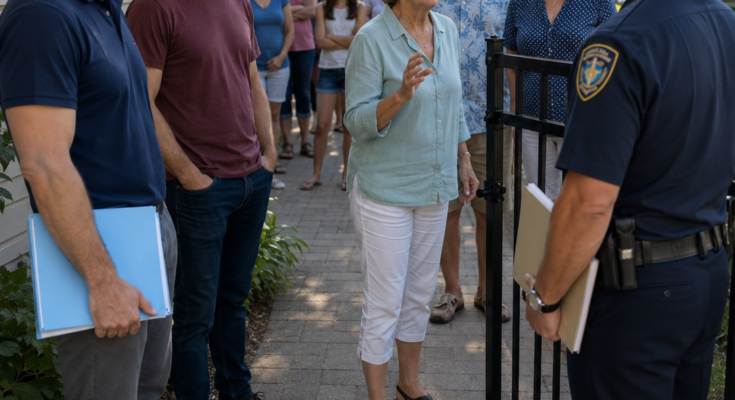
By Sunday noon, cars filled both sides of the street. Naomi was already directing people toward the side gate when the front of the group suddenly stopped.
Mom froze, staring at the officer beside my new lock.
“What is a police officer doing at my son’s house?” Dad demanded.
“The property owner filed a trespassing report. I’m here at his request.”
Naomi turned toward the porch and saw me standing there, a full-page printout in my hand — the text she’d accidentally sent me three days earlier.
I unfolded it slowly. Fifty-two people turned toward me.
PART 2
“I want to read something out loud,” I said, “since apparently a lot of you drove a long way believing I’d agreed to this.”
Naomi’s face went pale. “Don’t.”
“You sent this to me by accident three days ago,” I said, and read it clearly, my voice carrying across the quiet street. *”He doesn’t have the spine to call the cops. Once 50 people are in his yard, what is he going to do? Arrest his own family? Cecil already told everyone he agreed.”*
The silence that followed was different from the one before it. This one belonged entirely to Naomi.
“That’s not — I was venting to a friend,” she stammered. “It’s not what it sounds like.”
“It sounds like you knew I said no,” I said, “and decided my no didn’t count, because you didn’t think I’d actually enforce it.”
Dad stepped forward, his usual booming confidence noticeably smaller in front of a uniformed officer and fifty-two witnesses. “Son, this is a family gathering. Surely we can work something out without the police involved.”
“You gave Gentry a key to my house,” I said, “to a property you don’t own, that I asked you not to use for this event two days ago. You told the entire family I’d agreed, when I told you directly I hadn’t. This isn’t a misunderstanding, Dad. This has been a plan the whole family executed around the one ‘no’ I gave clearly and in writing.”
Mom finally spoke, her voice small. “We didn’t think you’d actually mind. You never use the yard.”
“I filled the pool last night,” I said. “Alone. For the first time since I bought the house. Because it’s mine, and I get to decide when and how it gets used, the same way any of you would if it were your backyard instead of mine.”
The officer, patient throughout, finally spoke. “Folks, the property owner has made his position clear and has a legal right to restrict access. I’d ask everyone to relocate off the property line.”
PART 3
The crowd didn’t disperse all at once. A few relatives, clearly embarrassed, started loading coolers back into cars almost immediately. Others lingered, uncertain, looking between Naomi, my father, and me like they were waiting for someone to announce this had all been a misunderstanding after all.
It wasn’t.
Shaw, standing beside me on the porch, quietly offered his own backyard as an alternative, an offer I hadn’t asked for but appreciated more than I let on. A handful of relatives — the ones who’d genuinely had no idea what Naomi had actually done, who’d simply trusted a group chat announcement without knowing the fuller story — ended up following him instead, grateful for somewhere to salvage the day.
Naomi didn’t leave right away. She stood at the gate long after most people had gone, staring at the printed text still in my hand.
“You didn’t have to embarrass me in front of the whole family,” she finally said.
“You didn’t have to lie to fifty-two people and let them drive hours based on a permission I never gave,” I said. “I didn’t do this to embarrass you, Naomi. I did it because I spent two weeks being clear, and every single time, somebody in this family decided my clarity was optional.”
Dad tried one more time, his voice quieter now than it had been at that dinner table two weeks earlier. “We’re still your family.”
“I know,” I said. “That’s exactly why this hurt as much as it did. If a stranger had done this, I’d have just called the police and moved on. It’s harder when it’s people who are supposed to already respect the word no without needing a locked gate and an officer to enforce it.”
The aftermath took longer to settle than the afternoon itself. Several relatives reached out individually over the following weeks, some apologizing genuinely, a few defending Naomi’s version of events, insisting I’d “overreacted” to what was, in their eyes, just an enthusiastic family gathering that got slightly out of hand. I let those relationships cool without much effort to repair them. Overreacting, apparently, meant enforcing a boundary I’d stated plainly, in writing, more than once.
My father and I had a longer, harder conversation about a month later, one that didn’t fully resolve everything between us but did include, for the first time in longer than I could remember, an actual apology — for the dinner table comment about my marriage, for handing out a spare key without asking, for assuming, the way he apparently always had, that my life was simply a smaller extension of decisions he got to make.
Naomi and I are still working things out, slowly, carefully, the trust between us considerably more conditional than it used to be. I don’t regret the printed text, the locked gate, or the officer standing beside it. I regret, if anything, that it took fifty-two people showing up in my driveway before anyone in my family finally understood that “not happening” meant exactly what it said.
The pool stayed full that whole summer. I swam in it most evenings, alone, sometimes with Shaw and a couple of actual friends who’d never once needed a police officer to respect a boundary I’d stated clearly the first time.
The survey stake is still in the northwest corner, exactly where I drove it back in. Some things, once you finally put them back where they belong, are worth defending, quietly and completely, no matter how many people show up assuming they’re entitled to move them.
— The End —