PART 1 — “It’s Better This Way, Mom”
The day my daughter put me in a nursing home, she told everyone it was because she loved me.
“Mom can’t live alone anymore,” Linda said.
She said it gently.
That was the clever part.
If she had shouted, threatened me, or dragged me out of my house, people might have noticed something was wrong.
Instead, she smiled.
She packed my sweaters.
She labeled my medication.
She even brought flowers to my new room.
Then she kissed my cheek and whispered:
“You’ll be safer here.”
I was seventy-eight years old.
I had arthritis.
I sometimes forgot where I left my glasses.
But I could still cook.
I still drove to church.
I still paid every bill myself.
And I had lived in that little brick house for forty-six years.
My husband, Frank, and I bought it when Linda was still a baby.
We raised three children there.
Frank died in our bedroom eleven years earlier.
Afterward, I could never bring myself to move.
The house wasn’t expensive.
But it was mine.
Or at least, I thought it was.
Three months before Linda moved me into the nursing home, she began appearing more often.
At first, I was grateful.
She brought groceries.
Fixed the Wi-Fi.
Helped organize paperwork.
Then one afternoon she placed several documents on my kitchen table.
“These are just so I can help if there’s an emergency,” she said.
A power of attorney.
Bank authorization.
Medical forms.
I read some of it.
Not all of it.
That mistake almost cost me everything.
Two weeks after moving into the nursing home, I asked Linda to bring me my blue winter coat.
She didn’t answer.
Three days later, I called again.
“Mom, you don’t need anything from the house.”
“I asked for my coat.”
“I’ll buy you another.”
“I want mine.”
There was silence.
Then she said something strange.
“The house isn’t really yours to worry about anymore.”
My hand tightened around the phone.
“What does that mean?”
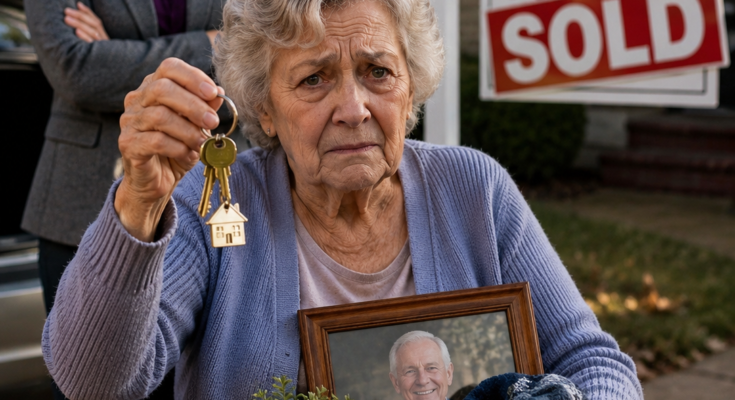
“We sold it.”
I thought I had misheard her.
“You what?”
“Mom, please don’t make this harder.”
My house had been sold.
Without anyone asking me.
Without anyone telling me.
For $418,000.
Linda said the money would be “managed for my care.”
I demanded to see the paperwork.
She refused.
So I called my son David.
He lived in Arizona and had no idea any of this was happening.
“You sold Mom’s HOUSE?”
Linda screamed at him over speakerphone.
“She needed care! I handled it!”
“You handled it by selling everything?”
“She gave me power of attorney!”
That night David flew home.
The next morning he came to the nursing home carrying a folder.
Inside were copies of the sale documents.
My signature appeared on three pages.
Except I hadn’t signed them.
I knew immediately.
Frank always teased me because my signature leaned sharply upward at the end.
The signatures on those documents were flat.
David looked at me.
“Mom… did you sign any of this?”
“No.”
That was when Linda walked into the room.
She froze when she saw the papers.
For several seconds nobody spoke.
Then I asked one question.
“Where is my money?”
Linda’s face changed.
Not guilt.
Not sadness.
Anger.
“Do you know how much I’ve sacrificed taking care of you?”
David stood.
“Answer her.”
Linda pointed at me.
“She was going to leave that house sitting there until she died!”
I stared at my daughter.
“That was my right.”
“You don’t understand anything anymore.”
That sentence hurt more than losing the house.
Because suddenly I understood how she had justified everything.
She had decided that being old meant I no longer deserved control over my own life.
David reached for his phone.
“I’m calling an attorney.”
Linda laughed.
“Go ahead.”
Then she looked directly at me.
“The house is gone.”
She picked up her purse.
“The buyers already moved in.”
And before walking out, she said:
“There’s nothing you can do.”
She was wrong.
Because Frank had prepared for something neither of us knew was coming.
And three days later, an attorney pulled an old document from the county records.
A document Linda had never seen.
PART 2 — Frank’s Last Protection
The attorney’s name was Margaret Bell.
She had handled Frank’s estate years earlier.
When David explained what happened, she became very quiet.
Then she asked:
“Did Linda sell the entire property?”
“As far as we know,” David said.
Margaret opened a file.
“Then we have a problem.”
My stomach dropped.
“For me?”
Margaret smiled slightly.
“For Linda.”
She placed a deed on the table.
Frank and I had refinanced the house nearly twenty years earlier.
At the time, Frank insisted on creating a life-estate arrangement.
I remembered arguing with him about it.
“It’s unnecessary,” I had said.
Frank disagreed.
He wanted to make sure that no matter what happened financially, nobody could force me from my home during my lifetime without my consent.
The arrangement meant something important.
Linda’s power of attorney did not automatically give her the authority she claimed.
And because my signature appeared to have been forged, the sale itself could be challenged.
David leaned forward.
“So the buyers don’t legally own the house?”
Margaret chose her words carefully.
“It is considerably more complicated than that. But Linda certainly had no right to do what she did.”
Then came the second surprise.
The money from the sale hadn’t gone into an account for my care.
Most of it was gone.
Linda had paid off her mortgage.
Bought a new SUV.
And transferred nearly $90,000 to her husband’s business.
When confronted, she insisted it was temporary.
“I was investing the money!”
David stared at her.
“With Mom’s money?”
“She doesn’t need four hundred thousand dollars sitting around!”
“I’m sitting right here,” I said.
Everyone went quiet.
I looked at Linda.
For the first time in my life, I didn’t see my little girl.
I saw a grown woman who had convinced herself that my age made my belongings available to her.
“Did you forge my signature?”
She looked away.
“Mom…”
“Did you?”
Her eyes filled with tears.
“I was trying to protect everything.”
“For whom?”
She had no answer.
The case became uglier from there.
The buyers were furious.
They had no idea anything was wrong.
I felt terrible for them.
They were a young couple who had put almost all their savings into the house.
So I refused to punish them for what Linda had done.
My attorney negotiated a settlement.
The sale remained in place.
But Linda was forced to repay the missing money.
Her husband sold his truck.
They refinanced their home.
The SUV disappeared.
She also lost control of my finances permanently.
David became my financial representative, but only under strict conditions that Margaret helped us establish.
Every major decision still required my approval.
Because I was old.
Not dead.
Then came the question everyone kept asking.
“Where will you live?”
I could have stayed in the nursing home.
I didn’t hate it.
The nurses were kind.
I had made friends.
But every morning at 6:30, I heard one woman crying for someone to take her home.
Eventually, I realized I was starting to feel the same way.
Not because I wanted my old house back.
That house no longer felt like home.
Too much had happened.
I wanted something different.
So at seventy-eight years old, I bought another house.
Not big.
Not fancy.
A two-bedroom cottage fifteen minutes from David.
The first night there, I sat alone at the kitchen table eating tomato soup.
No television.
No voices.
No one telling me when dinner was served.
No one checking whether I had taken my medication.
Just silence.
I started crying.
Then I started laughing.
Because for the first time in months, the silence belonged to me.
Linda did not visit.
Not for eight months.
Then one rainy afternoon, someone knocked on my door.
When I opened it, my daughter was standing there holding a cardboard box.
She looked older.
Smaller somehow.
Inside the box were photographs from my old house.
My wedding picture.
David’s kindergarten photo.
Frank holding Linda the day she was born.
And on top was my blue winter coat.
The one I had asked her to bring me almost a year earlier.
“I found it in storage,” she whispered.
I took the box.
Then Linda said:
“I don’t expect you to forgive me.”
I looked at her.
“Good.”
She started crying.
“I was scared.”
“Of what?”
“That everything Dad built would disappear.”
I shook my head.
“No, Linda.”
She looked at me.
“You were afraid it would disappear before you could have it.”
She covered her face.
And for the first time, she didn’t argue.
PART 3 — The Last Thing I Changed
Linda and I did not become close again overnight.
Real life rarely works that way.
She started visiting once a month.
Then twice.
At first, our conversations stayed polite.
Weather.
Food.
Grandchildren.
Nothing deeper.
Then one afternoon she brought a folder.
“I want you to see something.”
Inside was a repayment schedule.
Every dollar she owed me.
Every payment she had already made.
“I’m going to pay it all back.”
I closed the folder.
“The money is not the hardest part.”
“I know.”
“Do you?”
She nodded.
“You trusted me.”
“Yes.”
“And I used that.”
I waited years to hear those words.
No excuse.
No explanation.
Just the truth.
I reached across the table and took her hand.
“I still love you.”
She cried immediately.
I continued.
“But loving someone doesn’t mean pretending they didn’t hurt you.”
She nodded.
“I understand.”
And I think she finally did.
I lived in that little cottage for seven more years.
David visited every Thursday.
Linda came every Sunday.
Eventually, we were able to laugh together again.
But I changed my will.
Not because I wanted revenge.
Because I had learned something important.
After my expenses, my estate would be divided equally among my three children.
But my cottage would not go to any of them.
Instead, when I died, it would be sold.
The money would fund legal assistance for elderly people facing financial exploitation by relatives.
When I told David, he smiled.
“Dad would like that.”
When I told Linda, she was quiet.
Then she surprised me.
“He would.”
I died at eighty-five.
But before that happened, I wrote one final letter.
Margaret promised to read it to my children.
It said:
“Growing old does not make a person invisible.
It does not turn their home into your inheritance.
Their savings into your opportunity.
Or their decisions into inconveniences.
If you love your parents, do not spend your time calculating what will belong to you when they are gone.
Spend your time remembering that while they are still here, it belongs to them.”
And underneath, I added one final sentence.
The sentence Frank used to tell our children whenever they argued over toys:
“You don’t inherit something simply because you want it more than the person holding it.”
Linda kept that letter.
Years later, she framed it.
Not because it made her look good.
But because it reminded her of the hardest lesson our family ever learned:
Sometimes the cruelest thing you can do to an old person isn’t abandoning them.
It’s standing right beside them while slowly acting as though their life already belongs to you.