PART 2 — THE DOG WHO REMEMBERED
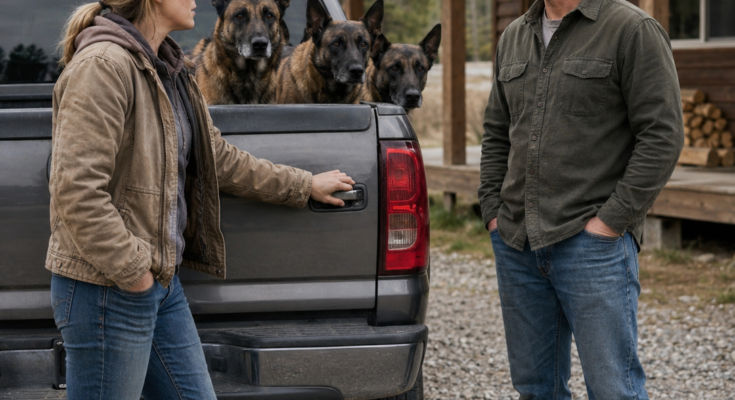
Samara dropped the tailgate.
The first two dogs jumped down immediately.
One was a thick-bodied black Lab with a gray muzzle. The other was a shepherd mix missing part of his left ear.
The third dog did not move.
He stood inside the truck staring at me.
Belgian Malinois.
Older now.
Gray around the face.
A scar cutting through the fur above his right shoulder.
And suddenly I was twenty-eight years old again, kneeling in dust beside Michael Corcoran while he poured bottled water into his helmet so a young military working dog could drink.
“No,” I whispered.
Samara heard me.
“Yes.”
The dog’s name was Rook.
Michael’s dog.
Not officially, at least not at first.
Rook had belonged to the military. Michael had been his handler during two deployments before Rook was reassigned. Years later, when the dog retired, Michael had fought through a mountain of paperwork to adopt him.
I remembered the two of them together.
Michael pretending Rook was nothing but equipment whenever officers were around.
Then sleeping with one hand resting against the dog’s side when he thought nobody was watching.
“Come on, Rook,” Samara said softly.
The dog ignored her.
He kept staring at me.
I didn’t know if dogs remembered people after that many years.
Maybe it was my voice.
Maybe the smell.
Maybe grief has a scent all its own.
I crouched despite the protest from my knee.
“Hey, brother.”
Rook’s ears shifted.
That was all.
But it was enough to break something loose inside my chest.
Michael used to say that.
Every single time he approached Rook.
Hey, brother.
Rook stepped down from the truck.
Slowly.
He walked toward me, stopped three feet away, and sniffed.
Then his nose touched my hand.
For one terrible second, I saw Michael again.
Not the way he looked in the photographs people posted after he died.
Not the dress uniform.
Not the flag.
I saw him filthy and exhausted, laughing because Rook had stolen half a protein bar from my pack.
I stood too quickly.
“I can’t do this.”
Samara didn’t move.
“Do what?”
“This.”
I pointed toward the dogs.
“You run a rescue. Take them somewhere.”
“They have somewhere.”
“Good.”
“Here.”
I laughed once.
There was nothing funny about it.
“No.”
Samara reached into the cab and pulled out an envelope.
My name was written across the front.
The handwriting was unmistakable.
DESTIN.
Michael had always written in block letters.
I stared at it without taking it.
“When?”
“Three years ago,” Samara said.
“Before he died?”
She nodded.
“He updated paperwork when his father got sick. His dad was supposed to take Rook. Michael knew that might not be permanent.”
“And he picked me?”
“He listed you as the last person.”
Last.
That sounded about right.
I finally took the envelope.
It felt heavier than paper had any right to feel.
I opened it on the porch while Samara gave the dogs water.
Michael’s letter wasn’t long.
That somehow made it worse.
**Barnes,**
**If you’re reading this, something went sideways.**
I actually smiled.
That was Michael. Even death wasn’t getting a dramatic speech out of him.
Then I kept reading.
**Dad gets Rook first. If Dad can’t keep him, Samara will figure it out. But if she brings him to you, don’t send him away just because you’ve decided being alone is easier.**
I stopped.
Read that sentence again.
Then again.
**You think nobody notices when you disappear. We noticed. I noticed.**
My jaw tightened.
There were more words.
**Rook’s getting old. He doesn’t need missions anymore. He needs a place where nobody expects him to be useful every second of the day.**
Then came the line that nearly folded me in half.
**Sound familiar?**
I put the letter down.
Samara was pretending not to watch me.
Rook wasn’t pretending.
He sat ten feet away, eyes fixed on my face.
I finished.
**Give him a porch. Give him some woods. Let him sleep.**
**And Barnes—maybe try doing the same.**
**You don’t owe the rest of your life to the worst day of it.**
**—Mike**
For a long time there was only wind.
Finally I asked, “What about the other two?”
“Temporary fosters.”
“You brought backup dogs?”
“I wasn’t sure which one you’d say yes to.”
“I didn’t say yes.”
Samara smiled.
“You read the whole letter.”
Apparently that counted.
She left before sunset.
The black Lab and shepherd mix went with her.
Rook stayed.
I stood at the end of the driveway watching Samara’s taillights disappear until there was nothing left but dust.
Then I looked down.
Rook looked up.
“You understand you’re not sleeping in my bed.”
His tail moved once.
“That isn’t negotiable.”
Another thump.
The first week was terrible.
Rook followed me everywhere.
Bathroom door?
Waiting outside.
Woodpile?
Beside me.
Physical therapy?
He would lie five feet away and stare as though disappointed by my form.
When I went into town, he sat by the truck before I had even grabbed my keys.
At night, I put an old military blanket beside the fireplace.
Rook ignored it.
He slept across my bedroom doorway.
I hated it.
That was what I told myself.
The truth was I had spent years building a house where nothing moved unless I moved it.
Then suddenly there were toenails clicking across the floor.
Breathing in the darkness.
A water bowl I tripped over twice a day.
A living thing waiting for me to come back inside.
My routines changed without permission.
Coffee on the porch became coffee with Rook’s head resting against my boot.
Two painful miles became one slow mile because his hips weren’t what they used to be.
Sometimes we’d sit above the tree line and watch the valley wake.
I started talking to him.
Nothing important.
Weather.
Fence posts.
How terrible Samara was at respecting property lines.
Michael.
Especially Michael.
I told Rook things I had never told another person.
About the night everything went wrong.
About the man we couldn’t reach.
About the helicopter.
About waking in a hospital and asking who had made it back.
About Michael sitting beside my bed for six hours even though he hated hospitals.
Rook would just listen.
He never said I should move on.
Never told me I was lucky to be alive.
Never said Michael would’ve wanted me to be happy.
He just stayed.
Then, three weeks after he arrived, I had the nightmare.
It was the bad one.
The one where I know what is about to happen but can’t stop it.
I’m running.
My knee works in dreams.
Michael is ahead of me.
Somebody is screaming over the radio.
I know where the blast will come from.
I know the exact second.
I try to yell.
Nothing comes out.
The explosion hits.
Except this time I don’t wake up.
Something is crushing my chest.
I can’t breathe.
I’m fighting somebody.
Hands around my throat.
Dust in my mouth.
Then pain ripped through my shoulder.
I came awake swinging.
Dark room.
Cold sweat.
My sheets twisted around my neck.
I had somehow rolled and pulled the fabric tight enough that I was choking myself.
Rook was standing over me.
His teeth were hooked into the collar of my shirt.
He yanked backward.
Hard.
The fabric loosened.
Air tore into my lungs.
I fell halfway off the bed, coughing.
Rook backed away.
For a second neither of us moved.
Then he walked forward and pressed his forehead against my chest.
Not dramatically.
Not like some movie dog.
He just leaned against me.
Solid.
Warm.
Real.
I wrapped both arms around his neck.
And for the first time since Michael’s funeral, I cried.
Not quietly.
Not with dignity.
I buried my face against an old dog’s fur and sobbed until my ribs hurt.
Rook stayed.
When it was over, I whispered into his ear.
“You were supposed to retire.”
His tail thumped against the floor.
I almost laughed.
Then I remembered Michael’s letter.
*He doesn’t need missions anymore.*
Maybe Rook hadn’t gotten the message.
Or maybe some instincts don’t disappear just because the war ends.
That morning I called Samara.
She answered on the second ring.
“What happened?”
“How did you know something happened?”
“Because you called me voluntarily.”
I looked at Rook sleeping near the woodstove.
“I think he saved my life last night.”
Samara was silent.
Then she said, “Maybe that’s why Michael sent him.”
I wanted to argue.
Instead I stared at that old dog.
And for the first time in years, the quiet inside my cabin didn’t feel empty.
It felt occupied.
There is a difference.
I was just beginning to understand how much of one.
—
## PART 3 — NO ONE LEFT TO SAVE
Winter arrived early that year.
By November, snow was piling against the north side of the cabin and the road into town had become something I checked before every trip.
Rook loved it.
His body was old, but apparently nobody had informed his brain.
He would charge through fresh snow like a puppy for approximately thirty seconds, then limp dramatically back to the porch and glare at me as though I had personally invented aging.
“You’re eleven,” I’d tell him.
He’d stare.
“So am I, in SEAL years.”
Tail thump.
That became our language.
I didn’t notice how much I had changed until Samara visited two months later.
She stepped into the cabin, looked around, and frowned.
“What?”
“There are groceries.”
“Yes.”
“Fresh groceries.”
“I eat.”
“You used to have canned chili from the Obama administration.”
“It was still good.”
She looked at Rook.
“What did you do to him?”
Rook yawned.
I had started driving into town once a week.
Then twice.
The veterinarian knew my name.
So did the woman who ran the feed store.
I even started answering Samara’s calls.
Most of them.
The nightmares didn’t disappear.
Some nights I still woke believing someone was dead.
But now, when it happened, Rook lifted his head from beside the bed.
Sometimes that was enough.
A month later, Samara asked me for a favor.
One of her foster volunteers had broken his leg.
She needed somewhere to keep a retired shepherd named Duke for three days.
“No.”
Duke stayed nine.
Then came Bailey, a Lab with arthritis.
Then a bomb-detection dog named Ghost who hated thunderstorms but was perfectly comfortable trying to steal steaks from my kitchen counter.
My quiet cabin became less quiet.
Strangely, I didn’t mind.
Michael had given me one old dog.
Somehow that dog had opened a door.
I still kept people at arm’s length.
Dogs were easier.
Dogs didn’t ask for the version of you that existed before everything happened.
They accepted the one standing in front of them.
Then came the January storm.
Weather reports predicted twelve inches.
Wyoming delivered nearly three feet.
The power died around midnight.
That wasn’t a problem. I had a generator.
The problem came at 4:17 in the morning when I woke because something felt wrong.
There was no weight against my bed.
“Rook?”
Nothing.
I checked the living room.
Empty.
The back door was partly open.
Wind had forced it against a piece of firewood I’d left near the frame.
Tracks were already filling with snow.
Rook had gone outside.
I grabbed my coat.
Every rational part of my brain told me not to go far.
Visibility was terrible.
Temperature dropping.
Bad knee.
No one nearby.
The old me would have calculated risk.
The man standing in that doorway thought only one thing.
He’s out there.
I followed the tracks.
They disappeared fifty yards into the woods.
“ROOK!”
Wind swallowed the name.
I kept going.
One hundred yards.
Two hundred.
My knee started screaming.
I found blood on the snow.
Just a few drops.
Then more.
Something inside me went cold.
“ROOK!”
A bark.
Faint.
Downhill.
I moved toward it.
The slope was steeper than I remembered beneath the snow.
My leg slipped once.
Then twice.
I caught a tree before I fell.
The third time, I didn’t.
My bad knee buckled and I went down hard.
The world flashed white.
Pain exploded through my leg.
For a few seconds I couldn’t breathe.
Then I heard Rook again.
One bark.
Close.
I crawled.
Twenty feet down the slope, I found him beside a fallen pine.
His rear leg was trapped beneath a branch.
He’d cut himself fighting to get free.
The stupid old warrior looked at me like he’d been waiting.
“Seriously?”
His ears moved.
“You leave a perfectly warm cabin in a blizzard and *I’m* the one who has to come get you?”
Tail thump.
I laughed.
Actually laughed.
Then I started digging.
It took twenty minutes to free him.
By the time the branch moved, my gloves were soaked.
Rook couldn’t put weight on the leg.
Neither could I, really.
The cabin might as well have been ten miles away.
I sat in the snow beside him.
For the first time since leaving the teams, I felt that old calm settle over me.
Not fear.
Procedure.
Assess.
Adapt.
Move.
I removed my outer layer, wrapped Rook as best I could, and tied a length of paracord from my belt through his harness.
“You’re going to hate this.”
He already did.
We moved uphill together.
I crawled when I couldn’t walk.
Rook dragged himself when he couldn’t stand.
Every few feet one of us stopped.
Then the other moved.
That’s how we made it.
Not because either of us was strong enough.
Because neither one would leave the other.
By the time I reached the porch, I couldn’t feel three fingers on my right hand.
I got Rook inside.
Turned on the emergency heater.
Wrapped his leg.
Then I made a call I had avoided making for years.
I called for help.
Not Samara first.
Emergency services.
A county deputy and volunteer rescue crew reached us several hours later when the storm eased.
The deputy looked at my swollen knee.
“You should’ve stayed inside.”
“I know.”
He looked at Rook.
“You went after the dog?”
“Yes.”
“Must be some dog.”
I looked down.
Rook was watching me from beneath a blanket.
“Yeah.”
My voice broke.
“He is.”
Rook needed surgery.
So did I.
Nothing major for me.
My knee hardware had survived, but I’d torn tissue around it.
Rook’s injury looked worse than it was.
The veterinarian called me the next morning.
“He’s going to be okay.”
I sat in a plastic chair in the clinic hallway.
I hadn’t realized until then how tightly I’d been holding myself together.
“Can I see him?”
A few minutes later, they brought me back.
Rook was still groggy.
His leg was bandaged.
I sat on the floor beside him.
His eyes opened.
His tail moved once.
Just once.
I placed my forehead against his.
“You idiot.”
Tail.
“You scared the hell out of me.”
Tail.
Then the strangest thought came into my head.
For years, I had believed there was no one left to save.
That was why I’d gone to Wyoming.
I thought the safest life was one where nobody depended on me.
No teammates.
No family.
No promises.
No chance of failing someone again.
But somewhere along the way, I’d confused having nothing to lose with being free.
They weren’t the same thing.
Having nothing to lose meant having nothing.
Rook had given me something back.
Fear.
Responsibility.
Attachment.
All the dangerous things.
All the things that made life worth staying for.
That evening, Samara arrived.
She sat beside me while Rook slept.
After a while she handed me something.
Michael’s letter.
“I already have it.”
“Turn it over.”
I had never noticed writing on the back.
One sentence.
Probably something Michael had added later.
**Barnes, if you ever start living again, don’t feel guilty about it.**
I stared at those words until they blurred.
Samara pretended she didn’t see me wipe my eyes.
Six months later, I put a second building on my property.
Nothing fancy.
Heated floors.
Six indoor kennels.
A fenced run.
A small treatment room.
Samara’s nonprofit paid for part of it.
I paid for the rest.
We called it Corcoran House.
Retired military and police dogs came there when they needed somewhere quiet.
Sometimes for a week.
Sometimes months.
Sometimes forever.
And occasionally their handlers came too.
Men and women who said they were only dropping off a dog.
I’d make coffee.
They’d sit on the porch.
Usually nobody talked much the first day.
That was fine.
I understood silence.
Rook became the unofficial commander of the place.
He inspected every arrival.
Stole every bed.
Ignored every rule.
And slept across my bedroom doorway every night.
Two years after Samara first drove up my driveway, I stood on the porch before sunrise with a mug of coffee in my hands.
Snow covered the mountains.
Six dogs were asleep inside.
Rook lay beside my chair.
Old now.
Really old.
His muzzle almost completely white.
I scratched behind his ears.
“You did a lousy job retiring.”
His tail tapped the porch.
I smiled.
The mountains were quiet.
But the quiet didn’t frighten me anymore.
It wasn’t the silence of a man hiding from the world.
Behind me were dogs breathing.
A coffee pot humming.
A phone that people actually called.
Boots beside the door belonging to a volunteer arriving later that morning.
Evidence everywhere that my life had become inconveniently full again.
I looked down at Rook.
For twelve years, I’d been trained to go toward people who needed saving.
Then I spent years afterward believing I’d failed because I couldn’t save everyone.
Michael knew something I didn’t.
Sometimes survival isn’t about finding one more person to rescue.
Sometimes it’s about letting something living walk into the fortress you’ve built around yourself…
and refusing to send it away.
I had gone to Wyoming because I wanted a quiet cabin and no one left to save.
Instead, a dead teammate sent me an old war dog.
Rook saved me from a nightmare.
I saved him from a storm.
And somewhere between those two nights, without either of us realizing it, we saved each other.