Part 1: The Introduction
My son did not call me his mother until his nine-year-old daughter embarrassed him into telling the truth.
The dinner was being held in a private room at an expensive hotel in Dallas. Gabriel had just been promoted to senior vice president, and his company invited executives, clients, and their families to celebrate.
I drove four hours from San Antonio wearing the navy dress I bought for his college graduation fourteen years earlier.
It was the nicest dress I owned.
Gabriel’s wife, Anna, had called me personally.
“He won’t admit it,” she said, “but having you there will mean everything to him.”
So I took two days off from the hotel where I cleaned rooms, paid a neighbor to watch my dog, and wrapped Gabriel’s late father’s watch in a small silver box.
Gabriel met me outside the ballroom.
He looked handsome in a charcoal suit. For a moment, I saw the boy who used to sleep at our kitchen table while I packed lunches for the morning shift.
Then his eyes moved over my dress, my shoes, and the purse I had carried for twenty years.
“You made it,” he said.
Not Mom.
Not I’m glad you’re here.
Just surprise.
“Of course I made it.”
He kissed my cheek and lowered his voice.
“Some of the board members are here. They can be a little formal.”
“I know how to behave at dinner, Gabriel.”
“That’s not what I meant.”
But it was.
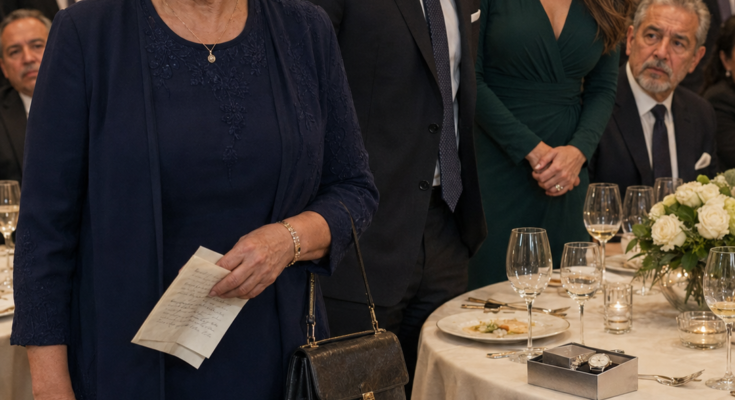
Inside, waiters carried trays of champagne beneath chandeliers brighter than anything in my house.
Gabriel introduced Anna as his wife and Mia as his daughter.
When people turned toward me, he kept talking.
He never said who I was.
At our table, his supervisor, Mr. Whitmore, asked whether I had known Gabriel long.
My son answered before I could.
“Rosa is an old family friend. She helped take care of me when I was growing up.”
The room did not stop.
Glasses clinked. A waiter placed bread on the table. Someone laughed near the bar.
But inside me, everything became silent.
I looked at Gabriel.
He would not meet my eyes.
Mr. Whitmore smiled politely.
“Then you must be very proud of him.”
“I am,” I said.
That part, at least, was still true.
Gabriel had been twelve when his father died from a heart attack at a construction site.
After that, I cleaned hotel rooms from six in the morning until two, served food at a nursing home four evenings a week, and ironed uniforms for cash on Sundays.
Gabriel studied beside laundry machines because I could not afford a babysitter.
When he earned a scholarship to college, it covered tuition but not housing. I took a loan against our small house and told him the money came from a community grant.
I never wanted him to feel indebted to me.
I only wanted him to feel possible.
Now the successful man I had raised was describing me as hired help.
Mia had been coloring quietly on the back of the dinner program.
She looked up.
“Daddy, Abuela isn’t your friend.”
Gabriel’s face tightened.
“Mia, not now.”
“She’s your mommy.”
Several people at the table looked from her to me.
Mia frowned.
“Why did you tell Mr. Whitmore she just helped take care of you? You said lying is wrong.”
Anna closed her eyes.
Gabriel whispered, “Please stop.”
I reached across the table and squeezed Mia’s hand.
“Your father is having an important night.”
“But you are his mom.”
“Yes,” I said. “I am.”
Gabriel finally looked at me.
I saw fear in his eyes—not fear that he had hurt me, but fear that someone important had heard the truth.
That was the part I could not forgive in the moment.
I placed the silver gift box beside his plate.
“Congratulations, Gabriel.”
Then I stood and left before dinner was served.
Part 2: The Speech He Removed
Gabriel caught me near the elevators.
“Mom, wait.”
It was the first time he had called me that all evening.
“Go back to your guests.”
“You’re overreacting.”
The elevator doors opened, but I did not enter.
“Tell me what I misunderstood.”
He loosened his tie.
“These people come from a different world. They went to private schools. Their parents know one another. I have spent fifteen years proving I belong in that room.”
“And having a mother who cleans hotel rooms proves you do not?”
“That isn’t what I said.”
“You did not have to say it.”
He looked toward the ballroom doors.
“I didn’t want the entire night to become a story about where I came from.”
“Then why did you invite me?”
He hesitated.
“Anna invited you.”
That answer hurt more than the introduction.
I pressed the elevator button again.
“I never asked you to announce everything I sacrificed,” I said. “I did not come to collect a debt. But I will not stand beside you while you erase me to make strangers comfortable.”
“I built my career myself.”
“Yes, you did.”
My answer surprised him.
“You studied. You worked. You survived rooms where people underestimated you. I am proud of what you built.”
I touched his sleeve.
“But bricks do not carry themselves to the construction site.”
The elevator arrived.
Before stepping inside, I handed him a folded sheet of paper.
Anna had asked me to prepare a two-minute toast. That morning, however, the event coordinator told me the family speech had been removed from the program.
I had assumed they were short on time.
Now I understood.
Gabriel unfolded it after I left.
The toast did not mention cleaning rooms, second jobs, or the loan against my house.
It said:
When Gabriel was ten, he came home crying because another boy said people like us never became important. I told him importance is not a room other people allow you to enter. It is the kind of person you remain once the door opens.
Tonight, my son has entered a very big room. I hope he always holds the door for the people coming behind him.
Anna later told me he read it three times.
When he returned to the dinner, Mia asked where I had gone.
“Abuela was tired,” he said.
Mia shook her head.
“No. Abuela was sad.”
This time, Gabriel did not correct her.
The silver box remained unopened until he reached home.
Inside was his father’s work watch, scratched and faded from years of construction dust.
Beneath it, I had placed a note.
Your father wore this while building homes he could never afford. He believed your life would be easier than his. He never believed that meant you should be ashamed of ours.
Gabriel called me eleven times that night.
I did not answer.
Not because I wanted revenge.
Because I knew he was still searching for words that would make the evening disappear.
I needed him to understand that an apology could not change the past unless it also changed what he did next.
Part 3: What He Finally Told the Room
The following Monday, Gabriel arrived at my hotel before sunrise.
I was stocking my cart with towels when I saw him standing near the service elevator in the same expensive coat he had worn to dinner.
“Guests aren’t allowed back here,” I said.
“I’m not here as a guest.”
My supervisor, Denise, recognized him immediately.
“You’re Gabriel,” she said. “Your mother has shown us every photograph from kindergarten through that promotion dinner.”
His face changed.
On the wall beside the time clock was a newspaper clipping about his promotion. I had printed it at the library and taped it there myself.
Gabriel stared at it.
“You told everyone?”
“Of course. You are my son.”
He began to cry.
Not loudly. Not dramatically.
He simply stood among the laundry carts and plastic bottles, finally seeing the difference between my pride and his shame.
“I thought if they knew where I came from, they would question whether I belonged,” he said.
“Maybe some of them would.”
“That’s supposed to make me feel better?”
“No. It is supposed to remind you that hiding me would not change them. It would only change you.”
He apologized.
I listened.
Then he asked what he could do.
“Do not buy me a car,” I said. “Do not pay off my house because you feel guilty. Tell the truth when telling it costs you something.”
The next morning, Gabriel requested five minutes at the beginning of his executive meeting.
He later told me his hands shook more than they had during any presentation of his career.
“At Friday’s dinner,” he said, “I introduced Rosa Morales as a family friend who helped raise me. That was a lie. She is my mother. She raised me alone after my father died, and every opportunity I have began with work she was willing to do when no one respected it.”
The room remained quiet.
Then Mr. Whitmore asked, “Why did you lie?”
Gabriel answered honestly.
“Because I was ashamed of being poor, and I confused that shame with being ashamed of her.”
No one applauded.
There was no movie ending.
The meeting continued.
But the truth remained in the room after he finished speaking.
That mattered more.
Gabriel did not earn my forgiveness with that confession.
He earned it slowly.
He began calling every Sunday without checking his email while we talked. He brought Mia to San Antonio and asked me to teach her the recipes his father loved. He stopped correcting my English in restaurants when everyone already understood me.
Most importantly, he stopped treating my life as the embarrassing first chapter of his.
At my sixty-fifth birthday, Gabriel stood in my backyard holding his father’s watch.
Our relatives, my hotel coworkers, Anna, and Mia gathered beneath strings of inexpensive lights.
“When I was young,” he said, “I believed success meant climbing so far that no one could see where I started.”
He looked at me.
“My mother taught me that success is whether you can still look down and recognize the hands that held the ladder.”
Then he fastened the old watch around his wrist.
It did not match his suit.
That was why I loved seeing him wear it.
Mia tugged on his sleeve.
“Tell everyone who Abuela is.”
Gabriel smiled through his tears.
“This is Rosa Morales,” he said. “She is my mother.”
The first time he said it at the hotel, a child had forced the truth out of him.
This time, he said it because he finally understood that no promotion, title, or important room could honor him if entering required him to erase the woman who made the journey possible.