Part 1 — The Woman in the Navy Dress
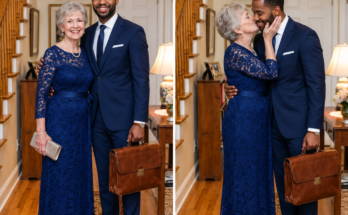
Robert and I were married for twenty-two years, and I would have told you, right up until the actual day of his funeral, that I knew that man completely — his coffee order, his terrible taste in old Westerns, the exact rhythm of his snoring that used to keep me awake back in our very first years together. He traveled a lot for work, a sales territory that stretched across three different states, gone two full weeks out of every single month for as long as I’d known him. I never questioned it, not once. Why would I? We had a good marriage, or at least what I fully believed was a good marriage, right up until a woman in a navy blue dress walked up to his open casket at the funeral home, placed her palm flat against the polished wood, and said, quiet enough that only I could hear it, “Twenty-two years, and he never told either of us about the other.”
I asked her what she meant, my voice barely working right, hands cold, the room around us starting to tilt slightly at the edges. She turned to look at me, not with malice exactly, just an exhausted kind of grief that matched my own far too closely for comfort. “I’m his wife,” she said simply. “I’ve been his wife for nineteen years. We have two kids together.”
I didn’t scream. I didn’t cry, not yet. I just asked her, very calmly, if she wanted to get coffee after the service ended, because whatever this actually was, we clearly both needed the same answers, and neither of us was ever going to get them from a dead man now.
Part 2 — Comparing Notes
Her name was Carol, and over coffee that smelled nothing like the funeral home we’d just left behind, she told me a story that ran uncomfortably parallel to mine — a wedding held in a different state, a house two hours from where I actually lived, two teenagers who genuinely believed their father worked “sales territory” that happened to overlap suspiciously with my own zip code every other week for years.
Robert had built an entire second life directly on top of the first one, not instead of it, both running simultaneously for nearly two decades, funded, it eventually turned out, by a single income he’d carefully never let either family fully audit or question too closely. Neither of Robert’s families held a legal marriage certificate that would have obviously invalidated the other one outright — bigamy, it turned out, wasn’t declared loudly, it was just two separate ceremonies, two separate counties, one enormous, carefully calculated silence holding the whole arrangement together for twenty years.
Carol and I sat there together for nearly two hours, comparing notes like a pair of detectives, piecing together the full timeline of a man who had apparently spent half his adult life becoming an expert at being in two places at once, and neither of us walked away angrier at the other woman. We walked away allies instead, both furious at exactly the same person, who was, conveniently for him, no longer around to answer for any single part of it.
Part 3 — What We Chose to Do With It
The estate turned out to be the easy problem, oddly enough — a probate lawyer we both hired jointly, a fact that surprised his own paralegal, walked us through what happens legally when a man dies with two undissolved marriages on record in two different states. Only one marriage, it turned out, was technically legal: mine, since Robert had married me first, six months before he’d ever met Carol at a work conference neither of us had known about until that week. Carol’s marriage, legally, had never actually existed at all, no matter how many years, how many holidays, how many mortgage payments she’d put into it in good faith, believing every single day that she was his lawful wife. When she found that out, sitting across from me at my kitchen table two weeks after the funeral, she didn’t get angry at me. She just put her head down on her arms and cried in a way I recognized instantly, because it was exactly the way I’d been crying alone in my car every night since the casket.
I could have taken everything. Legally, I was entitled to. The house, the retirement accounts, the life insurance policy that named me as the sole beneficiary because, as far as any paperwork was concerned, I was his only wife. But I kept thinking about her two teenagers, who hadn’t asked to be born into a lie, who were about to lose their father and their financial security in the very same month, through absolutely no fault of their own. So I did something my lawyer strongly advised against and my own sister called borderline insane: I split the life insurance payout with Carol, fifty-fifty, and set aside a college fund for her two kids out of what remained of Robert’s retirement account. Not because Robert deserved that kind of generosity from either of us. Because Carol didn’t deserve to be punished twice — once by a husband who lied to her for nineteen years, and again by the one other person on earth who actually understood exactly what that particular lie felt like from the inside.
It’s been a year and a half now. Carol and I still talk, more than either of us expected to, in a friendship built on the strangest possible foundation — two women who loved the same man at the same time without either of us knowing it, and who ended up finding each other more honest, in the end, than he ever managed to be with either of us across two decades of careful lying. Her kids call me “Miss Renee” now, politely, at the one holiday gathering a year we’ve started doing together, an arrangement that would sound insane to anyone who hasn’t lived it and makes perfect sense to the two of us who have.
I still don’t fully understand how Robert managed it logistically for so long, the calendars, the excuses, the sheer discipline of never once slipping up across two decades of double appointments. What I understand now, more than I ever expected to, is that grief and betrayal can exist in the exact same body at the exact same time, and that the only way through either one is finding somebody else who’s standing in the wreckage with you, instead of standing across from you as the enemy you were originally told to expect. Some days I think Robert never imagined either of us finding out, let alone finding each other. Other days I think some small, hidden part of him hoped we would, so that neither of us would have to carry the weight of him completely alone.
A fictional story.